AI's Impact on Europe's Power Grid: EU Calls for Reduced Consumption
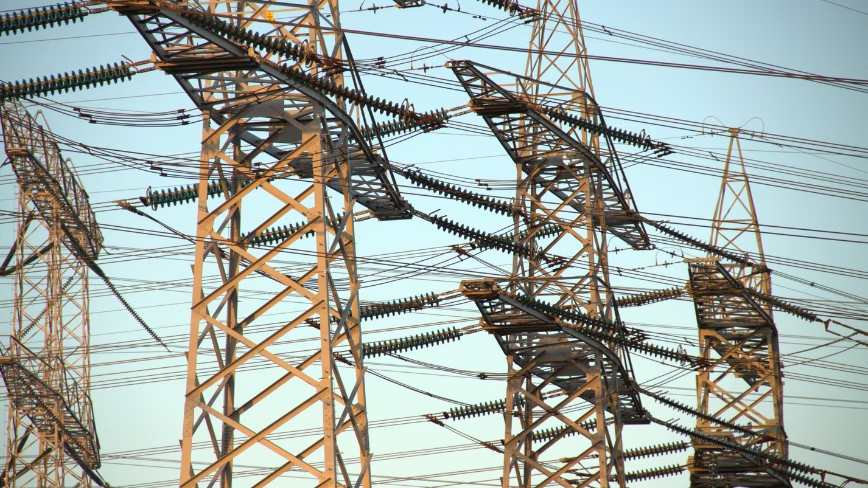
The European Commission has issued an appeal to citizens across the Union, urging them to moderate electricity consumption during peak hours. This request, highlighting increasing pressure on the continent's energy infrastructure, is primarily driven by the rapid expansion of data centers dedicated to artificial intelligence. This trend is compounded by accelerating electrification processes and a rising overall demand for digital infrastructure, factors that collectively are straining European power grids.
Concurrently with this appeal, the Commission published a "Data Centre Energy Efficiency Package" on June 3. This package introduces a series of measures aimed at improving the energy efficiency of data centers, recognizing the need to balance technological innovation with environmental sustainability and the stability of energy supplies. The initiative underscores how the exponential growth of AI is generating new infrastructure and energy challenges, requiring a coordinated approach to manage its impact on electricity consumption.
The Energy Context of AI Data Centers
The rise of Large Language Models (LLM) and other artificial intelligence applications has triggered an unprecedented demand for computational power. Data centers hosting these technologies require significant amounts of energy, both to power high-performance servers and GPUs (Graphics Processing Units), and for the cooling systems necessary to keep these machines operational. GPUs, in particular, are energy-intensive components, essential for the training and inference phases of LLMs, and their numbers in data centers are constantly increasing.
This increase is not only about computing power but also thermal management. The energy consumed translates into heat, which must be dissipated to prevent failures and maintain operational efficiency. Consequently, cooling systems themselves become major energy consumers, contributing substantially to the overall TCO (Total Cost of Ownership) of a data center. The combination of these factors explains why the rapid expansion of AI is becoming a critical element for the stability of power grids.
Implications for On-Premise Deployment and Sovereignty
For companies evaluating the deployment of AI workloads, particularly LLMs, in self-hosted or on-premise environments, energy considerations take on strategic importance. Energy availability, its cost, and system efficiency become decisive factors in infrastructure planning. An on-premise infrastructure offers advantages in terms of data sovereignty and direct control but requires careful evaluation of operational costs, among which energy stands out.
Decisions regarding hardware selection, from GPU VRAM to bare metal server configurations, must consider not only expected performance (throughput, latency) but also energy consumption. For those evaluating on-premise deployments, analytical frameworks are available on /llm-onpremise that allow for comparing the trade-offs between initial costs (CapEx) and operational costs (OpEx), including those related to energy. The ability to optimize energy efficiency can make a difference in the economic and environmental sustainability of a self-hosted AI project, especially in a context of increasing pressure on power grids.
Future Outlook and Sustainability in the AI Era
The European Commission's appeal and the launch of the data center energy efficiency package mark a turning point. They indicate a growing awareness that the growth of AI, while being a driver of innovation, cannot disregard considerations of sustainability and environmental impact. Future deployment strategies, both in the cloud and on-premise, will increasingly need to integrate energy efficiency metrics and sustainable management practices.
This scenario compels technical decision-makers, such as CTOs and infrastructure architects, to consider energy not just as a variable cost, but as an infrastructure constraint and a risk factor. Innovation in silicon, cooling systems, and software architectures for AI must aim not only to improve performance but also to reduce the energy footprint. The challenge is to ensure that the advancement of artificial intelligence can continue without compromising the stability of power grids and the continent's sustainability goals.







💬 Comments (0)
🔒 Log in or register to comment on articles.
No comments yet. Be the first to comment!