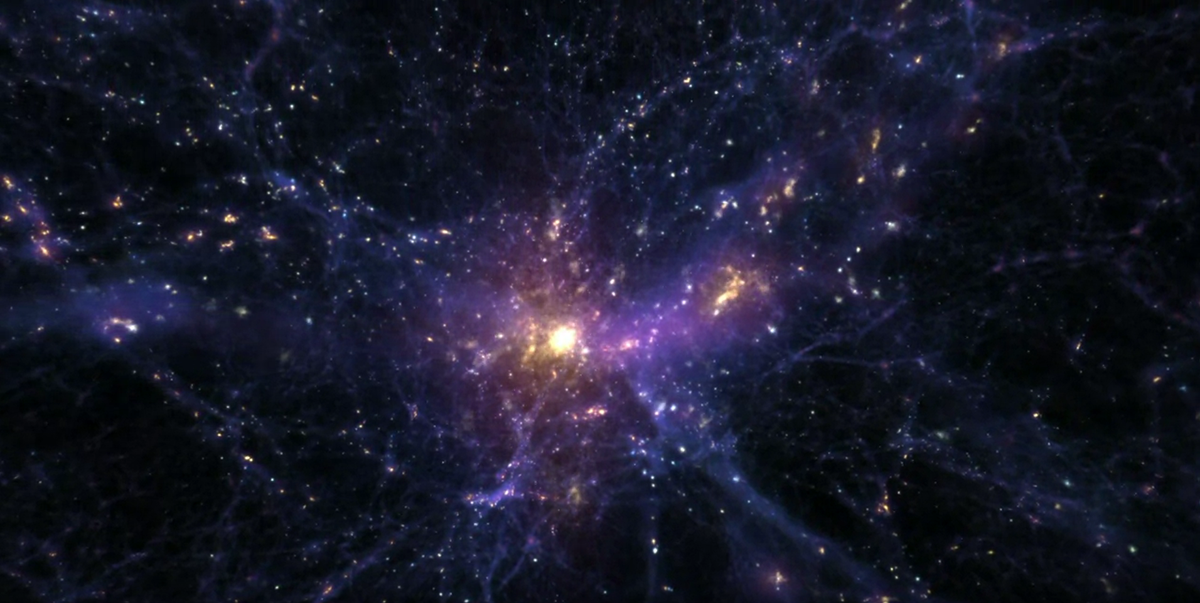
Two Italian physicists have just published in Nature a study set to make waves: the universe’s largest structures, those forming the so-called cosmic web, do not obey the uniformity that the standard model took for granted. Instead, they remain well defined up to a gigaparsec – over three billion light-years – signalling that matter distribution has preferred directions that don’t smooth out as expected.
Francesco Sylos Labini from the Enrico Fermi Center in Rome and Marco Galoppo from the University of Canterbury in New Zealand analyzed the latest release of the Dark Energy Spectroscopic Instrument (DESI), the most detailed 3D map ever produced, using statistical tools such as the Angular Distribution of Pairwise Distances (ADPD), particularly sensitive to large-scale anisotropies. The result is unequivocal: the size and coherence of the observed structures far exceed those produced by the best simulations based on the ΛCDM (Lambda Cold Dark Matter) model.
A more stubborn web
According to ΛCDM, the universe at scales of billions of light-years should appear homogeneous and isotropic: small primordial irregularities were supposed to blend into a uniform pattern. Instead, DESI data show that galaxies cluster along filaments and nodes that keep preferred orientations even in the most “zoomed-out” views. “Structures are larger and more persistent than expected – the authors explain – and the discrepancy is statistically highly significant.”
The difference isn’t just descriptive: the cosmic microwave background, the oldest light in the universe, suggests that directional correlations should quickly dissolve over large distances. The fact that they don’t forces a rethinking of some cornerstones.
What it changes for cosmology (and for those who simulate the cosmos)
The work puts on the table the concrete possibility of “new physics,” because at present there is no simple modification of the ΛCDM framework able to generate such large structures without breaking the uniformity observed in the cosmic background. New observational campaigns are needed – upcoming DESI releases, ESA’s Euclid telescope, the Vera C. Rubin Observatory in Chile – to see if the phenomenon extends to even vaster scales.
But there is an implication that closely touches those designing computing infrastructures for research. Simulating the evolution of the universe with enough resolution to test these anomalies requires enormous computational capacity: billions of dark matter particles, hydrodynamics, galaxy formation. It’s no surprise that many centers are building on-premise high-performance clusters, driven by data volumes (petabytes per single survey) and the need to iterate models quickly without saturating cloud connections.
For those evaluating on-premise deployment, the case is emblematic: when data grows faster than hypotheses, sovereignty and direct control over hardware become a competitive advantage. It’s not just about costs, but latency and the ability to customize the entire stack, from filesystem to simulation framework. This holds as true for astrophysics as for those training language models on local architectures today.
Beyond the standard model, inside the computer
The discovery by Galoppo and Sylos Labini is a strong signal that our picture of the universe is still incomplete. While waiting for Euclid and Rubin to deliver new maps, the physics community is already working to understand whether it’s enough to tweak the dark matter halo or if we need to revise general relativity on large scales. In the meantime, progress will also run on silicon: more accurate simulations will demand ever more powerful compute nodes, and the choice between cloud and on-premise will never be neutral.



💬 Comments (0)
🔒 Log in or register to comment on articles.
No comments yet. Be the first to comment!