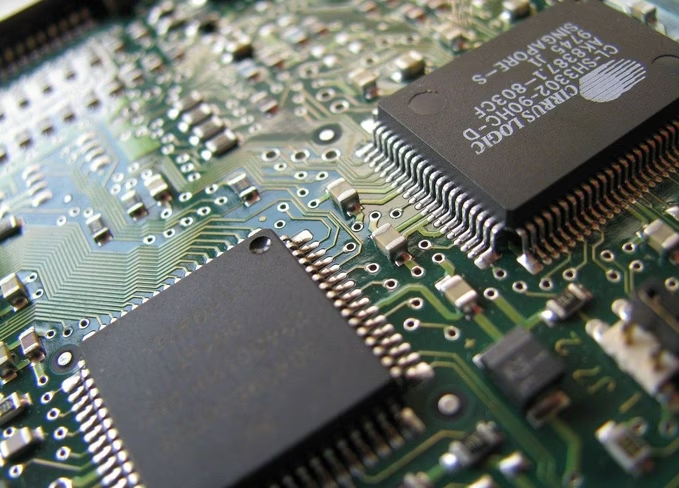
The holiday-shortened week before Independence Day delivered a violent break in the trade that defined the first half of 2026: buying anything with proximity to a GPU. The PHLX Semiconductor Index, after gaining over 80% in the first six months, dropped 6.3% on Wednesday and another 5.4% on Thursday, burning roughly twelve percentage points in just two sessions.
This is no mere technical pullback. It is the symptom of a nervousness that has been simmering beneath a hardware rush fueled more by expectations than by near-term fundamentals. Demand for training and inference chips remains high, but in recent months valuations had begun to price in a perfect scenario: linear hyperscaler spending growth, immediate migration of every workload onto LLMs, and no energy bottlenecks.
For those building on-premise infrastructure, the signal is twofold. On the one hand, a cooling of the bubble could translate into easing price pressure on high-end GPUs – those with ample VRAM and memory bandwidth to serve quantized models at low latency – making the Total Cost of Ownership of a local cluster less prohibitive. On the other, the stock-market hit reminds us that hardware cycles are still cycles: anyone sizing a self-hosted LLM environment today must look at cost sustainability over three to five years, not follow the euphoria that inflates vendor price lists.
The index fracture also raises questions about the durability of the GPU-first model pushed by major cloud providers. If financial speculation retreats, the scramble for exotic accelerators might slow, giving more room to those who prefer hybrid or fully on-premise deployment, where data sovereignty and cost predictability matter more than raw throughput measured in tokens per second. In a correction scenario, companies that postponed hardware purchases for local inference could find more favorable pricing windows, provided they avoid the hype of new launches and stick to concrete metrics: real throughput under mixed workloads, tail latency, power consumption.
It is still unclear whether this episode marks the end of the speculative phase or merely profit-taking ahead of quarterly reports. But the jolt is strong enough to refocus attention on a basic principle: AI hardware is not a magical asset class. It is subject to the same supply, demand, and risk-perception adjustments that govern the entire semiconductor sector. For those evaluating on-premise deployment, that awareness is the best antidote to rushed decisions.






💬 Comments (0)
🔒 Log in or register to comment on articles.
No comments yet. Be the first to comment!