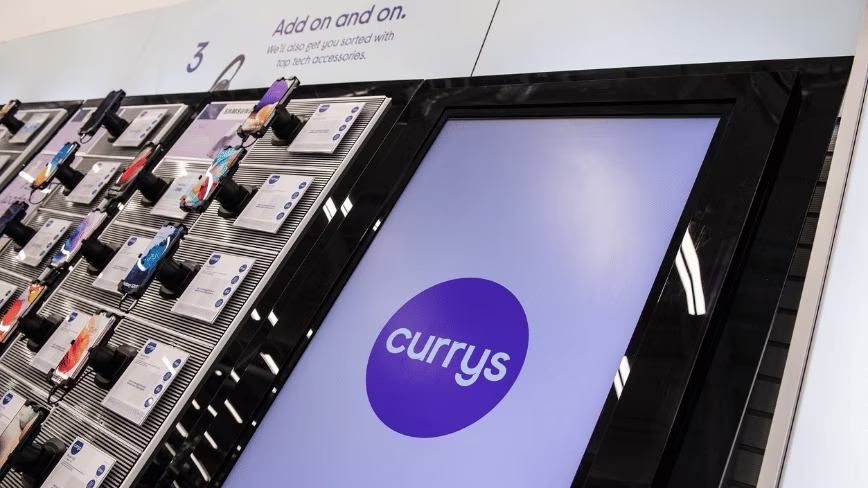
The warning came straight from the annual results presentation of Currys, Britain’s largest consumer electronics retailer. “Prices of phones, laptops and TVs will rise by the end of the year,” said chief executive Alex Baldock, pointing to the surging demand for memory from the artificial intelligence industry. It is not a new phenomenon: for months, analysts have been discussing the “AI memory squeeze,” the supply crunch for DRAM and high-bandwidth memory (HBM) driven by the insatiable appetite of data centers. Now that pressure is about to spill onto store shelves.
The root of the problem lies in the vast amount of memory required by chips for training and inference of language models. Latest-generation GPUs, essential for handling LLMs with billions of parameters, embed HBM2e or HBM3 technology – the same technology sought after by servers, smartphones, and gaming consoles. When global silicon production is diverted toward these high-margin components, the available volume for consumer device memory shrinks, and costs cascade. Currys’ signal is not isolated: it is the thermometer of a global friction between two worlds competing for the same resources.
For those building and managing AI infrastructure away from public clouds, the news has a bittersweet edge. On-premise deployments – which enable data sovereignty, lower latency, and long-term total cost of ownership control – critically depend on the availability of hardware with generous VRAM. The memory price hike directly increases capital expenditure for GPU-equipped servers, whose price tags had already soared over the past two years. And it stretches procurement lead times, forcing teams to reconsider roadmaps and expectations.
It is not merely a matter of budget. Memory pressure prompts reflection on alternative approaches for inference and fine-tuning. Smaller but carefully trained models, quantization techniques that reduce the VRAM footprint, architectures that spread the load across multiple nodes with less expensive memory: all these avenues gain attention when top-tier hardware is in short supply. In this context, system design choices become an integral part of procurement strategy, not just a technical footnote.
To be fair, part of the memory demand comes from cloud services that, in turn, face the same squeeze. But for organizations that have already opted for self-hosted infrastructure, or are evaluating a shift from rental to ownership, the message is clear: component cost is not a stable baseline, and time-to-market can lengthen precisely when AI urgency grows. AI-RADAR covers these trade-offs in the section dedicated to on-premise deployment frameworks, comparing different scenarios without offering easy answers.
The retail reaction is an alarm bell also for small and medium-sized enterprises building their first local prototypes. If consumer hardware becomes more expensive, enterprise gear follows the same curve, often with a multiplier. The gap between those who can afford GPU clusters and those forced to settle for scaled-down solutions risks widening, with consequences for widespread innovation capacity. At a time when the LLM race is wide open, memory — in every sense — may become the most contested resource of 2024.





💬 Comments (0)
🔒 Log in or register to comment on articles.
No comments yet. Be the first to comment!