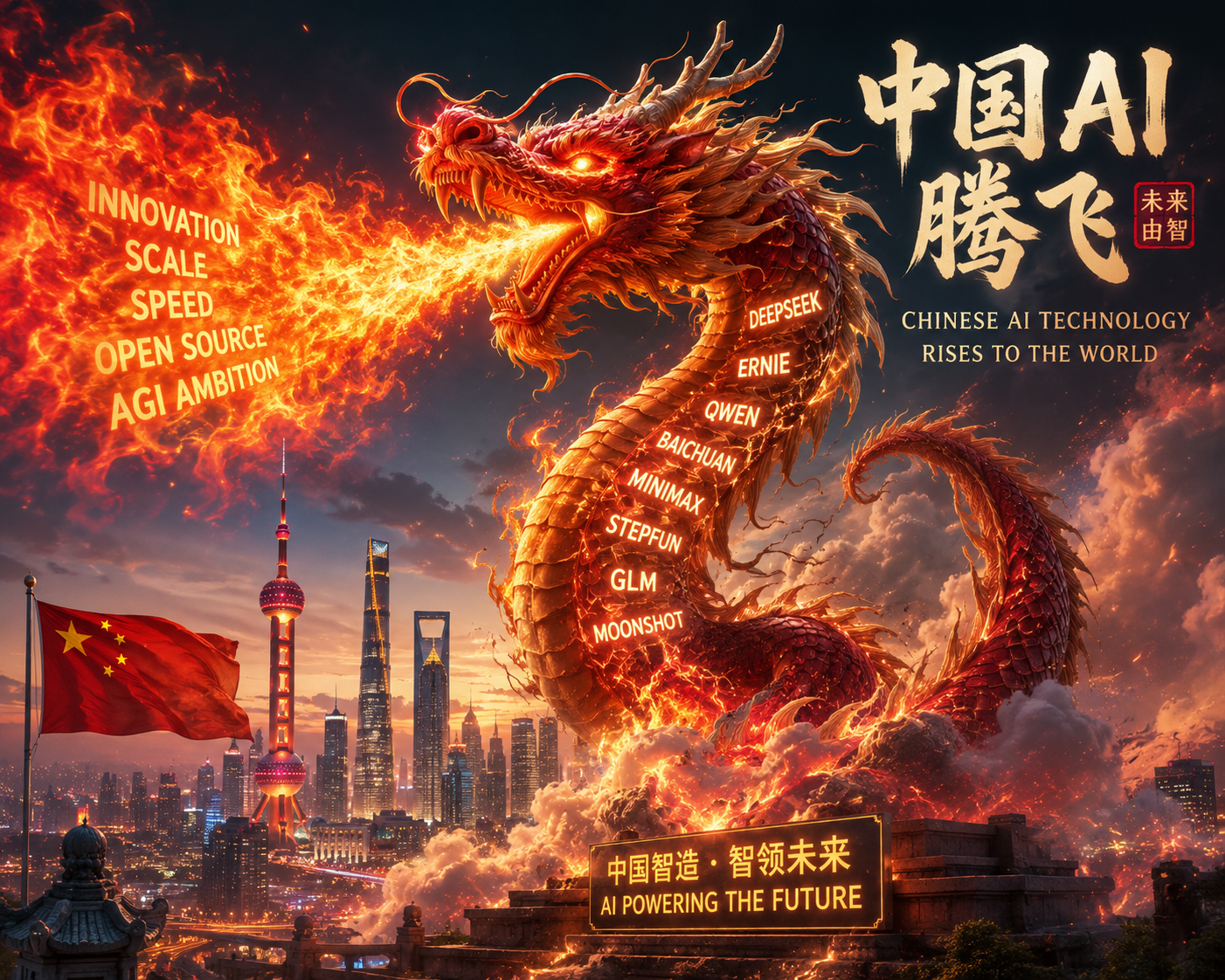
The Sino-American AI Convergence: How China is Rewriting the Rules of the Global AI Arms Race By the AI-Radar Investigative Desk | July 19, 2026
For the past three years, the global artificial intelligence narrative has been dominated by a singular, unquestioned premise: American unilateral hegemony. Fueled by limitless venture capital, unprecedented computing infrastructure, and the pioneering innovations of labs like OpenAI and Anthropic, the United States appeared to be running a race against itself.
However, an exhaustive investigation by AI-Radar, cross-referencing global benchmark leaderboards, geopolitical policy briefings, and proprietary enterprise deployment data, reveals a fundamentally altered reality in 2026. The historical performance gap between leading United States and Chinese foundation models has effectively closed to within single digits. According to the 2026 Stanford AI Index Report, the top American models lead their Chinese counterparts by a mere 2.7% on human-preference leaderboards.
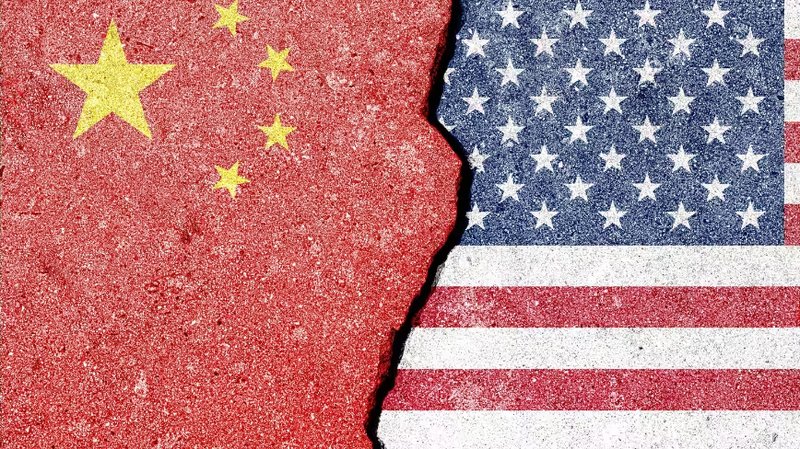
Yet, to call this a "race" is to fundamentally misunderstand the dynamic. The U.S. and China are no longer running on the same track; they are building increasingly incompatible technology stacks driven by vastly divergent strategic philosophies. The United States remains fixated on the ideological pursuit of Artificial General Intelligence (AGI) and absolute frontier capability, mobilizing trillions of dollars in compute infrastructure. China, constrained by severe semiconductor export controls, has engineered a rebellion in software architecture, pivoting toward extreme algorithmic efficiency, cost-optimized open-weight models, and the rapid diffusion of AI into the physical and industrial economy.
This is the story of how the Great Divide in artificial intelligence happened, and why the global market is fracturing along its fault lines.
The Strategic Bifurcation: AGI vs. Industrial Diffusion
To understand the current state of Sino-American AI, one must look at the underlying policies driving both nations. The U.S. strategy is defined by winning through scale. In 2025 and 2026, American technology giants committed over $400 billion and an estimated $800 billion, respectively, to capital expenditures, expanding a data center base that already boasts nearly 54 gigawatts of capacity. This is best exemplified by the $500 billion "Stargate" infrastructure initiative led by major U.S. tech and financial players. The American objective is brute-force computational dominance aimed at achieving AGI and Artificial Super Intelligence (ASI).
Chinese policymakers and enterprises view the landscape through a distinctly different lens. In China, they are "AI-pilled but not AGI-pilled". The nation's "AI+" initiative, introduced in 2024, explicitly targets the large-scale integration of AI into manufacturing, public administration, and everyday life, with goals of over 70% penetration of AI-enabled intelligent agents by 2027. While the U.S. chases theoretical intelligence ceilings, China focuses on practical economic integration, evidenced by its installation of 54% of the world's industrial robots in 2024 and its leadership in AI patents.
Table 1: The Systemic Enablers of AI (US vs. China, 2026)
| Dimension | United States | China | Strategic Impact |
|---|---|---|---|
| Capital Deployment | $800B+ Estimated Big Tech CapEx (2026) | $63B Big Tech CapEx (2025) | US dominates raw financial scale and mega-cluster buildouts. |
| Data Center Capacity | 53.7 GW installed | 31.9 GW installed | US leads in absolute compute hosting. |
| Electricity Generation | 4,670 TWh total generation | 10,707 TWh total generation | China generates double the power, charging $0.08/kWh vs US $0.18/kWh, enabling cheaper long-term scaling. |
| Research & IP | 50 notable models produced (2025) | 41% share of top 100 most-cited AI papers | US leads in notable commercial models; China leads in academic output and patents. |
Architectural Alchemy: Bypassing the Hardware Squeeze
The most remarkable achievement of the Chinese AI ecosystem in 2026 is its survival and thriving despite aggressive U.S. export controls. Denied access to Nvidia's state-of-the-art extreme ultraviolet (EUV) fabricated chips like the H100, H200, and Blackwell series, Chinese labs were forced into a structural hardware deficit. Semiconductor Manufacturing International Corporation (SMIC) remains effectively capped at an enhanced 7-nanometer process with notoriously low yield rates ranging from 20% to 40%.
According to analyses by the Council on Foreign Relations, Huawei’s best chips, such as the Ascend 910C, still only perform at roughly 60% the capacity of an Nvidia H100 in real-world environments, and the gap threatens to widen to 17x by 2027 as Nvidia releases its next-generation Rubin architectures.
Yet, Chinese AI companies have circumvented this physical hardware ceiling through groundbreaking architectural innovations designed to bypass the quadratic memory and compute bottlenecks of standard Multi-Head Attention (MHA).
DeepSeek's Multi-Head Latent Attention (MLA): Hangzhou-based DeepSeek shocked the world with its V3 and V4 models. By utilizing MLA, DeepSeek compresses key and value tensors into a lower-dimensional latent space before storing them in the KV cache. This reduces memory overhead by over 93%, allowing the model to handle massive context windows with extreme hardware efficiency. DeepSeek further amplified this with a highly sparse Mixture-of-Experts (MoE) architecture; in its 1.6-trillion-parameter V4-Pro, only 49 billion parameters are active per token.
Moonshot AI's Kimi Delta Attention (KDA): Moonshot AI recently released Kimi K3, a 2.8-trillion-parameter open-weight model. To manage its 1-million-token context window, Moonshot engineered KDA, a hybrid linear attention mechanism that enables up to 6.3x faster decoding over million-token inputs compared to standard architectures. K3 utilizes "Stable LatentMoE," activating a mere 16 out of 896 experts per token, ensuring massive intelligence scaling without proportionate compute costs.
MiniMax Sparse Attention (MSA): Shanghai-based MiniMax developed MSA for its M3 model, executing per-group block selection to slash per-token attention compute by 28.4 times at 1 million context lengths. This allows the natively multimodal M3 to process long-horizon agentic tasks—such as autonomously reproducing a complex academic paper over 12 hours—with extreme efficiency.
These software-level optimizations are how China turned a severe hardware disadvantage into an algorithmic renaissance.
The Benchmarks: A Photo Finish at the Frontier
The result of this algorithmic efficiency is an AI landscape where Chinese models go toe-to-toe with the most expensive, compute-heavy American systems. While MMLU and HumanEval have reached benchmark saturation (with frontier models routinely scoring 90%+ across the board), tests like SWE-Bench Verified, GPQA Diamond, and Humanity's Last Exam (HLE) remain the true differentiators in 2026.
Table 2: State-of-the-Art Frontier Models Comparison (Mid-2026)
| Model | Lab (Origin) | Arena Elo | SWE-Bench Verified | GPQA Diamond | Humanity's Last Exam | Core Strength |
|---|---|---|---|---|---|---|
| GPT-5.6 Sol | OpenAI (US) | ~1486-1514 | 78%+ | 90%+ | 60%+ | Mathematical logic (100% AIME 2026), general reasoning. |
| Claude Fable 5 | Anthropic (US) | 1507-1525 | 95.0% | 92.6% | 53.3% | Unattended agentic runs, elite software engineering. |
| Claude Opus 4.8 | Anthropic (US) | ~1512-1580 | 80.9% (v4.5) | 84%+ (v4.6) | 50%+ (v4.6) | Compliance, complex multi-step error recovery. |
| Kimi K3 | Moonshot AI (China) | 1486 | N/A (67.5% DeepSWE) | 93.5% | 43.5% | 300-subagent Swarm architectures, dynamic web creation. |
| DeepSeek V4 Pro | DeepSeek (China) | 1462-1467 | 79.4% | 85%+ (v3.2) | 52%+ (v3.2) | Low-cost agentic backbones, long-document parsing. |
| MiniMax M3 | MiniMax (China) | 1455 | 59.0% (Pro) | N/A | N/A | Native multimodality, 1M context sparse attention. |
Note: Benchmark scores fluctuate rapidly due to testing variations and scaffolding differences, but the parity is undeniable.
On the absolute upper bounds of graduate-level science (GPQA Diamond) and the newly minted Humanity's Last Exam, American proprietary models—specifically Anthropic's Claude Mythos Preview and Claude Fable 5—still hold a measurable lead. Anthropic’s Constitutional AI approach enables highly consistent behavior on open-ended adversarial prompts, granting it dominance in complex, multi-step error recovery where tools fail.
However, in coding and standard enterprise agentic workflows, the gap is functionally closed. DeepSeek V4-Pro ties or sits within striking distance on major coding leaderboards, and Moonshot's Kimi K3 leads outright on subsets like BrowseComp and Arena's Frontend Code arena.
The Economics of Intelligence: The Cost-Quality Gap
If the U.S. leads in absolute intelligence ceilings, China has achieved total supremacy in the economics of inference. The pricing disparities between the two ecosystems in 2026 are staggering, directly influencing how global enterprises architect their AI deployments.
Table 3: The Economic Disparity (API Cost per 1 Million Tokens, USD)
| Model | Input Cost | Output Cost | Cost Multiple vs. DeepSeek Flash |
|---|---|---|---|
| Claude Fable 5 | $10.00 | $50.00 | ~178x |
| GPT-5.5 | $5.00 | $30.00 | ~107x |
| Claude Opus 4.8 | $5.00 | $25.00 | ~89x |
| Gemini 3.1 Pro | $1.25 | $10.00 | ~35x |
| MiniMax M3 | $0.60 | $2.40 | ~8.5x |
| DeepSeek V4-Pro | $0.435 | $0.87 | ~3.1x |
| DeepSeek V4-Flash | $0.14 | $0.28 | Baseline (1x) |
Anthropic’s Claude Fable 5 is a dense frontier model optimized for quality, charging an astronomical $50.00 per million output tokens. In stark contrast, DeepSeek V4-Flash costs $0.28 per million output tokens.
This 178x pricing gap has created a new operational paradigm: Task-Complexity Routing. The Anaconda and Forrester State of Agentic AI 2026 report notes that 88% of enterprise AI agent pilots fail to graduate to production due to exorbitant scaling costs. To survive, enterprises no longer use a single model. Instead, orchestrators route up to 85% of standard, high-volume commodity work (data extraction, log parsing, basic code completion, classification) to ultra-cheap Chinese models like DeepSeek V4-Flash, MiniMax M3, or Qwen 3.5.
The expensive American frontier models—GPT-5.6 or Claude Fable 5—are treated as scarce intellectual commodities, reserved strictly for the remaining 15% of high-stakes workflows: architectural planning, security reviews, and complex error resolution. In a simulated enterprise scenario processing 50 million output tokens a month, this hybrid routing strategy slashes a $43,500 monthly Claude API bill down to just $8,800, without sacrificing quality where it matters.
The Silicon Battlefield: Custom ASICs and Sovereign Tech Stacks
Behind the API endpoints lies the physical reality of the semiconductor market. The U.S. government’s attempt to throttle Chinese AI development via hardware bans has resulted in a classic unintended consequence: the accelerated birth of a self-sufficient, highly specialized Chinese semiconductor ecosystem.
Recognizing they cannot acquire Nvidia's general-purpose Hopper or Blackwell GPUs, Chinese tech giants have pivoted aggressively to Application-Specific Integrated Circuits (ASICs). ASICs sacrifice the programming flexibility of a GPU for raw, specialized efficiency in inference tasks.
Huawei has emerged as the clear champion, projected by Morgan Stanley to capture 62% of China's domestic AI accelerator market in 2026. The Huawei Ascend 910C, currently in mass production with targets of 600,000 units, is explicitly approved on China's "secure and reliable" state procurement lists. Next-generation chips like the Ascend 950PR and Cambricon's Siyuan 690 are reportedly outperforming Nvidia's export-compliant (and heavily degraded) H20 chip by 50% to 150% in token-per-second throughput.
Alibaba has gone a step further with its server designs. The Alibaba PG1 server fits sixteen T-Head PG1_810E cards in a single box, yielding 1.5 Terabytes of VRAM—enough to run full-fat, private frontier models completely on-premise without telemetry.
However, China’s hardware ascent is fragile. By standardizing on Huawei's CANN software stack and Cambricon’s proprietary architectures instead of Nvidia's globally ubiquitous CUDA platform, China is fracturing the global software ecosystem. While the Council on Foreign Relations rightly points out that SMIC cannot manufacture chips matching the absolute raw processing power or high-bandwidth memory (HBM3e) integration of an Nvidia H200, China mitigates this by maintaining near 100% datacenter utilization and massive deployment volumes.
The Open-Weights Weaponization
The final dimension of the Sino-American AI divide is the distribution model. U.S. leaders like OpenAI and Anthropic strictly gate their most capable models behind closed, proprietary APIs, citing safety, intellectual property, and national security—such as the recent U.S. government intervention temporarily suspending Anthropic's Claude Mythos from foreign national access due to cyber capabilities.
Chinese labs have recognized that open-weight releases are their most potent geopolitical and commercial weapon. By releasing models like DeepSeek V4, Kimi K2.6/K3, and MiniMax M3 under highly permissive MIT or Modified MIT licenses, Chinese firms are flooding the global market. This approach drastically lowers the barrier to entry for developers worldwide, forcing global reliance on Chinese architectures while allowing enterprises to self-host and bypass the data routing laws associated with hosted APIs.
This strategy is highly effective in the Global South and middle-power economies. As the U.S. ecosystem becomes a walled garden of premium, highly regulated intelligence, China is exporting cost-optimized, open-source AI stacks seamlessly integrated into its broader Belt and Road Initiative infrastructure. For countries seeking AI resilience without the geopolitical strings of Washington, the Chinese stack presents an irresistible value proposition.
Conclusion: The Permanent Divide
The 2026 AI landscape proves that intelligence can be achieved through multiple paradigms. The United States maintains its crown in absolute reasoning ceilings, math logic, and the sheer financial willpower of its hyperscalers. But China has decisively proven that the "scaling laws" of brute-force compute are not the only path forward. Through profound software alchemy, open-weight proliferation, and a ruthless focus on inference economics, China has effectively neutralized the American hardware embargo.
The convergence in intelligence metrics masks a permanent structural divide. As algorithms split across CUDA and CANN software stacks, and as hardware diverges between generalized GPUs and custom ASICs, the global AI ecosystem is breaking in two. For international enterprises, developers, and policymakers, the luxury of ecosystem neutrality is rapidly expiring. The Great Divide is no longer a future prediction—it is the foundational reality of the 2026 AI economy.




💬 Comments (0)
🔒 Log in or register to comment on articles.
No comments yet. Be the first to comment!