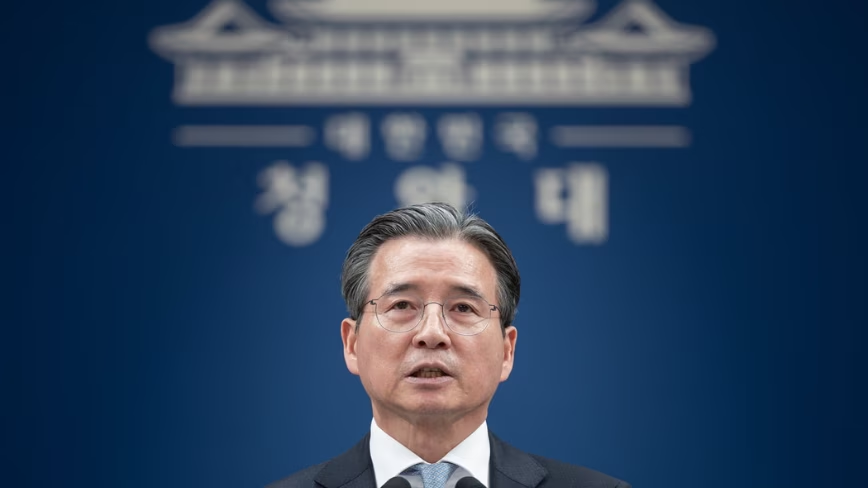
This is not merely about square footage or building permits. When South Korean presidential adviser Park Sang-wook stated that artificial intelligence demand could pull forward fab construction by «more than a decade», he laid bare a reality that anyone managing on-premise LLM infrastructure knows too well: computational raw material is scarce, and the race to produce it has only just begun.
According to The Next Web, the Seoul government has begun formal talks with Samsung Electronics and SK Hynix to outline the next large-scale investment in chip manufacturing. The goal is to create a second production cluster, beyond the existing Yongin site, to meet a hunger for compute that data centers, cloud providers, and enterprises opting for self-hosted solutions are struggling to satisfy.
The strategic weight of HBM and advanced memory
Behind South Korea's acceleration lies a structural fact: Samsung and SK Hynix together control almost the entire market for High Bandwidth Memory (HBM), critical components for the latest GPUs and AI accelerators. HBM3 and upcoming HBM3E are the fuel that allows cards such as NVIDIA H100 or AMD MI300 to swallow prompts and return tokens at acceptable speeds. Without an abundant supply of these memories, on-premise deployment of models in FP16 or FP8 precision, with extended context windows, becomes an exercise in patience and haggling with distributors.
Building a second cluster is therefore not a defensive move but a capacity expansion that looks toward 2030 and beyond. It means advanced wafer production lines, 3D packaging, and—crucially—HBM volumes capable of finally easing the pressure on a supply chain that currently forces some integrators into wait times exceeding six months.
What changes for those evaluating on-premise infrastructure
For IT leaders weighing the total cost of ownership (TCO) of a local inference cluster, the Korean news is not background noise. Increasing chip and memory production capacity, even if the effect materializes over a medium-to-long time horizon, lays the groundwork for a possible stabilization of AI hardware prices. The current scenario, by contrast, sees inflated quotations and intermittent availability, pushing many organizations to fall back on cloud solutions despite a desire to retain data control.
This is not only about costs. Technological sovereignty also requires confidence that critical components are not subject to geopolitical bottlenecks or unilateral decisions by single suppliers. South Korea's commitment, backed by a government-industry axis, represents a concrete answer to the trade tensions that have made chip supplies volatile in recent years. For Europe, and especially for Italy, where the SME community experimenting with on-premise LLMs is growing, diversifying procurement sources is an enabling factor.
The worksite for the next decade
Beyond the still-undefined timelines, the political signal is strong: chip manufacturing is now seen as national infrastructure, on par with highways or energy grids. If AI is pulling demand, nations with a solid manufacturing base are gearing up to intercept it. South Korea is doing so with its national champions, and it is doing so by doubling production sites.
For those working in the field—system architects, CTOs, teams building fine-tuning and inference pipelines on owned hardware—the message is clear: the next generations of LLM servers will depend on the ability of Samsung and SK Hynix to churn out memories with sufficient bandwidth. Keeping an eye on supply chain movements becomes an integral part of deployment strategy, as much as choosing a serving framework or a quantization level. Resources like AI-RADAR, which map the intersections between technical choices and market dynamics, help read these signals before they turn into budget constraints.






💬 Comments (0)
🔒 Log in or register to comment on articles.
No comments yet. Be the first to comment!