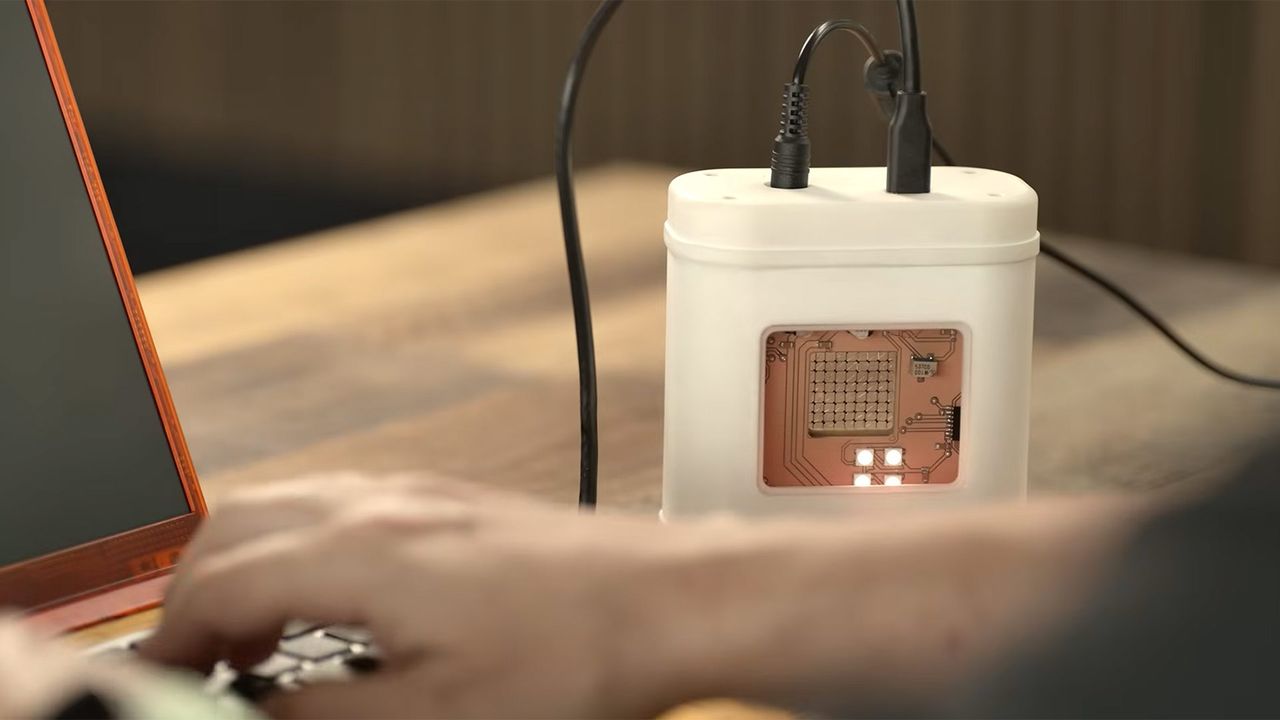
When memory prices hit obscene levels, sometimes the solution comes straight from the 1960s. That's the case with an anonymous maker who, for challenge and necessity, decided to build a USB drive based on magnetic core memory, the same technology used in the Apollo mission computers. The project — documented online — uses hand-threaded ferrite cores and salvaged Russian components to give life to a device that looks like it came out of a museum, but actually works.
Magnetic core memory doesn't need power to retain data: each bit is represented by the magnetization state of a small ferrite ring, read and written through electrical pulses on a wire matrix. Non-volatile, resistant to radiation and heat, this technology dominated computing before the rise of semiconductors. Today it's making a comeback not for speed — access times are in microseconds and density is abysmal — but for other qualities: longevity, physical transparency of data, and, why not, a taste of revenge against a market that crushes budgets for those who want to keep control of their own hardware.
The builder retrieved memory modules from old Soviet machines and hand-weaved the core matrix, then connected it to a USB interface via a microcontroller. The result is a drive of a few kilobytes — maybe a few tens — costing far more in time and patience than silicon, but restoring a forgotten principle: physical ownership of the bit. In an age where every byte flows through someone else's servers, the idea of being able to touch the medium that holds your data carries a symbolic and practical value beyond mere eccentricity.
Why it matters (also) for on-premise deployments
For AI-RADAR readers, used to evaluating trade-offs between cloud and on-premise, this story offers an unusual angle. Magnetic core memory doesn't heat up, survives blackouts without loss, and withstands extreme environmental conditions. In edge or air-gapped scenarios — for example, inference nodes operating in industrial or remote sites — persistence without backup batteries can simplify management. Sure, the drive's minuscule capacity makes it a toy, not a replacement for GPU VRAM. But the principle of intrinsic non-volatility is something that emerging memory designers are chasing with technologies like MRAM and memristors, often without the vintage charm of this experiment.
There's also a lesson on total cost of ownership. The maker invested hours of work and component hunting to escape a market dynamic perceived as unsustainable. It's a micro-example of what happens when organizations move workloads on-premise to avoid runaway cloud prices: they seek autonomy, cost predictability, and a more direct relationship with infrastructure. The magnetic core USB drive won't save any data center, but it reminds us that every deployment choice stems from a calculation among control, cost, and complexity.
The initiative fits into a broader retro-computing movement that is not just nostalgia, but a lab of ideas: revisiting forgotten technologies to solve modern problems, or simply to explore alternatives when mainstream solutions become too expensive or restrictive. Magnetic core memory, with all its limitations, remains a fascinating demonstration of how data sovereignty can also pass through one's own hands and a soldering iron.





💬 Comments (0)
🔒 Log in or register to comment on articles.
No comments yet. Be the first to comment!