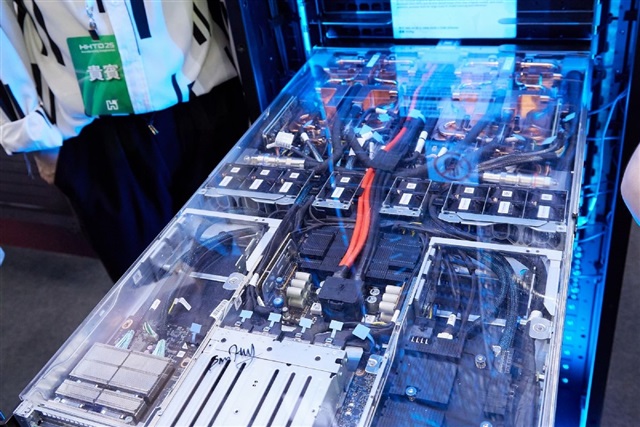
FII Challenges Broadcom and Nvidia: System Integration Redefines the CPO Race
The competitive landscape in the Co-Packaged Optics (CPO) sector is undergoing a profound transformation. A new player, FII, is positioning itself as a direct challenger to established giants like Broadcom and Nvidia. The stakes are no longer just about producing individual optical components; the focus is decidedly shifting towards system integration, an increasingly critical factor for high-performance computing infrastructures, particularly those dedicated to Large Language Models (LLM) and artificial intelligence.
This evolution underscores a fundamental change in the priorities of modern data centers. For CTOs, DevOps leads, and infrastructure architects, the ability to effectively integrate optical components directly into chip packages is not just a matter of efficiency, but a key element for optimizing Total Cost of Ownership (TCO) and ensuring data sovereignty in self-hosted and air-gapped environments. FII's challenge highlights how innovation in this field is essential to support the growing demand for bandwidth and reduce energy consumption.
The Strategic Importance of System Integration in CPO
Co-Packaged Optics represent an emerging technology aimed at overcoming the limitations of traditional interconnections by bringing optical modules closer to electronic chips, such as processors or switches. This approach significantly reduces the distance traveled by electrical signals, converting them into optical signals much closer to the source. The benefits are numerous: higher bandwidth, lower latency, and, crucially, a drastic reduction in power consumption, a vital aspect for data centers hosting intensive workloads like LLM Inference and training.
The shift towards system integration implies that manufacturers can no longer limit themselves to supplying standard optical modules. Instead, they must offer complete solutions that interface optimally with the overall system architecture, including chip packages, heat sinks, and motherboards. This complexity requires expertise beyond mere optoelectronics, encompassing system design, thermal management, and materials engineering. The goal is to create a single, highly efficient communication pipeline that can sustain the throughput required by the most demanding AI applications.
Implications for On-Premise Deployments and TCO Analysis
For companies evaluating on-premise LLM deployments, choosing CPO solutions with superior system integration can have a direct and significant impact. Tighter integration translates into higher port density, better energy efficiency, and ultimately, a lower TCO in the long run. By reducing cabling complexity and improving heat dissipation, data center space can be optimized, and operational costs related to energy and cooling can be decreased.
This trend favors vendors who can offer not only high-performing components but also expertise in optimizing the entire infrastructure stack. For CTOs and architects, this means considering not only the technical specifications of individual components but also their ability to integrate harmoniously into a broader ecosystem. Purchasing decisions thus shift from a "best component" logic to a "best integrated solution" logic, with an eye towards compatibility with existing and future hardware, such as the latest generation GPUs and high-speed network architectures.
Future Prospects and the Race for Efficiency
FII's challenge to Broadcom and Nvidia in the field of CPO and system integration is a clear indicator of the industry's direction. As AI models become larger and more complex, the need for high-speed, low-power interconnections will become even more pressing. A company's ability to innovate in system integration will be a decisive factor for its success and its capacity to support the next generation of AI infrastructures.
This competitive scenario stimulates innovation and offers new opportunities for those seeking optimized solutions for data sovereignty and complete control over their infrastructure. For those evaluating on-premise deployments, AI-RADAR offers analytical frameworks on /llm-onpremise to assess the trade-offs between different architectures and solutions, helping to make informed decisions that balance performance, costs, and compliance requirements. The race for efficiency in the data center has just begun, and system integration in CPO is a fundamental pillar of it.







💬 Comments (0)
🔒 Log in or register to comment on articles.
No comments yet. Be the first to comment!