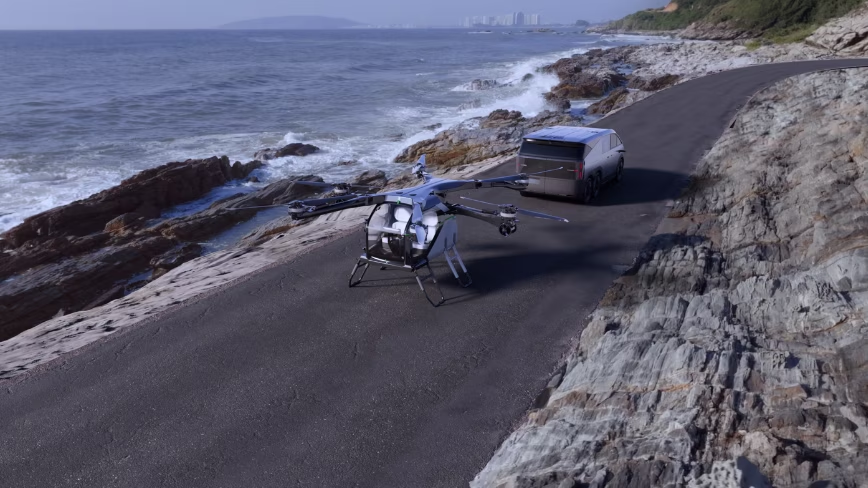
Munich hosted the European debut of the Land Aircraft Carrier on Wednesday, the modular vehicle from China’s Xpeng that combines a six-wheeled ground unit – called the Mothership – with a detachable two-seat eVTOL flight module stowed in the rear. The company claims 7,000 orders already secured and a factory capable of producing 10,000 units per year.
Those numbers signal commercial ambition, yet they distract from a decisive architectural detail: the brain of this machine. A vertical take-off and landing aircraft that flies autonomously, communicates with the Mothership, and must react to in-flight surprises without leaning on a remote data center is, in practice, the most extreme manifesto of on-premise AI inference. Or, if you prefer, edge computing that tolerates no compromises: no cloud, no buffering, no acceptable latency.
The quiet chip front
The six rotors of the flying module and the sensors required for autonomous navigation dump onto the system a load of real-time decisions that demands dedicated processors – most likely system-on-chip designs with integrated neural acceleration. We don’t know which components Xpeng chose, as the company did not discuss them in Munich, but the workload profile is well understood: sensor fusion, visual odometry, obstacle detection, trajectory planning, energy management. All operations that require always-on inference pipelines running on low-power embedded hardware in complete self-sufficiency.
The parallel with the choices facing those evaluating on-premise deployment of LLMs and foundation models is striking. In both cases the aim is to escape cloud dependency: for a business it’s a matter of data sovereignty and cost predictability, for an eVTOL it’s literally a matter of survival. A network dropout during a manoeuvre is not an inconvenience, it’s an accident. Consequently, the compute infrastructure must be self-hosted on the platform, redundant, and certified to aerospace standards that make any corporate SLA look tame.
Winners and losers in the aviation edge race
Xpeng’s entry into Europe with such a flashy product accelerates a repositioning already underway. Specialized silicon suppliers – from NVIDIA with its Drive and Jetson platforms to Qualcomm with Snapdragon Ride – see autonomous aircraft as a niche but highly lucrative market where margins are inflated by safety requirements and certification. Those who bet on an exclusively cloud-centric future for AI, even in mobility, receive a clear signal: mission-critical use cases swing the pendulum toward the most extreme on-premise form, the kind installed directly on the vehicle that cannot share resources with anyone else.
There is also a regulatory dimension. The German debut is no accident: the European Union, with its privacy framework and the emerging AI Act, favours architectures that process information on board, reducing exposure to cross-border data flows. An eVTOL that handles all data – from camera feeds to telemetry – locally is intrinsically aligned with minimization and data residency principles. It may not have been the main talking point at the Munich event, but it is one of the factors that will determine market acceptance in Europe.
Structurally, the Xpeng story reminds us that the inference battle is not fought only in data center racks or office workstations, but also on objects moving hundreds of meters above the ground. For those following discussions on on-premise deployment of AI workloads, this is a textbook case: the key variables – latency, reliability, independence from connectivity, and data sovereignty – all appear together, multiplied by a risk factor no server room ever faces. While infrastructure suppliers sharpen their tools, the real winner will be whoever can deliver a certifiable, continuous inference pipeline that, quite literally, never drops the line.







💬 Comments (0)
🔒 Log in or register to comment on articles.
No comments yet. Be the first to comment!