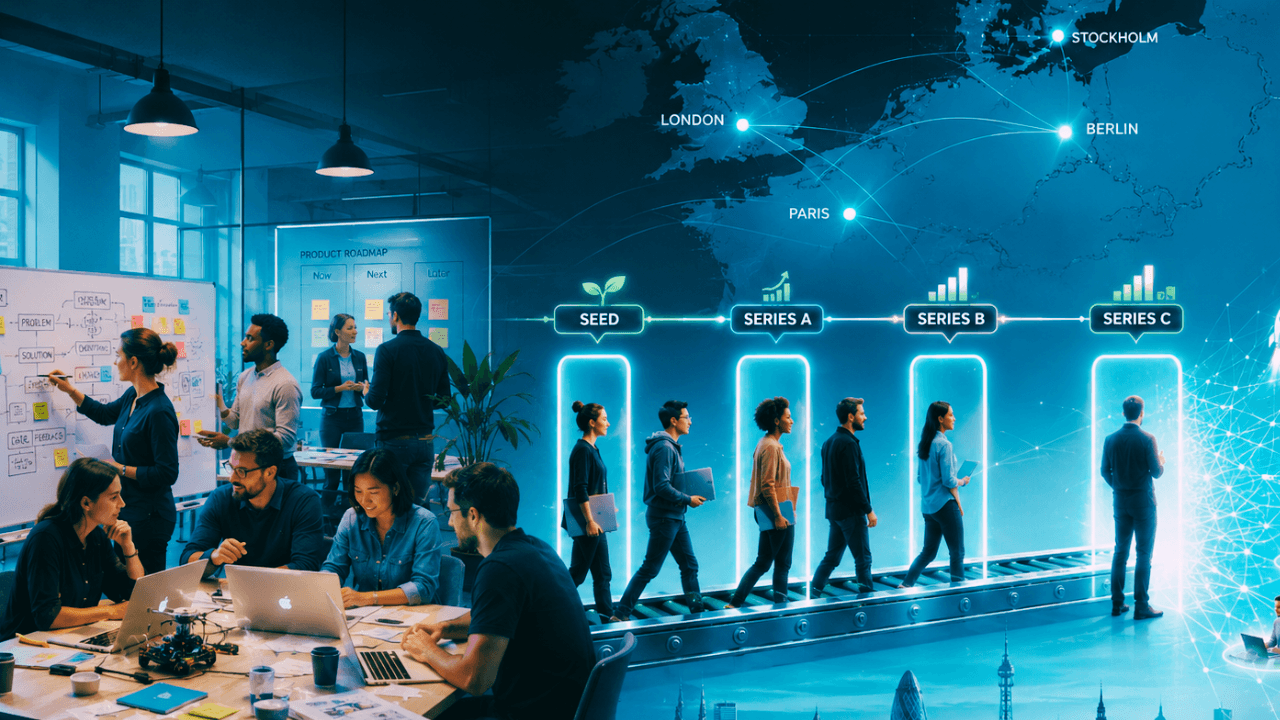
Research published by global VC Antler leaves no doubt: the single most important decision a future founder can make is not which university to attend or which big tech company to join, but the company they worked at before striking out on their own. And not just any company—they must have lived through its scaling journey, from Seed to Series C, during that pressure-cooker phase where fundraising, hiring, and product decisions are made under the spotlight. The study, titled Europe’s Growth Stage Founder Factories, screened 51,722 European companies that closed a seed round between 2010 and 2021. The average Series A conversion rate is 23 percent. But for founders with direct experience inside a growth-stage startup, that figure leaps to 45.6 percent, a gap of over 22 points. Those coming from Big Tech or from startups that remained at an initial stage stop at 33 percent: a real advantage, but exactly the same as being an ex-Googler.
For those building in the on-premise AI space, these numbers are not just a venture capital curiosity. They confirm a suspicion that has long simmered among system architects and CTOs obsessed with data sovereignty: managing a self-hosted LLM, deciding which quantization level to adopt for running local inference without saturating VRAM, calculating the TCO of a bare-metal cluster or the energy cost of a hybrid deployment—these are skills honed when you’ve been inside an organizational machine that grew under your own hands, not when you’ve tapped into an hyperscaler’s infinite resources.
The experience of those who navigated tight budgets, negotiated hardware, orchestrated data pipelines, and kept an eye on GDPR compliance while the product evolved, shapes a founder capable of setting deployment strategies that prioritize control, latency, and security. The report indirectly confirms this: founders who joined a startup at seed stage and stayed long enough to see it raise a Series B or above go on to build their own company that converts a Series A in 55.3 percent of cases. A gap that speaks of discipline, not luck.
The global “founder factories” list compiled by Antler—from GitHub to Klarna, from Dropbox to Riot Games—shows that this dynamic is not confined to a single sector. But the principle resonates especially for the current wave of startups developing inference stacks for on-premise deployment or frameworks for fine-tuning models under confidentiality constraints. In a market where every gigabyte of memory and every token per second carries a real cost, the “make do with what you have” mindset turns out to be the antidote to frictionless SaaS strategies that ignore the reality of enterprise data centers.
Christoph Klink, partner at Antler, puts it bluntly: “It’s being inside a company as it was actively scaling—navigating the fundraising pressure, the hiring pace, the product decisions made under scrutiny—that predicts future success better than any other signal we tested. And it produces more than double the lift of working at Google or Meta.” Good news for Europe, which is producing a generation of unicorns and, at the same time, a vibrant early-stage ecosystem capable of giving the next founders the best training ground. For those investing in startups that bet on on-premise deployment of artificial intelligence, the message is clear: update your filters, look for those who have already sweated on the field, and back them early.






💬 Comments (0)
🔒 Log in or register to comment on articles.
No comments yet. Be the first to comment!