
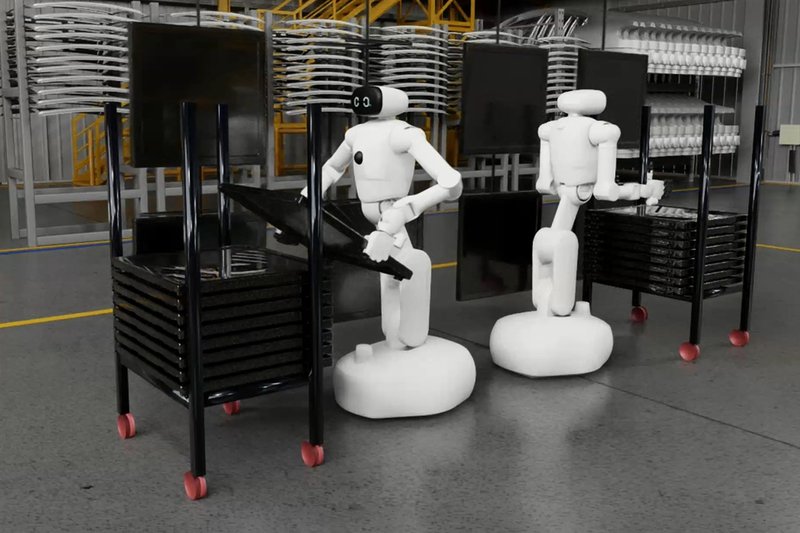
Artificial intelligence is no longer confined to the cloud. When robots, robotic arms, and entire smart factories are in motion, responses must come in milliseconds, and data cannot leave the company perimeter. This is the direction LG Group is heading, as its management recently visited Nvidia to expand collaboration on physical AI and robotics.
The meeting, reported by DIGITIMES, has yet to yield official announcements, but it fits into a broader mosaic: the race to integrate AI with physical systems is pushing large industrial groups to invest not only in models, but in a robust hardware and software foundation for local inference.
The hardware backbone of physical AI
For a robot operating on a factory floor, every millisecond counts. Cloud-based architectures, with their network delays, are unsuitable. That’s why Nvidia, with its edge computing platforms like the Jetson series and software such as Isaac and Omniverse, has become an almost mandatory partner for anyone designing the next generation of automation.
LG, which produces components, consumer electronics, and smart factory solutions, sees this collaboration as an opportunity to bring AI inference directly onboard machines. This is a paradigm shift: no longer training in the data center and making API calls to the cloud, but rather compact, possibly quantized models running on embedded GPUs with strict power and memory constraints. On-premise—or rather, on-device—deployment becomes the norm.
Why on-prem is no longer an option, but a necessity
LG’s interest is not isolated. In physical AI applications—where AI interacts directly with the physical world—data sovereignty, latency, and connectivity reliability make on-premise or edge deployment not just preferable, but often the only viable path. Data from sensors, cameras, and actuators stay within the local network, reducing exposure risks and ensuring full compliance with regulations like GDPR.
For enterprises evaluating such architectures, the trade-off is well-known: on-premise hardware resources are limited, maintenance is more complex than in the cloud, and in-house expertise is needed to optimize models. However, Total Cost of Ownership can become favorable when data volumes are high and connectivity is costly or intermittent. AI-RADAR provides analytical frameworks to navigate these variables, helping quantify the benefits of self-hosted vs. cloud solutions.
A look at the value chain
The meeting between LG and Nvidia fits into a landscape where the chip supplier is no longer just a component vendor, but an enabler of entire vertical ecosystems. With platforms spanning simulation (Omniverse), data center training (H100 and B200 GPUs), and edge inference (Jetson Orin), Nvidia is urging enterprises to build integrated systems and retain internal control of intelligence.
For manufacturing, this means developing custom models with fine-tuning on proprietary data, all running on-premise. This is not science fiction: production lines with robots that can autonomously adapt to new situations are already emerging. The crux, as always, is the upfront hardware investment and the availability of high-quality labeled data.
Ultimately, LG’s visit to Nvidia is a signal: physical AI will pivot on local deployments, pushing on-premise well beyond traditional data center boundaries. The challenge will be to build efficient, repeatable solutions, but the path is now clear.





💬 Comments (0)
🔒 Log in or register to comment on articles.
No comments yet. Be the first to comment!