
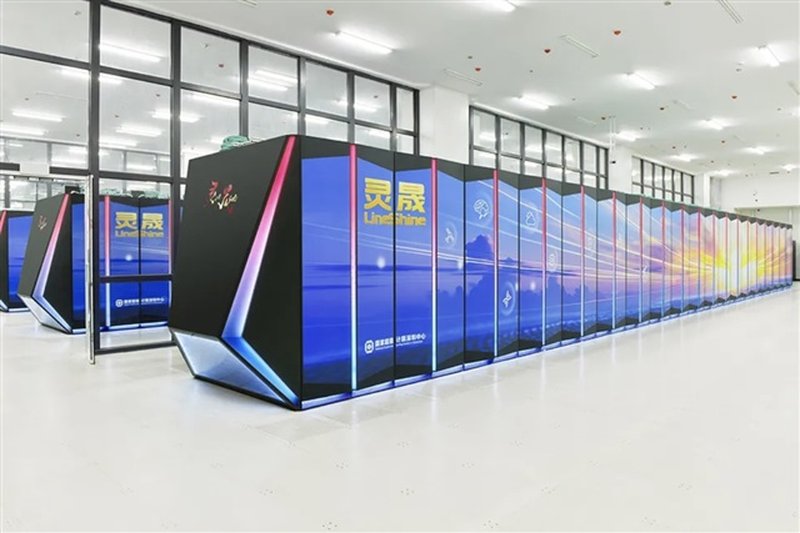
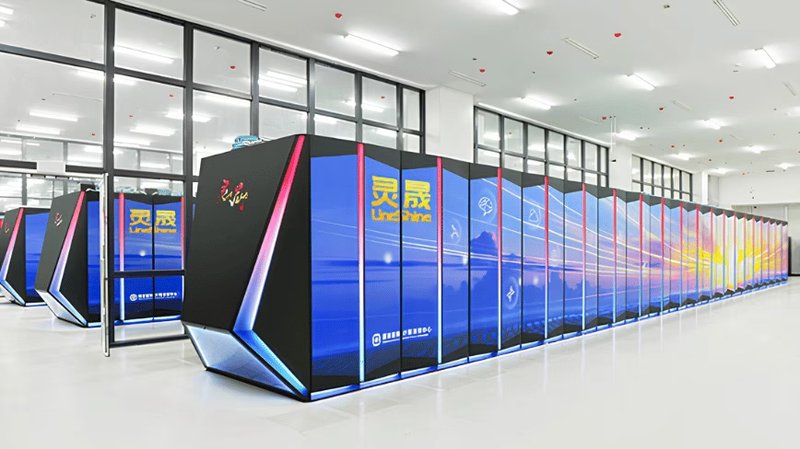
After three years of voluntary absence, China returned to the TOP500 public rankings and immediately grabbed the top spot. LineShine, housed at the National Supercomputing Centre in Shenzhen, reached 2.198 exaflops on the HPL benchmark, displacing El Capitan at Lawrence Livermore National Laboratory (1.809 exaflops). The result reignites the geopolitical semiconductor contest but says very little about real-world artificial intelligence capability.
An accelerator-free architecture: linear math wins, mixed-precision loses
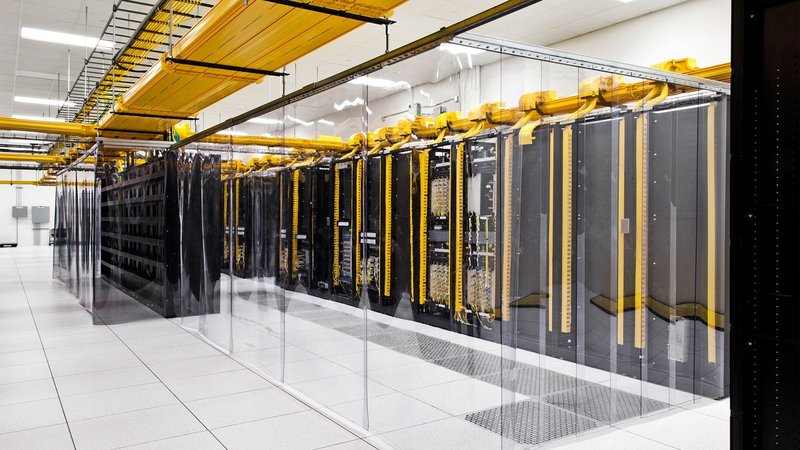
TOP500 describes LineShine as a system built on the LingKun platform, with 304-core LX2 processors, LingQi interconnect, and Kylin OS. More than 13.7 million cores at 1.55 GHz, drawing about 42.2 megawatts with 52.07 gigaflops per watt efficiency. Impressive on paper, yet the key detail is the absence of dedicated low-precision accelerators. LineShine is a CPU-only machine: on HPL-MxP, the mixed-precision benchmark relevant to AI workloads, it falls to fourth place with 7.92 exaflops, while it leads the traditional HPCG test with 22 petaflops.
This architectural detail makes a substantial difference for anyone evaluating on-premise infrastructure for LLM serving or fine-tuning. Modern language models lean heavily on low-precision compute (FP16, INT8) and require GPUs or other accelerators with high memory bandwidth. Without specialized units, even a record-breaking supercomputer can be less suited than a cluster of consumer GPUs for large-model inference or training. LineShine is a perfect example: raw HPL power does not automatically translate into AI competitiveness, a trade-off every organization must weigh when balancing TCO, data sovereignty, and real workload performance.
The political move behind the ranking
Analysts were struck less by LineShine’s performance than by Beijing’s decision to submit the system for public measurement. Addison Snell, CEO of Intersect360 Research, reads it as a bid for external validation of domestic chip design, at a time when U.S. export controls are squeezing China’s ability to produce advanced semiconductors. The disclosed specs show no cutting-edge AI chips, likely because the tools to manufacture them remain under restriction.
The TOP500 list, moreover, does NOT capture the full AI supercomputing landscape. Most hyperscalers – Microsoft, Amazon, Google – and firms like xAI do not submit their clusters for ranking. A 2025 Epoch AI study estimated that about 80% of AI supercomputer performance in its dataset came from the private sector, and that the U.S. held roughly 75% of capacity versus China’s 15%. Colossus, xAI’s system with 200,000 chips, was the top performer as of March 2025. Jimmy Goodrich of the University of California noted that if major hyperscalers submitted their machines, LineShine would not even make the top five. For those managing on-premise deployments, this underscores a fundamental point: public benchmarks matter only up to a point. Architectural choices must be tailored to the actual workload – LLMs, RAG, fine-tuning – not a linear petaflop chase.
Technological sovereignty and the limits of DIY hardware
The LineShine story reopens the debate on data sovereignty and technological autonomy. Building processors and interconnects in-house is a step toward independence from Western supply chains, but the lack of AI acceleration reveals the depth of the gap. For an enterprise evaluating a fully self-hosted, air-gapped infrastructure, China’s case offers a lesson: domestic hardware design is possible, but it demands years and compromises that can make the architecture ill-suited for the latest models without heavy investment in hardware-software co-design and efficient quantization pipelines.
The phenomenon of unreported private systems complicates the picture further. While cloud vendors tout agility, the on-premise choice hinges on granular data control and long-term cost predictability – factors that escape public rankings but weigh heavily in real decisions. AI-RADAR will keep tracking these dynamics, providing analytical frameworks for those who must weigh trade-offs among hardware, software, and local deployment constraints.






💬 Comments (0)
🔒 Log in or register to comment on articles.
No comments yet. Be the first to comment!