An Era Ends: The Linux Kernel Departs with a Piece of History
The world of software development is in constant evolution, and the Linux kernel is no exception. With the imminent release of version 7.2, developers have decided to remove the driver for the Hercules Monochrome ISA graphics card, a component that marked an era in personal computing. This card, with over forty years of history, represents a true digital archaeological relic, whose driver has resided at the heart of the operating system for decades.
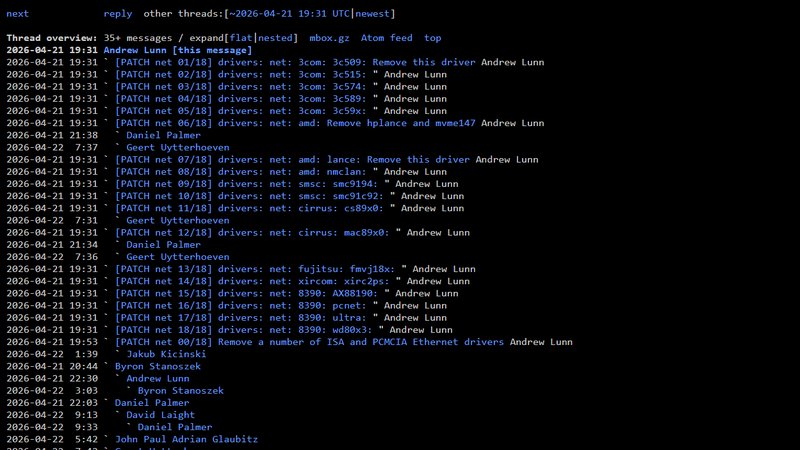
The decision to eliminate support for such dated hardware is not isolated. Already with version 7.1, the Linux kernel had begun a cleanup operation, dropping support for the now obsolete i486 CPUs and for various device drivers based on ISA and PCMCIA architectures. These moves reflect a clear strategy: to streamline code, reduce maintenance complexity, and concentrate resources on more current technologies and architectures.
The Context of Modernization and Benefits for Infrastructure
The removal of obsolete drivers is not merely a nostalgic exercise, but an essential practice for the health and efficiency of a modern operating system. Maintaining support for hardware with over four decades of life entails a significant cost in terms of code complexity, potential introduction of bugs and security vulnerabilities, and a general increase in "code bloat." By eliminating these layers of compatibility, developers can dedicate themselves to improving the performance, stability, and security of the kernel for contemporary hardware platforms.
For IT professionals and decision-makers managing complex infrastructures, this trend in the Linux kernel offers important insights. Hardware and software lifecycle management is crucial, especially in on-premise deployment contexts where control and efficiency are priorities. A leaner, more focused kernel means less overhead, greater responsiveness, and a more solid foundation for demanding workloads, such as those related to Large Language Models (LLM) and artificial intelligence.
Implications for TCO and Data Sovereignty
The choice to maintain an updated infrastructure, both at the hardware and software level, has a direct impact on the Total Cost of Ownership (TCO). Although the initial investment in newer hardware may seem greater, the long-term benefits in terms of lower maintenance costs, greater energy efficiency, and superior performance often outweigh the initial burden. An operating system that no longer has to worry about supporting 40-year-old graphics cards can better optimize its resources for modern GPUs, essential for LLM inference and training.
Furthermore, for companies prioritizing data sovereignty and operating in air-gapped environments or with stringent compliance requirements, the stability and security of the underlying operating system are fundamental. A clean and well-maintained kernel reduces the attack surface and facilitates auditing, crucial aspects for ensuring sensitive data remains protected within corporate boundaries. The removal of legacy code contributes to this goal, eliminating potential weak points that may no longer be actively monitored or patched.
Future Prospects: Efficiency and Innovation
The progressive elimination of obsolete hardware components from the Linux kernel is a clear signal of the community's commitment to driving innovation and efficiency. This approach ensures that the operating system remains at the forefront, ready to support emerging technologies and ever-increasing computational needs. For those designing and implementing on-premise AI solutions, choosing an operating system with a modern and optimized kernel is a key factor in maximizing performance and minimizing risks.
In an era where computing power and efficiency are critical parameters for the success of artificial intelligence projects, a "lightweight" and performant operating system like Linux, freed from the weight of the past, offers a robust foundation. This continuous evolution ensures that self-hosted architectures can benefit from the latest optimizations, guaranteeing that investments in dedicated hardware, such as high VRAM GPUs, are utilized to their full potential.






💬 Comments (0)
🔒 Log in or register to comment on articles.
No comments yet. Be the first to comment!