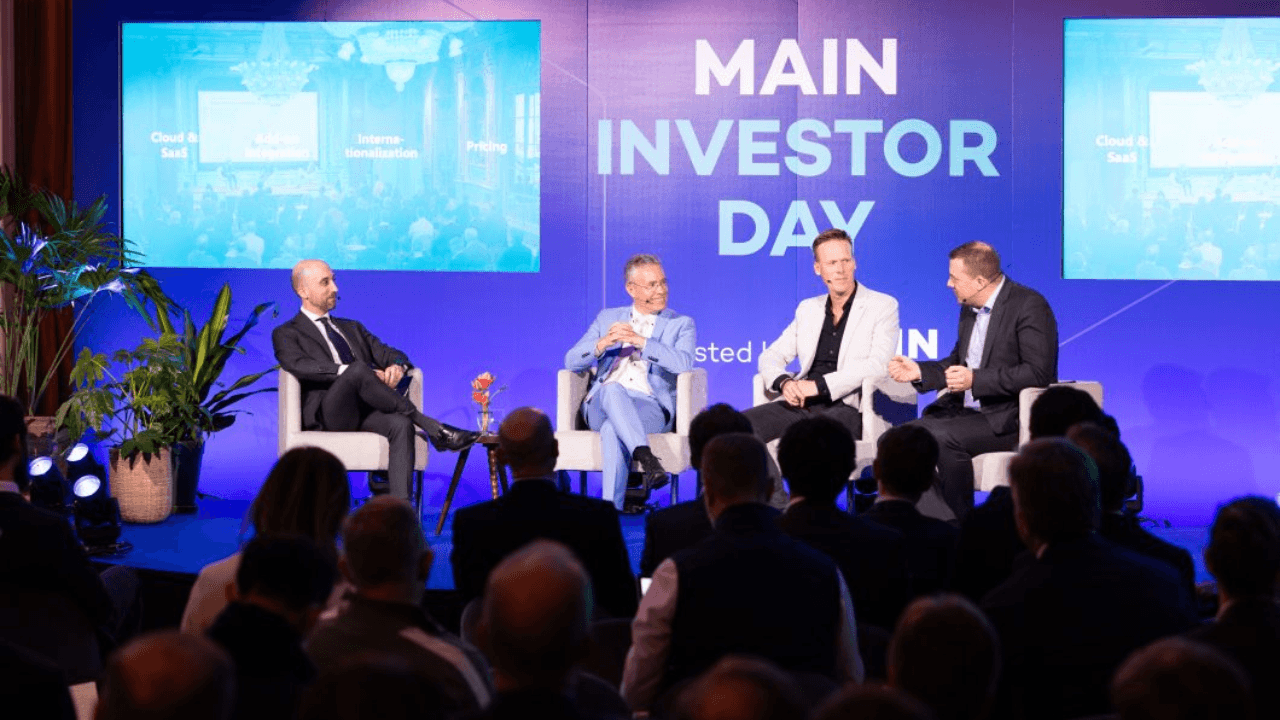
This is not just a fundraising record. When a European enterprise software specialist closes €5.25 billion in commitments – more than double its previous vehicles – the market coordinates shift. Main Capital, headquartered in The Hague, announced the closing of Main Capital IX (€4 billion) and Main Foundation III (€1.25 billion), pushing total assets under management past €12 billion. Existing LPs came back at a re-up rate above 120 percent, while new institutional investors from the United States, Asia, and the Middle East – sovereign wealth funds, public pension funds, insurers – broadened the base. The message: lower mid-market enterprise software is a strategic asset in times of deep transformation.
The fund’s DNA and the AI bet
Main is no generalist. For over two decades it has been buying and building profitable, resilient software companies with equity tickets between €5 and €150 million, turning them into cross-border groups through organic growth and targeted M&A. Sectors span healthtech, govtech, infrastructure, and proptech. Now the firm aims to ride the AI wave. The idea, in founder and CIO Charly Zwemstra’s words, is that AI is “unlocking a new wave of growth and value creation.” The thesis isn’t abstract: AI is reshaping how software is built, sold, and scaled, and for European lower mid-market companies that can mean an immediate competitive edge – provided they can integrate models and data in often regulated environments.
Deployment you cannot delegate
Here lies the crux for anyone tracking the on-premise evolution of Large Language Models. Much European enterprise software serves sectors – healthcare, public administration, critical infrastructure – where data sovereignty and compliance (GDPR and sectoral rules) make it impractical or risky to rely solely on third-party cloud services. The ability to run inference locally, on self-hosted hardware without moving data, becomes a prerequisite. The influx of capital into companies operating in these areas could accelerate the development of vertical solutions that include models optimized for on-premise, aggressive quantization to reduce VRAM consumption, and pipelines that run entirely behind the corporate firewall.
The numbers behind the strategy
Main Capital boasts 38 exits with a weighted-average gross return of 4.7x and a loss rate well below 0.5 percent. With roughly 100 staff across The Hague, Düsseldorf, Stockholm, Antwerp, Paris, and an affiliate in Boston, the fund announced it will actively pursue platform investments in the United Kingdom with the new vehicles. The geographic expansion, together with the AI focus, paints a future where portfolio software companies can integrate ever more powerful language models, but must do so within architectures that balance performance, cost, and control. For those evaluating on-premise deployment, well-known trade-offs exist: higher upfront CapEx versus lower long-term OpEx, the need for in-house hardware management skills, but full data sovereignty and reduced latency. Accelerated investment could make pre-integrated solutions more accessible, lowering barriers for mid-sized enterprises.
A warming ecosystem
The closing of a fund this size is not merely a financial headline. It signals where resources – and, by extension, innovation – are heading. If capital flows into enterprise software that must also function in air-gapped or hybrid environments, demand is set to grow for on-premise LLM serving frameworks, inference-optimized hardware, and fine-tuning tools for constrained settings. It is no coincidence that many new investors come from regions where strict regulation and technological ambition push toward local-first architectures. For IT decision-makers, the takeaway is clear: AI in core processes will not just be about models, but about owned and governed infrastructure. With this capital injection, the enterprise software market is gearing up to supply an increasing number of pieces to that puzzle.






💬 Comments (0)
🔒 Log in or register to comment on articles.
No comments yet. Be the first to comment!