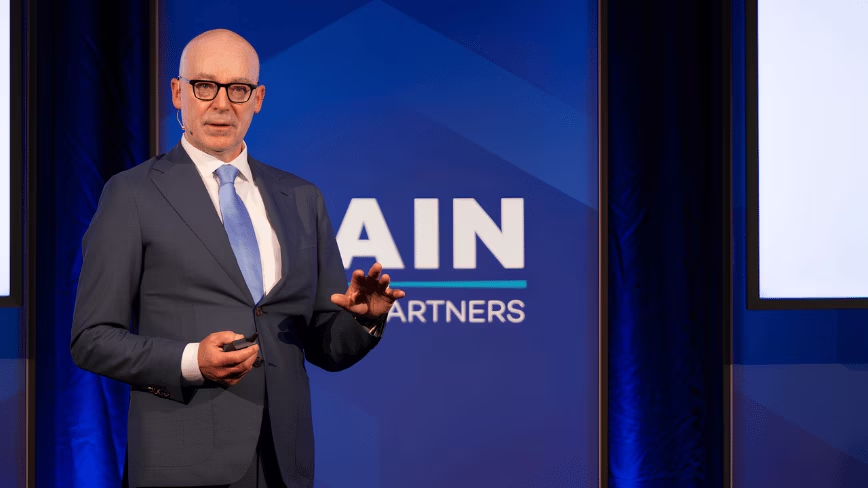
As public markets panic that AI will gut enterprise software, a Dutch firm just raised €5.25 billion betting on the exact opposite. Main Capital, led by Charly Zwemstra, closed the largest fund in the Netherlands’ history with a pitch that sounds almost heretical in 2025: the real value for the next decade lies in boring software — hospital appointment systems, municipal tax platforms, and other unglamorous but essential tools.
The record fund and Zwemstra’s lesson
Zwemstra has spent 23 years acquiring software companies that build decidedly unexciting products. Hospital scheduling systems, local tax management platforms, internal logistics applications: these are not tech magazine cover stories, but they keep both public and private administration running. With this new vehicle, Main Capital aims to scale the same recipe at a time when global venture capital is obsessed with generative AI. The bet is clear: essential software infrastructure will not vanish; if anything, it will become more valuable as digitalization advances, regardless of fleeting trends.
Why boring software resists the hype
The term 'boring software' is not a criticism but an acknowledgment of its nature: vertical, deeply integrated solutions with long lifecycles and prohibitive switching costs. A medical records system or a tax collection platform cannot be swapped out like a messaging app. It is often embedded in on-premise environments for compliance, latency, or data sovereignty reasons, and it enjoys multi-year contracts with extremely high renewal rates. While AI promises to automate workflows, the operational reality of a hospital or a municipality is made of legacy integrations, strict regulations, and users who seek reliability, not disruption. That is the competitive moat that no chatbot can erode in a few months.
The AI-RADAR perspective: those evaluating on-premise deployment already know
For anyone involved in deployment strategy, this news is more than a financial curiosity. AI-RADAR, focused on local stack analysis and make-or-buy decisions, notes how the emphasis on essential software aligns with a growing demand for control and predictability. Large language models run on cloud infrastructure, but the systems that manage sensitive data — from medical reports to tax archives — remain largely self-hosted, behind firewalls, away from third parties. Main Capital’s fund implicitly recognizes that value does not lie solely in disruptive innovation, but also in the ability to offer stability, compliance, and predictable TCO. On this, AI-RADAR’s resources on on-premise deployment help evaluate trade-offs that generalist vendors often overlook.
Beyond opposition: AI and boring software can coexist
AI’s rise is not necessarily a threat to such applications. On the contrary, a hospital scheduling system could integrate language processing models to optimize appointments or analyze patient sentiment. But it would likely do so while keeping the core on-premise, adding local inference capacity with enterprise GPUs or optimized CPUs. The real contest is not between AI and traditional software, but between reckless cloud adoption and an architectural approach that puts operational sovereignty at the center. Main Capital appears to be betting that the latter scenario is undervalued, and the market may prove it right.







💬 Comments (0)
🔒 Log in or register to comment on articles.
No comments yet. Be the first to comment!