Son's statement and Musk's orbital vision
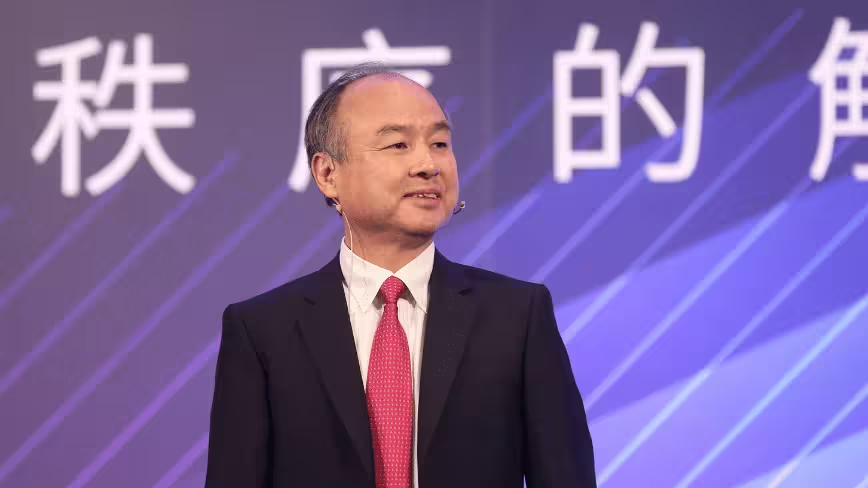
On June 23, 2026, at SoftBank's shareholders meeting, Masayoshi Son bluntly dismissed the idea of building data centers in space. The founder of the Japanese giant, known for bold AI bets, said he sees little merit in the approach championed by Elon Musk and predicted that the AI race will be won by keeping compute power firmly on the ground.
This isn't just a disagreement between two tech visionaries; it highlights a strategic fault line over where tomorrow's models should run. While Musk, through SpaceX and Starlink, pushes for a distributed infrastructure that includes orbital nodes, Son bets on terra firma — and, implicitly, on traditional data centers, regional clouds, and on-premise architectures.
Why space falls short: latency, energy, and cooling
Orbital data centers hold sci-fi appeal but collide with hard physical constraints. Communication latency to low-Earth orbit (LEO) satellites sits around 10–30 milliseconds per hop — acceptable for many applications but penalizing for real-time inference, where every microsecond matters. Moreover, shuttling large data volumes to and from space requires bandwidth that, while growing, remains limited compared to terrestrial fiber backbones.
Then there's the energy question. A space data center would rely on solar panels, with all the challenges of storage and thermal dissipation. On Earth, we can tap into power grids increasingly fed by renewables and rely on proven cooling systems — from free cooling in cold climates to liquid cooling for high-density racks. Moving training and inference workloads to orbit today would lead to prohibitive TCO (Total Cost of Ownership) and operational complexity that is hard to manage.
The sovereignty knot: where data lives
There's an aspect that directly affects those who choose to retain control over their data. AI-RADAR has repeatedly analyzed the factors pushing enterprises and institutions toward on-premise or hybrid deployments rather than cloud-only: GDPR compliance, confidentiality, audit, and broadly, digital sovereignty. In this picture, the hypothesis of orbital data centers — physically located outside any national jurisdiction — raises more questions than answers. Even if technically feasible, they would open a regulatory vacuum that is hard to fill.
Son's stance, therefore, goes beyond a technological judgment: it indirectly reinforces the choice of terrestrial architectures where legal boundaries are known and data can be kept compliant with regulations. For those evaluating on-premise inference on owned hardware, the SoftBank Group's statement offers another argument: investing in in-house racks or colocation appears as a more concrete path with fewer regulatory risks.
Beyond the controversy: the AI race will be won on the ground
Masayoshi Son is not a mere observer. SoftBank has invested heavily in semiconductors and AI platforms — from the Izanagi project to its stake in Arm — and his market reading carries weight. Predicting that the winning compute power will remain on Earth means betting on a supply chain of advanced chips, modular data centers, and ultra-fast networks, elements that already define today's on-premise infrastructure.
Of course, SpaceX continues to test components for harsh environments, and the idea of space edge computing might find niches (for example, scientific missions or remote communications). But for the core AI game — the one made of LLMs, fine-tuning, data pipelines, and at-scale inference — Son's verdict seems aligned with the pragmatic choices of those building digital factories: the next generation of intelligent services will run on servers we can touch, cool, and protect with clear laws.






💬 Comments (0)
🔒 Log in or register to comment on articles.
No comments yet. Be the first to comment!