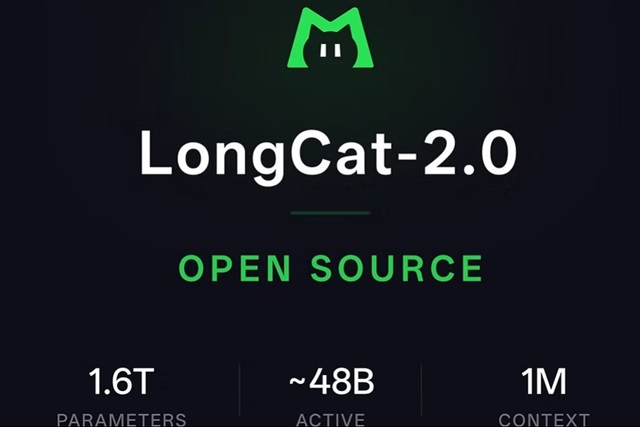
It’s not just another deep learning library on GitHub. When a giant like Meituan – running one of the world’s most complex logistics platforms – decides to open-source a piece of its internal software infrastructure, the signal goes beyond a philanthropic gesture. LongCat-2.0, now public, arrives as China’s domestic AI stack is entering a phase of unprecedented acceleration.
The backdrop is well known: semiconductor export restrictions, targeted sanctions, and a data-control architecture that pushes companies and institutions toward self-hosted solutions. In this scenario, every component released by the Chinese tech galaxy – from training frameworks to inference engines – reshapes a game where technological sovereignty is not rhetoric but operational necessity. LongCat-2.0 slots right there: a tool designed to run AI workloads on hardware controlled directly by the organization, bypassing cloud APIs managed by extra-national entities.
Meituan’s announcement matters because the company is not a pure research lab but an operator handling millions of daily transactions. The technology it chose to open up was molded by real-world demands: high throughput, predictable latency, dynamic resource management. For those evaluating on-premise deployment of LLMs, the rise of such tools provides concrete alternatives to the usual Western frameworks, often optimized for NVIDIA-dominated GPU ecosystems and accessible via cloud subscriptions. Here a different path emerges: integration with local hardware – even not the latest generation –, deep customization, and, crucially, immediate compliance with data residency rules, including China’s GDPR equivalents.
The second-order implications are significant. First, open-sourcing LongCat-2.0 lowers the barrier for mid-sized Chinese enterprises wanting to adopt language models without handing their data to third parties, creating a network effect that feeds the entire domestic ecosystem. Second, it pressures other giants like Baidu, Alibaba, and Tencent to follow suit, accelerating fragmentation or, conversely, an involuntary convergence toward a shared set of building blocks. In the short term, the losers are global cloud providers watching an enterprise market erode as sovereignty concerns rise; the winners are internal IT teams in banks, insurers, and public administrations, who can now build AI pipelines without license constraints or lock-in.
Finally, there’s a structural signal: China is investing not just in raw compute power, but in the entire software stack required to run complex models on proprietary infrastructure. LongCat-2.0 is not a model; it’s a piece of the assembly plan. And in an era where total cost of ownership and physical server control move back to the center of decision-making, having battle-tested open-source bricks that have already run at massive scale can make the difference between strategic dependency and genuine autonomy.






💬 Comments (0)
🔒 Log in or register to comment on articles.
No comments yet. Be the first to comment!