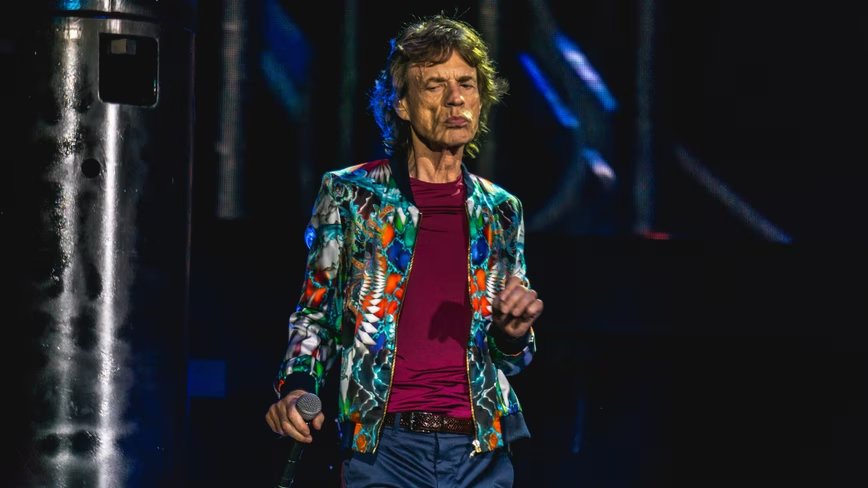
When Mick Jagger speaks, even about technology, the music industry listens. In a recent Billboard interview, the Rolling Stones frontman gave a qualified green light to artificial intelligence in music: “If someone wants to make music by AI, go ahead — but it has to be original.” The punchline is sharp: it must not sound like him. At first glance, it sounds like a rockstar’s protective quip. In reality, it opens a deep crack in the debate over generative models, data control, and creative sovereignty.
Jagger’s request is simple yet technologically treacherous. What does it mean for an AI system to produce something “original”? Audio generative models, like text ones, learn from vast corpora of existing songs. They can synthesize voices, capture styles, even mimic a famous vocalist’s vibrato. Originality, in this context, is not a binary property: every output is a statistical reworking of already-heard patterns. Demanding that a model not sound “like Mick Jagger” essentially means preventing it from reproducing the artist’s specific timbral and rhythmic fingerprint. This requires either the complete exclusion of Jagger’s data from training — no small feat with enormous public datasets — or a post-generation filtering system that checks for similarity to a protected style.
That shifts the discussion from the stage to the data center. Controlling what a generative model outputs requires granular control over the pipeline: what data goes in, how it’s weighted, which outputs are blocked. In a centralized cloud service, this level of transparency is rarely assured. The alternative, increasingly discussed even in enterprise circles, is on-premise execution: models trained and run on owned hardware, where the dataset and inference rules remain under the builder’s oversight. For a musician or a label, a self-hosted model fine-tuned on their own repertoire could generate “original” variations — new melodies, arrangements, even lyrics — without ever crossing into unwanted copying, precisely because the training perimeter is known and bounded. Jagger would then have assurance that AI isn’t stealing his voice, because his voice was never part of the training set.
Of course, reality is more nuanced. State-of-the-art generative models for voice synthesis or music composition are often distributed pre-trained on web-scale data, making it impractical to verify every source. The directive “don’t sound like me” collides with a legal void: in many jurisdictions, style isn’t covered by copyright, and algorithmic imitation remains a gray area. Yet Jagger’s stance signals a growing discomfort among creators: it’s not a Luddite reflex, but a demand for a principle of control over artistic identity in the AI era. And this demand finds a technical ally in on-premise deployments, which give organizations — and potentially recording studios — the lever to define what truly counts as “original.”
In the end, Jagger’s remark is more than a stylistic proviso: it’s a symptom of a structural tension that runs through the entire generative AI landscape. As long as models remain opaque and centralized, the promise of originality will be a gamble. The way out likely lies in a distributed, verifiable architecture where data and inference stay under the control of those with a direct stake in protecting them. For artists, labels, and, more broadly, any organization handling proprietary content, the message is clear: originality isn’t just an algorithmic matter — it’s about who holds the server keys.








💬 Comments (0)
🔒 Log in or register to comment on articles.
No comments yet. Be the first to comment!