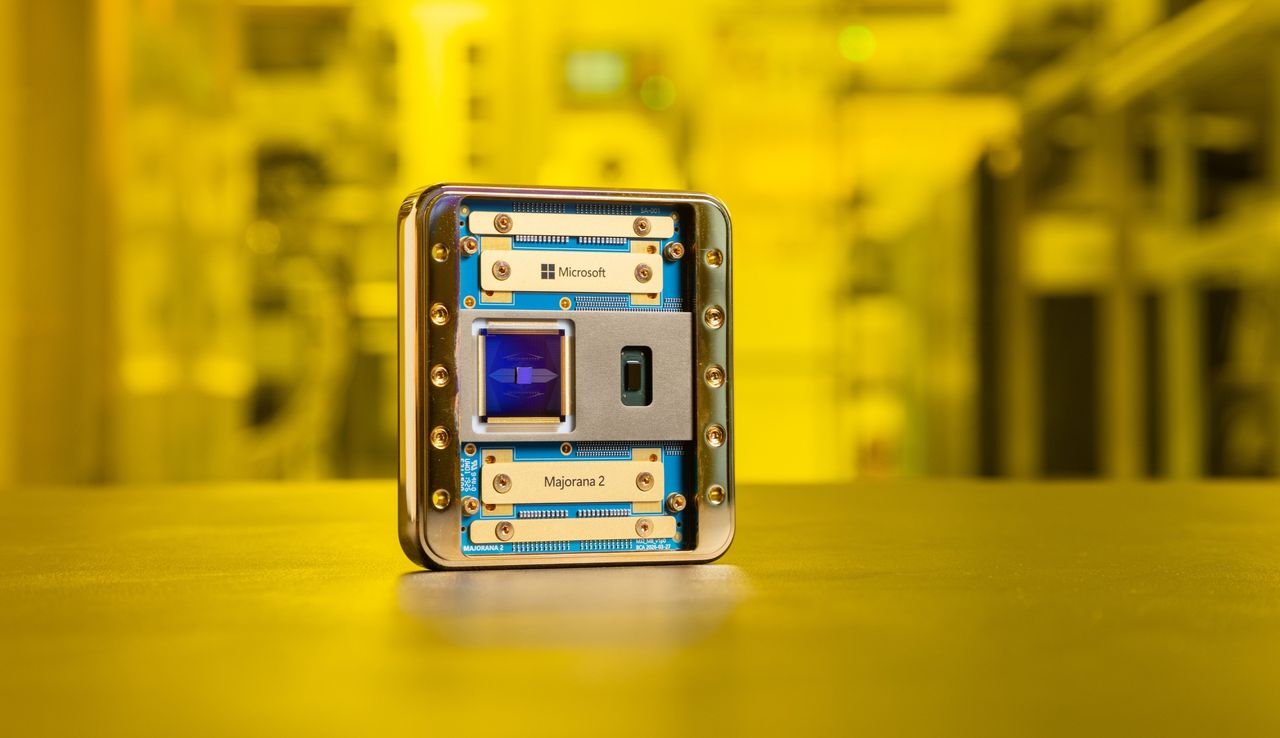
Microsoft Unveils Majorana 2: The Quantum Computing Race Intensifies
Microsoft has announced the development of Majorana 2, a new chip poised to advance the field of quantum computing. The company has set an ambitious target to make a "practical" quantum machine available by 2029. This announcement highlights the increasing commitment from tech giants to push beyond the limits of classical computation, exploring entirely new paradigms to tackle complex problems.
Quantum computing represents a frontier in information technology that promises to solve calculations currently impossible even for the most powerful supercomputers. The ability to manipulate quantum states such as superposition and entanglement opens up unprecedented scenarios for sectors ranging from medicine to materials science, and from cryptography to logistical optimization, promising a generational leap in processing capabilities.
The Technological Core: Majorana 2 and the Vision of a Quantum Future
At the heart of Microsoft's announcement is the Majorana 2 chip. While specific technical details of the chip have not been disclosed at this initial stage, the name "Majorana" refers to Majorana fermions, hypothetical particles that are their own antiparticles. In the context of quantum computing, Majorana fermions are considered promising candidates for building topological qubits, which would offer greater stability and resistance to decoherence compared to other types of qubits. This stability is crucial for overcoming one of the biggest obstacles to developing reliable and scalable quantum computers.
Microsoft's vision of a "practical machine" by 2029 suggests a system not only capable of performing quantum calculations but also robust and accessible enough for real-world applications. This implies significant progress not only at the hardware level but also in the development of software, algorithms, and interfaces that can translate quantum potential into concrete solutions for industry and research, overcoming the current limitations of NISQ (Noisy Intermediate-Scale Quantum) systems.
Long-Term Implications for Computing Infrastructure
Advances in quantum computing, exemplified by initiatives like Majorana 2, open a long-term perspective for the evolution of computing infrastructure. Although quantum machines will not replace classical systems for most current workloads, including those of LLMs, they could become essential specialized components for solving specific problems that require exponentially higher processing capabilities. Their integration might occur in hybrid environments, where quantum computing complements classical computation.
For CTOs, DevOps leads, and infrastructure architects, monitoring these developments is crucial for anticipating future needs. Even if an on-premise deployment of a complete quantum computer is still a distant and highly specialized hypothesis, understanding these emerging technologies is vital for strategic planning. Data sovereignty and hardware control will remain guiding principles, even in such advanced computing scenarios, pushing towards the evaluation of solutions that ensure maximum operational autonomy and security.
The Challenge of Quantum Computing and the AI-RADAR Perspective
Developing a fault-tolerant and scalable quantum computer is one of the most complex engineering challenges of our time. Issues such as qubit decoherence, the need for extreme cryogenic temperatures, and the complexity of error correction systems require massive investments in research and development. Microsoft's announcement with Majorana 2 highlights the competitiveness in this sector and the diversity of technological approaches, with companies exploring various qubit architectures, from superconductors to trapped ions, and topological qubits.
For the AI-RADAR community, focused on on-premise LLMs and local stacks, quantum computing represents a long-term vision of what the future of computation might hold. While current attention is directed towards optimizing LLM inference and training on classical hardware (GPUs, CPUs, NPUs), the evolution of quantum computing suggests that the most extreme computing demands might one day require radically different architectures. Evaluating TCO and data sovereignty will remain crucial, regardless of the nature of the silicon or the complexity of the underlying infrastructure.





💬 Comments (0)
🔒 Log in or register to comment on articles.
No comments yet. Be the first to comment!