
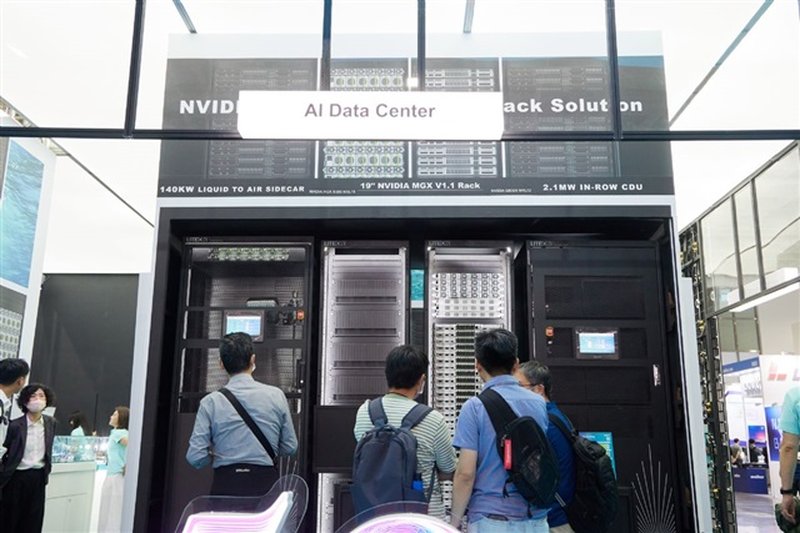
MSScorps’ latest investment in Taiwan is more than a supply chain move: it speaks directly to the future of facilities hosting the most demanding AI workloads. The company is once again expanding its footprint in silicon photonics, a technology poised to reshape how compute nodes communicate inside a data center — especially those run on-premise.
Photons instead of electrons: interconnect architecture
The race toward ever-larger models has drawn attention to GPUs, VRAM, and token throughput. Yet one link is often overlooked: the fabric connecting accelerators, memory, and storage. Traditional electrical interconnects are hitting physical limits when scaling to clusters with hundreds or thousands of GPUs. Silicon photonics uses light pulses to move data, slashing latency and power consumption while boosting bandwidth dramatically. It’s not a new idea, but the ramp-up in mass-production investments signals a shift from the lab to real infrastructure adoption.
By deepening its commitment in Taiwan — home to a mature semiconductor and advanced packaging ecosystem — MSScorps aims to integrate optical transmission directly on chips or processor packages, eliminating external electro-optical converters. For AI workloads, this translates into a drastic reduction in time wasted transferring data among GPUs, memory, and networking, a critical concern both in distributed training and in inference scenarios where latency must be rock-bottom.
What it means for those keeping AI workloads on-prem
Decision-makers evaluating on-prem architectures for LLMs, driven by data sovereignty or operational control, are familiar with the trade-off: managing specialized hardware demands expertise, while leaning on a public cloud brings variable costs and compliance constraints. In this picture, optical interconnects are not just a performance upgrade — they can alter compute density and TCO. Linking hundreds of accelerators without bandwidth degradation enables more compact, efficiently cooled systems, potentially within reach of organizations that lack the budget for limitless cloud infrastructure.
We aren’t talking about a component you can buy tomorrow and deploy next week: silicon photonics is in the industrialization phase. But the direction is set, and investments like MSScorps’ suggest that the roadmaps of leading data-center hardware suppliers — including white-box server makers used in self-hosted deployments — will embed this technology within a few refresh cycles. It’s a factor to weigh when planning cluster purchases with a horizon beyond two years.
Beyond brute power: an ecosystem in motion
The story isn’t only about MSScorps. Taiwan is already the epicenter of advanced chip production, and expanding silicon photonics capacity will attract other players along the value chain. For the on-prem world, this means the supply of optical components is likely to diversify and come down in price, lowering one barrier to non-electrical interconnects. Non-trivial engineering challenges remain — fiber alignment, thermal packaging, communication standards — but the signals are clear.
At AI-RADAR we track these dynamics because they directly influence design choices for local clusters. Without venturing into recommendations, it is worth recalling that every hardware decision isn’t just about a spec sheet, but about how components cooperate under real load. When interconnects become the bottleneck, even the fastest accelerator scales poorly. Silicon photonics promises to push that boundary further out, and current investments will determine how soon we can grasp that leap.





💬 Comments (0)
🔒 Log in or register to comment on articles.
No comments yet. Be the first to comment!