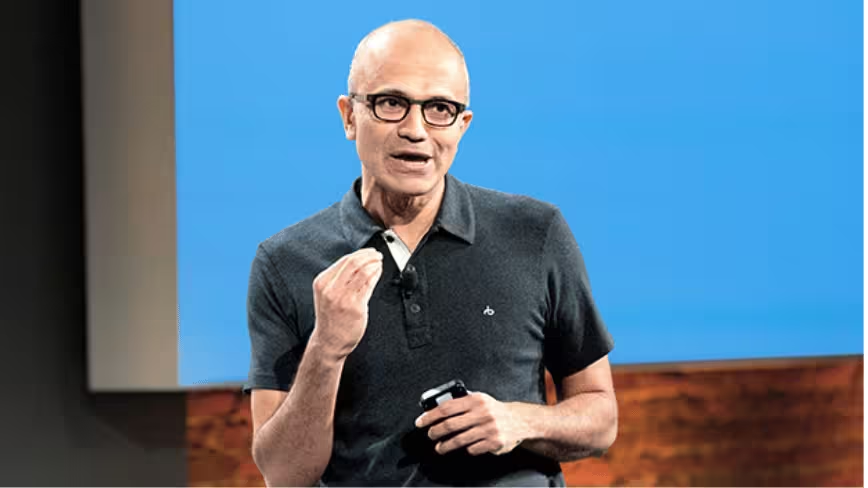
Satya Nadella lit the fuse of the artificial intelligence boom. Now, in an interview that leaves no room for ambiguity, he turns to the very giants he helped build. The message is blunt: you cannot keep promising mass job losses while simultaneously demanding free rein to build whatever you want.
The stance and Microsoft’s shift
This statement marks a turning point in the public debate. As big tech pushes for ever-faster adoption of LLMs, Microsoft’s CEO dismantles the victim narrative that innovation makes job losses inevitable. The company’s practical response is a three-pillar strategy: cheaper models, greater customer control, and a renewed commitment to trust. No specific hardware is mentioned, but the subtext for anyone watching the inference market is clear: cutting costs and giving sovereignty back to users means steering architectures that can also run far from hyperscale data centers.
Low-cost models and the on-premise path
The emphasis on “cheaper models” goes beyond pricing. For real workloads, slashing cost per token often requires aggressive quantization (FP16 → INT8 or lower) and running inference directly on enterprise hardware. That’s where self-hosted deployment becomes the natural ally: a server equipped with GPUs offering sufficient VRAM can serve an LLM optimized for the business domain, without depending on external cloud APIs. Fine-tuning on proprietary data keeps know-how inside the corporate perimeter, eliminating exposure to third-party providers.
The scenario collides with a familiar reality: hardware acquisition costs (CapEx) can be high, and managing bare-metal inference pipelines demands substantial orchestration skills. Yet, the long-term Total Cost of Ownership, especially at high volumes, often flips the comparison against cloud consumption pricing. This is why more organizations are evaluating serving frameworks that scale inference across on-premise Kubernetes clusters, balancing latency and throughput.
Control and trust: two sides of sovereignty
The “trust” Nadella invokes is a slippery concept when the counterpart is a vendor running the entire stack. Those seeking real control don’t settle for service-level agreements; they bring the model home. On-premise is not just an answer to GDPR compliance or data residency demands; it’s the lever to design data flows where training data never leaves the company perimeter. In this light, “cheaper models” also mean smaller, edge-deployable ones, capable of operating air-gapped. The promise of control materializes when the IT department can decide which LLM version to serve, how to manage model versioning, and when to update checkpoints — all without depending on an external vendor’s roadmap.
Outlook: beyond reassurances, towards autonomy
Nadella’s words sound more like an alarm bell than a defensive move. They signal that the generative AI race is entering a maturity phase where cost, predictability, and governance matter at least as much as raw performance. For those evaluating production adoption, the lesson is twofold: on the one hand, on-premise inference hardware keeps getting cheaper, and compact-model ecosystems are flourishing; on the other, trust is not bought — it is built through architectural independence. AI-RADAR will track this evolution, offering analytical frameworks for navigating on-premise deployment trade-offs. Because, in the end, the final word belongs to whoever controls their own bits.




💬 Comments (0)
🔒 Log in or register to comment on articles.
No comments yet. Be the first to comment!