A Historic Milestone in Space Exploration
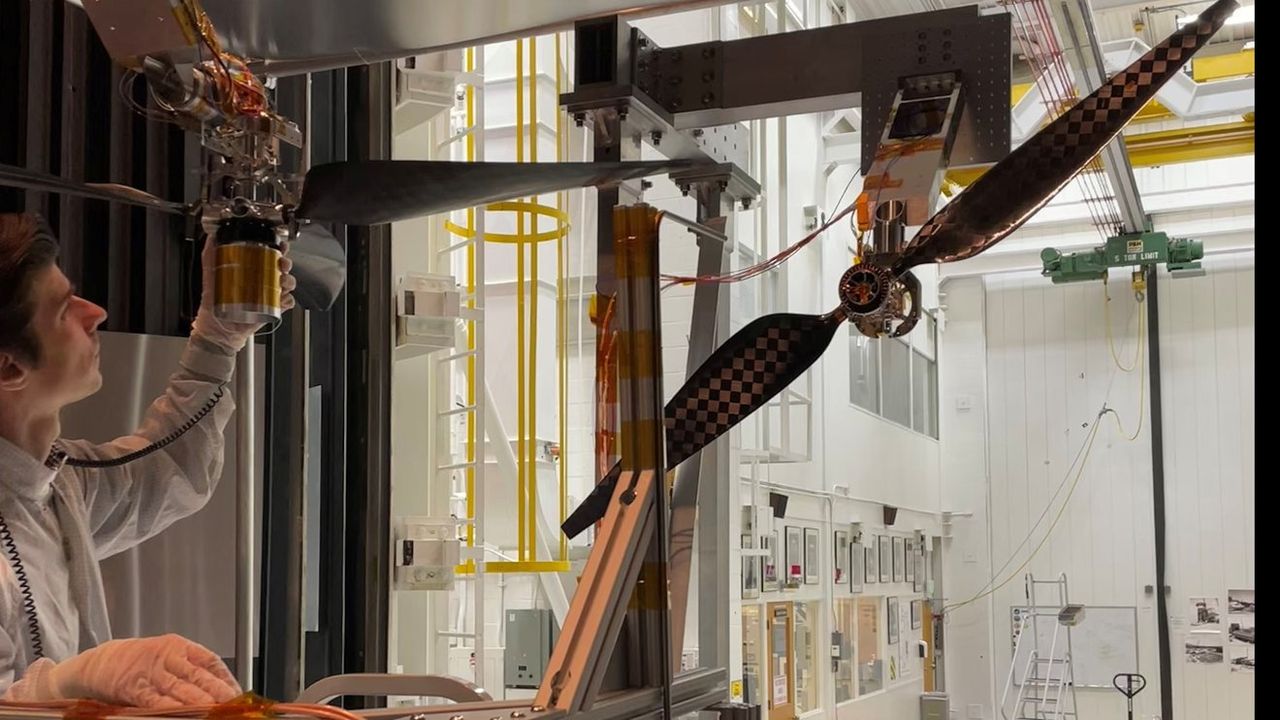
NASA has announced an unprecedented engineering achievement: for the first time, the rotors of a helicopter designed for Mars exploration have exceeded the speed of sound. This success represents a significant step forward in developing new capabilities for future missions to the Red Planet. The next-generation aircraft, named "SkyFall," is at the heart of this innovation.
Tests conducted have shown that "SkyFall"'s rotors are capable of reaching a speed of 3,750 RPM, a remarkable value that is ten times faster than the typical operating speed of conventional helicopters used on Earth. Such performance is crucial for operating in Mars's thin atmosphere, where lift is drastically reduced compared to Earth's.
Engineering Challenges and the Parallel with AI Hardware
Pushing rotors past the speed of sound in an alien environment like Mars presents extreme engineering challenges. Mars's atmospheric density, approximately 1% of Earth's, requires rotors to move at very high speeds to generate the necessary lift. This involves issues of structural resistance, aerodynamic efficiency, and vibration control, demanding advanced materials and innovative designs.
Similarly, in the field of artificial intelligence, the pursuit of extreme performance for Large Language Models (LLM) in self-hosted or air-gapped environments presents comparable challenges. Optimizing hardware for inference and fine-tuning requires careful evaluation of factors such as available VRAM, throughput, latency, and power consumption. Deploying LLMs on-premise means addressing space, cooling, and power supply constraints, similar to the limitations imposed by a space mission.
Hardware Innovation: A Critical Factor for Every Frontier
NASA's success with "SkyFall" highlights how hardware innovation is a fundamental enabler for overcoming technological limits, both in space exploration and in other computationally intensive sectors. The ability to design and deploy systems that operate at the edge of their specifications is essential for achieving ambitious goals. This principle applies directly to the deployment of AI infrastructure.
For companies evaluating on-premise AI solutions, the choice of silicon and hardware architecture is crucial to ensure data sovereignty, compliance, and optimized TCO. Understanding the trade-offs between performance, cost, and management complexity is vital. AI-RADAR offers analytical frameworks on /llm-onpremise to support these decisions, providing tools to evaluate different deployment options and their respective constraints.
Future Prospects: From Space to Enterprise AI
This NASA milestone not only paves the way for more ambitious future Mars missions but also serves as an inspiration for engineering in general. It demonstrates that, with targeted research and development, it is possible to overcome obstacles that once seemed insurmountable. The continuous evolution of hardware, for both space applications and AI workloads, is a key driver of technological progress.
In the context of enterprise AI, the commitment to hardware innovation translates into the search for increasingly efficient and powerful solutions for LLM inference and training. Infrastructure decisions, balancing performance, scalability, and control, will remain central to the technological strategies for anyone intending to fully leverage the potential of artificial intelligence in controlled and secure environments.






💬 Comments (0)
🔒 Log in or register to comment on articles.
No comments yet. Be the first to comment!