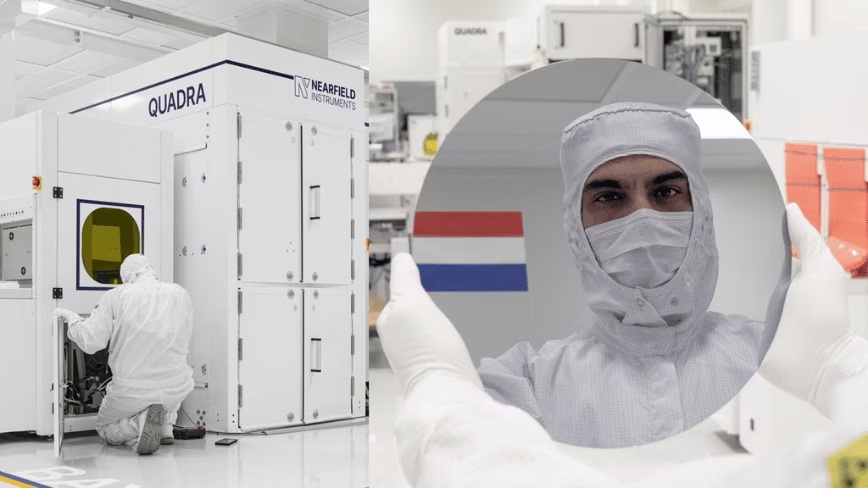
The semiconductor world has a new protagonist in the AI race, and it doesn’t make chips. Nearfield Instruments, a Rotterdam-based company, has raised $380 million at a $1.6 billion valuation, marking a record for Dutch deep-tech. The investors include institutional players and, notably, sovereign wealth funds.
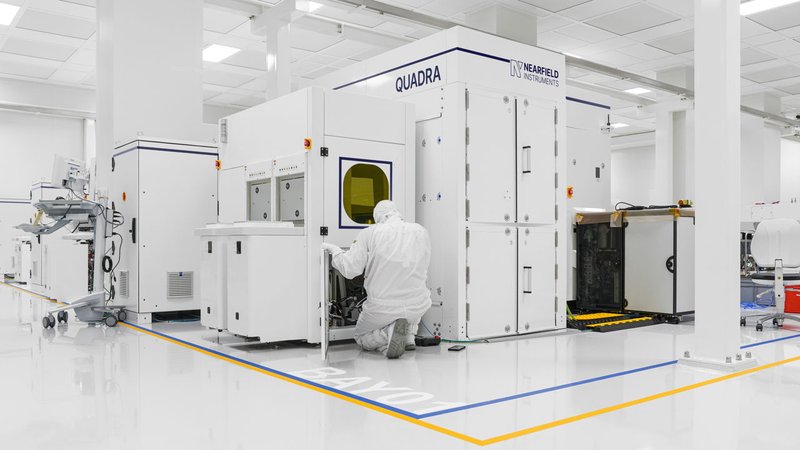
The sum is huge, but what matters is the purpose: metrology tools that inspect chips at the atomic scale. While Nvidia designs GPUs, TSMC manufactures them, and ASML provides lithography machines, Nearfield Instruments checks that every transistor is aligned with sub-nanometer precision. In an industry where a single defect can ruin a multi-million-dollar wafer, this capability is not optional — it’s the precondition for producing chips at 3, 2 nanometers and beyond.
Why atomic inspection isn’t just a fab concern
When talking about LLM infrastructure, the mind goes straight to GPUs, VRAM, bandwidth, and TCO. But the quality of the starting silicon directly affects the reliability and longevity of the hardware that powers on-premises deployments. A chip with latent defects can degrade inference performance, cause silent errors during fine-tuning, or shrink the usable context window in production. Nearfield Instruments sells chip manufacturers — the big names that fill enterprise data center racks — the guarantee that each die meets specifications.
For those running AI workloads away from the cloud, the stakes are high. On-premises hardware is chosen carefully, often with long lifecycles and without the elastic redundancy of the cloud. A server with eight GPUs bought for inference must perform without surprises for years. Technologies like Nearfield’s, which detect anomalies at the atomic level during manufacturing, reduce the risk of early failures and boost the yield of advanced nodes. It’s no coincidence that sovereign funds — often instruments of industrial policy — have paid close attention to this deal.
The thread of technological sovereignty
The sovereign funds’ interest isn’t just financial. Countries seeking to reduce dependency on foreign supply chains for AI are investing upstream in the capacity to fabricate and control semiconductors. It’s the same principle that drives enterprises to bring models on-premises: data sovereignty, infrastructure control, geopolitical resilience. If tomorrow an export restriction prevented TSMC or Samsung from delivering AI accelerators to certain customers, having local production lines with high quality would become a lever of autonomy. Nearfield Instruments, in this scenario, is a trusted supplier for anyone aiming to build advanced chips.
For those tracking the evolution of private AI stacks, this round signals that the battle for hardware control is also fought in metrology labs. You can’t simply order GPUs; you need assurance that the fab can produce them with the precision required by next-generation nodes. And that, today, demands atomic-scale inspection tools.
A lens on local deployment
AI-RADAR focuses on practical decisions: does on-premises inference make sense? Which models run on consumer hardware? How much VRAM is enough? Behind these questions lies a physical reality of silicon, lithography, and quality control. The Dutch news may seem distant from the racks of an Italian company, but it isn’t. When selecting a GPU server vendor, you’re betting on the silicon producer’s ability to deliver defect-free components. A round of this size, with these participants, suggests that the next chip generation will be even more complex and that inspection tools will become either a bottleneck or an enabler for the entire supply chain.
For professionals evaluating on-premises deployments, known trade-offs exist between upfront cost, power consumption, and performance. Yet few consider the defect rate of the manufacturing node as a variable. With increasing densities and shrinking geometries, the probability of defects rises, and with it the importance of companies like Nearfield Instruments. While the world watches Nvidia and ASML, it’s in the atomic details that the quality of the AI running in our data centers is determined.






💬 Comments (0)
🔒 Log in or register to comment on articles.
No comments yet. Be the first to comment!