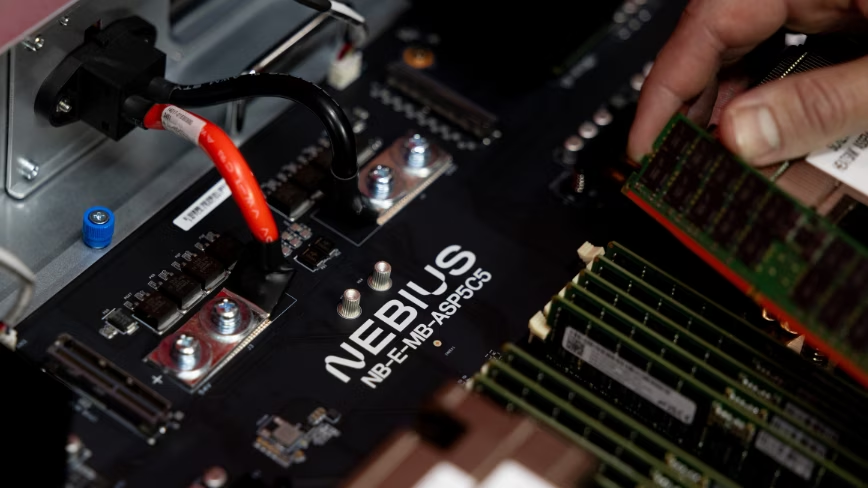
Nebius has just shown that GPUs are no longer just accelerators for neural networks; they are now financial assets. The company raised $775 million through its first secured debt facility, pledging its deployed GPU infrastructure and the cash flows from a contract with an investment-grade customer. This marks a milestone in how the market values AI chips.
The loan, maturing on October 31, 2030, was priced at SOFR + 2.50%, translating to roughly 6.8% at current rates. While not cheap debt, the rate reflects moderate risk, cushioned by the quality of the client and the fact that the contractual cash flows alone cover more than 100% of the facility. In effect, the lender has an almost fully hedged position.
But the most disruptive detail lies elsewhere: Nebius says it has an additional $40 billion in contracts that could be securitised in the future. That figure dwarfs the initial round and puts the company on a financial scale reminiscent of traditional infrastructure giants.
AI hardware becomes an asset class
For years we have talked about GPUs as a safe haven in a digital gold rush, but Nebius has turned that metaphor into accounting reality. Securing a loan backed by hardware and service contracts means the financial world now views AI training and inference facilities as comparable to real estate, pipelines, or power plants. This shift carries deep implications.
First, it lowers the cost of capital for hyperscalers and AI cloud providers, who can expand faster by borrowing against their installed capacity. This will widen the gap between those who can access this financing and those who cannot — typically companies seeking on-premise deployments for data sovereignty or direct control, but lacking the scale to offer comparable collateral.
Second, if the securitisation of GPU contracts becomes systemic, the AI cloud market risks dangerous inflation. Consider what could happen if demand for AI computing were to shrink, or if a new generation of chips rendered the debt-financed clusters obsolete overnight. GPUs age quickly, and the collateral value could evaporate faster than the loan can be repaid. So far, however, lenders appear to be betting on steady growth and ever-expanding demand.
A third-order consequence, less immediate but no less important: the availability of large-scale, asset-backed financing could accelerate industry consolidation into a handful of major players able to absorb heavy debt and sign contracts with clients solid enough to satisfy credit committees. For European organisations, often oriented toward self-hosted or hybrid solutions to comply with GDPR, it becomes even more critical to develop alternative financing models — perhaps through consortia or publicly backed instruments — to avoid being shut out of access to cutting-edge computational resources.
The Nebius deal is not just a financial milestone; it’s a thermometer for the maturation of the AI sector. GPUs are now recognized collateral, and that will attract capital that in turn will amplify production capacity and service offerings. But as always when credit embraces a sizzling technology, the line between momentum and bubble becomes thin. And the $40 billion figure waiting to be securitised is there to remind us.






💬 Comments (0)
🔒 Log in or register to comment on articles.
No comments yet. Be the first to comment!