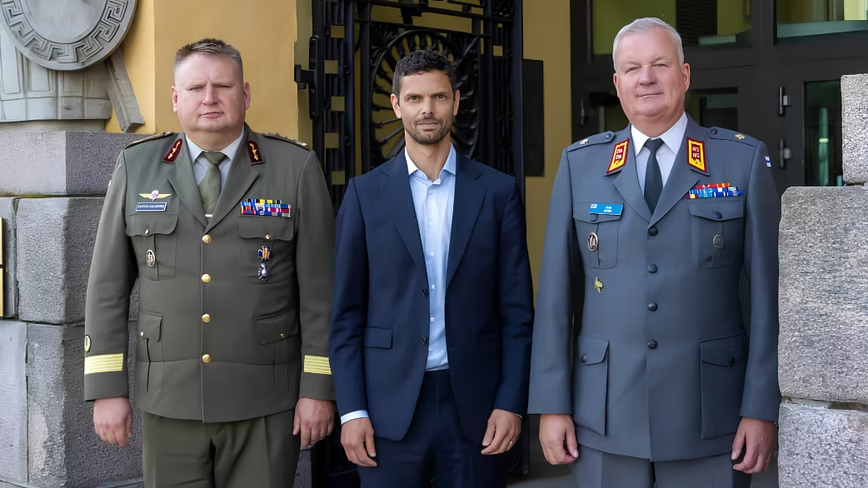
On the last day of June, officials from Finland’s Ministry of Defence, the Estonian Defence Forces, and a Helsinki AI lab barely a year old sat down not for a briefing, but to write battlefield software together. NestAI, funded by Nokia and the Finnish state, has risen so fast that its story overshadows any corporate roadmap: Europe is building an entirely sovereign military AI layer, where control trumps every performance metric.
The news, reported in advance, is conspicuously bare of technical detail—no benchmarks, no hardware specs. That absence is telling. In defence, the real stakes aren’t tokens per second or whether your LLM passes the latest reasoning test. They’re about who owns the code, where model weights execute, who holds the kill switch. NestAI embodies a principle reshaping the continent’s tech investments: AI for sensitive use cases must live in on-premise, isolated, often air-gapped environments, unreachable by any cloud API.
The short circuit between performance and control
For enterprise operators, the tension between model capability and data sovereignty isn't new. The military context makes it absolute. This isn't about GDPR or data residency; it's about operational doctrines, weapon systems, intelligence. Every bit that leaves the perimeter is an existential risk. The result is a phantom market growing in silence: fine-tuning of open-source LLMs in hardened vaults, aggressive quantization to squeeze models onto rugged hardware, inference pipelines optimised for minimal latency without ever touching an external data centre.
This landscape rewards those who can deliver independent, vertical stacks. NestAI, bearing the dual seal of Nokia and the Finnish government, positions itself exactly there: not a generalist vendor, but a state partner for governments that want to write their own algorithmic future. Estonia’s involvement—a pioneer of digital government—widens the table beyond single national projects, pointing toward regional cooperation that aims at common standards for European military AI, bypassing dependency on non-EU suppliers.
Winners and losers in the new order of defence AI
The structural signal is twofold. On one side, Europe accelerates the fragmentation of the AI market: instead of a single dominant model (or a single cloud), national and supranational supply chains are emerging, each with its own stacks, its own data, its own hardware supply lines—increasingly oriented toward silicon produced locally or at least assembled outside US control. On the other side, the moat widens for big hyperscalers, who find the most lucrative segment—defence—blocked by self-hosting requirements that, by architecture, they cannot meet.
In this reshuffle, the winners are European system integrators, specialised labs like NestAI, and makers of extreme-environment hardware. The losers are cloud-first ecosystems and anyone who built their business on the assumption that remote inference was inescapable. But the ripple effects reach startups too: those building orchestration tools, serving engines, or quantization frameworks for on-premise environments find a growing market, while pure API sellers risk being shut outside the fence.
The Finnish lab is no anomaly. It’s the vanguard of a doctrine that flips the classic hierarchy: first you decide where and how the model runs, then you choose the model. Sovereignty is no longer a compliance checkbox—it’s the founding architectural principle. And while Silicon Valley giants chase ever more fleeting benchmarks, here they write code that will never see an internet connection.








💬 Comments (0)
🔒 Log in or register to comment on articles.
No comments yet. Be the first to comment!