The Impact of CPO Delays on AI Networking
The artificial intelligence sector, particularly that of Large Language Models (LLMs), is characterized by a growing demand for high-performance computing and networking infrastructures. In this context, networking innovation is crucial to support increasingly complex and distributed workloads. Recent market analyses, such as those from DIGITIMES, suggest that potential delays in the full adoption of Co-Packaged Optics (CPO) may not curb the overall demand for AI networking, but rather shift its priorities and adoption timelines for technologies.
This scenario implies that, while awaiting next-generation solutions, organizations will continue to invest in robust network infrastructures to power their AI projects. The need to move massive volumes of data between GPUs and servers, for both training and inference, remains constant, driving the search for performant and scalable solutions, even if not yet based on the most futuristic technologies.
Co-Packaged Optics and AI Requirements
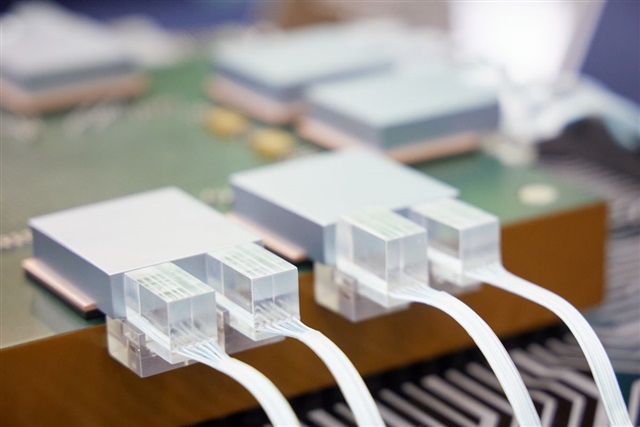
Co-Packaged Optics represents a promising technological frontier for high-speed networking. This technology involves the direct integration of optical components within the same silicon chip package, rather than using external pluggable optical modules. The goal is to significantly reduce the distance between the processor and the optical transceivers, leading to notable advantages in terms of power consumption, bandwidth density, and latency.
For AI workloads, which demand massive throughput and minimal latency for communication between thousands of GPUs in distributed clusters, CPO is seen as a key enabler for the next generation of AI supercomputers. Its ability to handle data flows in the order of terabits per second with greater energy efficiency is fundamental for containing the Total Cost of Ownership (TCO) and the environmental footprint of AI-dedicated data centers.
On-Premise Deployment Strategies and Trade-offs
For companies opting for on-premise or self-hosted LLM deployments, the choice of networking solutions is a critical factor. CPO delays might force CTOs and architects to reconsider their infrastructure roadmaps. Instead of waiting for CPO's full maturity, they might prioritize networking solutions based on the latest generation of pluggable optics, such as 400G or 800G modules, which already offer high performance and are widely available today.
This choice involves a trade-off: on one hand, it allows AI projects to proceed without interruption, ensuring data sovereignty and control over the infrastructure; on the other hand, it could mean a higher TCO in the short term due to increased energy consumption and the need for future upgrades. Strategic planning thus becomes essential to balance immediate needs with long-term prospects, considering the evolution of silicon and interconnections.
Future Outlook and Market Adaptation
Despite potential delays, the growth trajectory of AI networking demand remains unchanged. The industry will adapt, likely with a more gradual adoption of CPO and continuous improvement of existing networking technologies. Hardware vendors and infrastructure teams will need to collaborate to optimize data pipelines and maximize the efficiency of current architectures, pending CPO becoming a mature and widely available solution.
For organizations evaluating on-premise deployments, it is crucial to monitor market evolution and the technical specifications of different solutions. The ability to adapt to rapidly evolving technological scenarios, while maintaining a focus on performance, efficiency, and control, will be a key factor for success in implementing large-scale AI workloads.





💬 Comments (0)
🔒 Log in or register to comment on articles.
No comments yet. Be the first to comment!