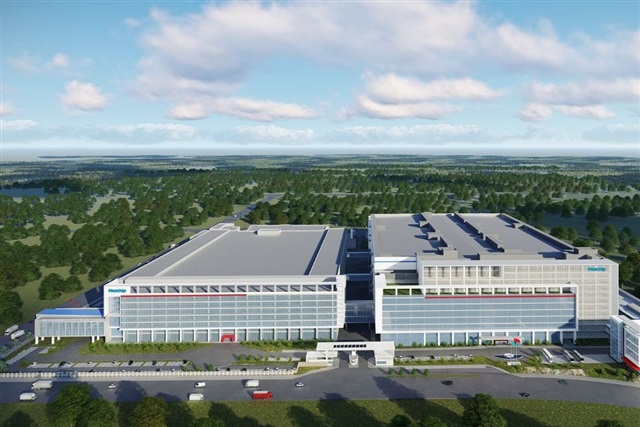
Nexchip's Rise in the Global Foundry Landscape
Nexchip, a key player in the semiconductor foundry sector based in China, has recently solidified its position by entering the global top eight. This achievement underscores a rapidly evolving market dynamic where the demand for artificial intelligence components plays an increasingly central role. The expansion and success of companies like Nexchip are clear indicators of an industry vigorously responding to new technological needs.
The sector's growth has been particularly evident in recent periods, with the overall foundry market recording record numbers. This expansion is directly linked to the exponential increase in AI adoption across various sectors, from research and development to practical implementation in enterprise solutions.
AI Demand and Its Impact on Silicon
Artificial intelligence, particularly Large Language Models (LLMs), demands unprecedented computing power. This translates into a massive requirement for advanced silicon, from specialized GPUs to Application-Specific Integrated Circuit (ASIC) chips designed for Inference and training acceleration. Foundries are at the heart of this ecosystem, responsible for the physical production of these critical components. Their production capacity and ability to innovate in manufacturing processes are decisive factors for the evolution of the entire AI sector.
The surge in demand has put pressure on the global supply chain, prompting foundries to invest in new capacities and technologies. This scenario highlights the strategic importance of having access to robust and diversified semiconductor production, a crucial aspect for companies planning large-scale LLM deployments, whether in the cloud or on-premise.
Implications for On-Premise Deployments and Data Sovereignty
For organizations evaluating the implementation of AI solutions, particularly LLMs, in self-hosted or air-gapped environments, the availability and cost of silicon are primary considerations. The rise of new foundries and the increase in global production capacity can potentially improve access to the hardware needed to build robust and high-performance AI infrastructures. This is particularly relevant for those prioritizing data sovereignty and complete control over their infrastructure.
The choice between an on-premise deployment and cloud-based solutions often comes down to a thorough Total Cost of Ownership (TCO) analysis, which includes not only initial hardware costs but also energy, maintenance, and lifecycle management. A more competitive and diversified silicon supply chain can positively influence the TCO for self-hosted infrastructures, offering greater flexibility and procurement options. AI-RADAR offers analytical frameworks on /llm-onpremise to help evaluate these trade-offs.
Future Prospects and Supply Chain Challenges
The foundry market will continue to be a key barometer for the health and growth of the AI sector. With the continuous evolution of LLMs and the emergence of new applications, the demand for increasingly powerful and efficient silicon will not diminish. This scenario requires companies to carefully evaluate hardware procurement strategies, considering supply chain resilience and the ability to scale their AI infrastructures.
Competition among foundries, as demonstrated by Nexchip's entry into the top eight, can lead to innovations and greater production efficiency. However, challenges related to geopolitics, sustainability, and technological complexity remain significant, requiring constant monitoring by technical decision-makers who must balance performance, costs, and control in their AI deployments.






💬 Comments (0)
🔒 Log in or register to comment on articles.
No comments yet. Be the first to comment!