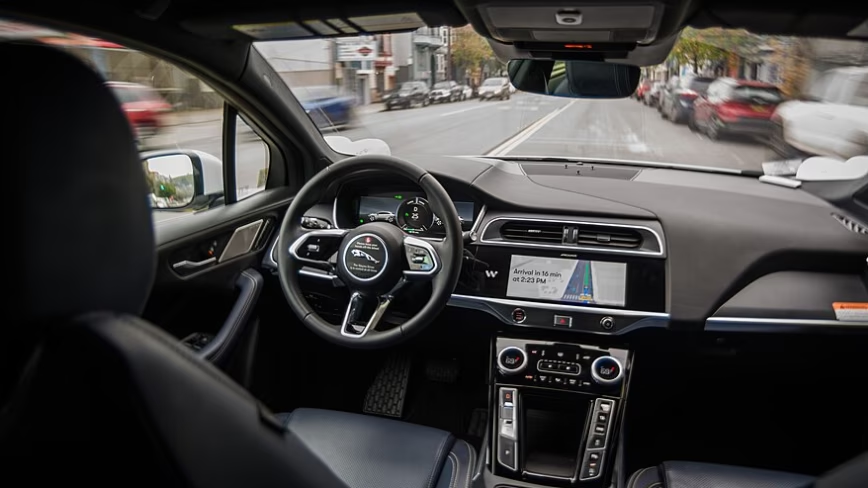
The National Highway Traffic Safety Administration on Wednesday issued a directive ordering autonomous vehicle developers to address what administrator Jonathan Morrison called a “clear pattern” of interference with first responders and law enforcement. Driverless cars have driven into active emergency scenes, blocked ambulances and fire trucks, and failed to recognize flashing lights, flares, smoke, or fire. The deadline for submitting solutions is the end of July.
While the story seems niche, it actually functions as a clinical test of the state of AI inference in the physical world. Autonomous vehicles are extreme edge nodes: they operate in real time, process sensor streams with no tolerable latency, and cannot lean on a cloud for critical decisions. Every missed ambulance is a system bug running on local hardware—often GPUs and embedded accelerators—with computer vision and planning models optimized for edge inference.
The issue flagged by NHTSA is not just a gap in training datasets; it’s a structural flaw in the dominant approach. Emergency scenarios are statistically rare but deadly-serious: smoke, glare, sudden obstacles, hand signals from officers. Teaching a neural network to recognize them demands not only high-quality labeled data but also a level of generalization where current models often stumble. And because inference happens onboard, there is no remote safety net: the car is on its own.
This episode redefines what technological sovereignty means for autonomous systems. It’s not only about privacy or data residency, but about the ability to operate correctly in contexts where failure has immediate consequences. The message for anyone developing on-premise or on-device AI is clear: robustness and reliability at the edge are not optional, and regulators will start measuring them with tougher testing. We are likely to see a rush for more onboard compute power (more VRAM, specialized chips) to run larger models or ensemble networks that cross-check each other, along with training pipelines that incorporate accurate physical simulations of real-world chaos.
Costs will rise. Fleet operators will have to justify investments in more performant hardware and longer testing cycles, shifting TCO away from immediate savings. Yet without these steps, mass adoption will stall. NHTSA’s move, in short, is not just a regulatory scolding: it’s a market signal that rewards whoever can bring on-device AI to a maturity level that is still lacking today.




💬 Comments (0)
🔒 Log in or register to comment on articles.
No comments yet. Be the first to comment!