NVIDIA’s NVentures Invests in Alice & Bob, Strengthening CUDA-Q Ties
Introduction
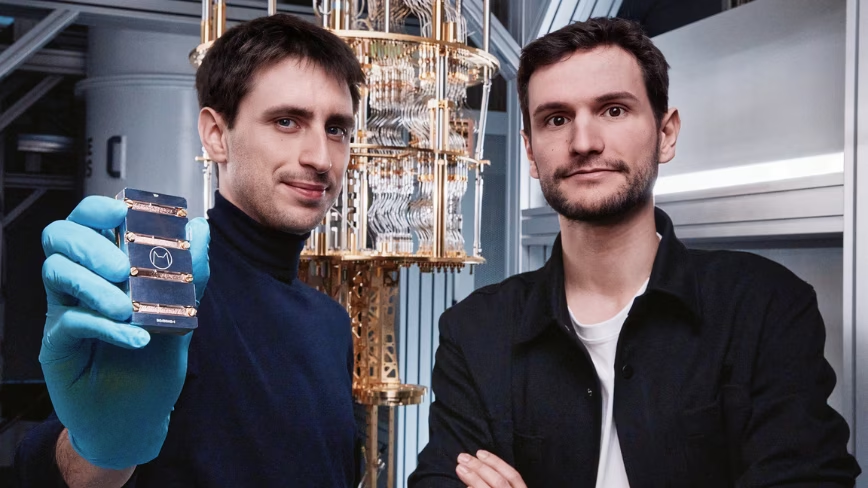
NVentures, NVIDIA’s venture capital arm, has announced a strategic investment in Alice & Bob, a company specializing in quantum hardware. This move not only adds a new player to NVIDIA’s quantum computing portfolio but also solidifies the existing collaboration between the two entities, particularly concerning NVIDIA’s CUDA-Q Framework. Alice & Bob, with offices in Paris and Boston, is recognized for its innovative approach to building fault-tolerant quantum machines.
NVentures' entry into Alice & Bob's capital table joins other significant investors such as FFC, AVP, and Bpifrance, underscoring the growing interest and perceived potential in the field of quantum computing. Such investments are crucial for accelerating the development of technologies that could redefine the limits of computation, an aspect of great interest to decision-makers evaluating future technological infrastructures.
The "Cat-Qubit" Architecture and Error Tolerance
At the core of Alice & Bob's technological proposition is its proprietary "cat-qubit" architecture. In the quantum computing landscape, one of the biggest obstacles to realizing large-scale, reliable quantum computers is the fragility of qubits and their susceptibility to errors. Qubits, the fundamental units of quantum information, are extremely sensitive to environmental interference, which can cause decoherence and, consequently, computational errors.
The "cat-qubit" approach aims to overcome these inherent challenges by developing quantum machines that are intrinsically more fault-tolerant. The ability to manage and correct errors is fundamental for the scalability and reliability of quantum systems, making them viable for complex applications. The synergy with NVIDIA's CUDA-Q Framework is particularly relevant in this context, as it offers tools and libraries for quantum programming and simulation, facilitating the development and integration of these advanced hardware architectures.
Implications for Infrastructure and Advanced Computing
NVIDIA's investment in a quantum hardware company underscores the strategic importance of developing new computing platforms. For CTOs and infrastructure architects, quantum computing research represents a frontier that, while still in its early stages, promises to tackle computational problems currently unsolvable. The need for specialized hardware, both for Large Language Models Inference and for training complex models, is a central theme for those evaluating on-premise Deployment.
While quantum computing is distinct from LLM-based AI, both sectors require significant investment in hardware research and development to unlock new capabilities. The creation of fault-tolerant quantum machines could, in the long term, offer solutions for cryptography, drug discovery, and optimization of industrial processes—areas where data sovereignty and infrastructure control are priorities. This type of hardware development exemplifies how companies are investing in computing capabilities that may one day require dedicated and controlled Deployments.
Future Prospects and Strategic Synergies
The strengthened partnership between NVIDIA and Alice & Bob, facilitated by NVentures' investment, highlights a clear strategic vision. NVIDIA, already a leader in accelerated computing with its GPUs, is expanding its influence into the nascent quantum ecosystem. This not only positions the company as a key player in various computing frontiers but also offers Alice & Bob a significant technological partner for the development and optimization of its hardware.
The integration of advanced quantum hardware and programming Frameworks like CUDA-Q is essential for accelerating research and moving quantum technologies from the laboratory phase to practical applications. For organizations looking at the future of computing, understanding these developments is crucial for planning infrastructure investments that can support the next generations of computational workloads, including those that may emerge from quantum computing.




💬 Comments (0)
🔒 Log in or register to comment on articles.
No comments yet. Be the first to comment!