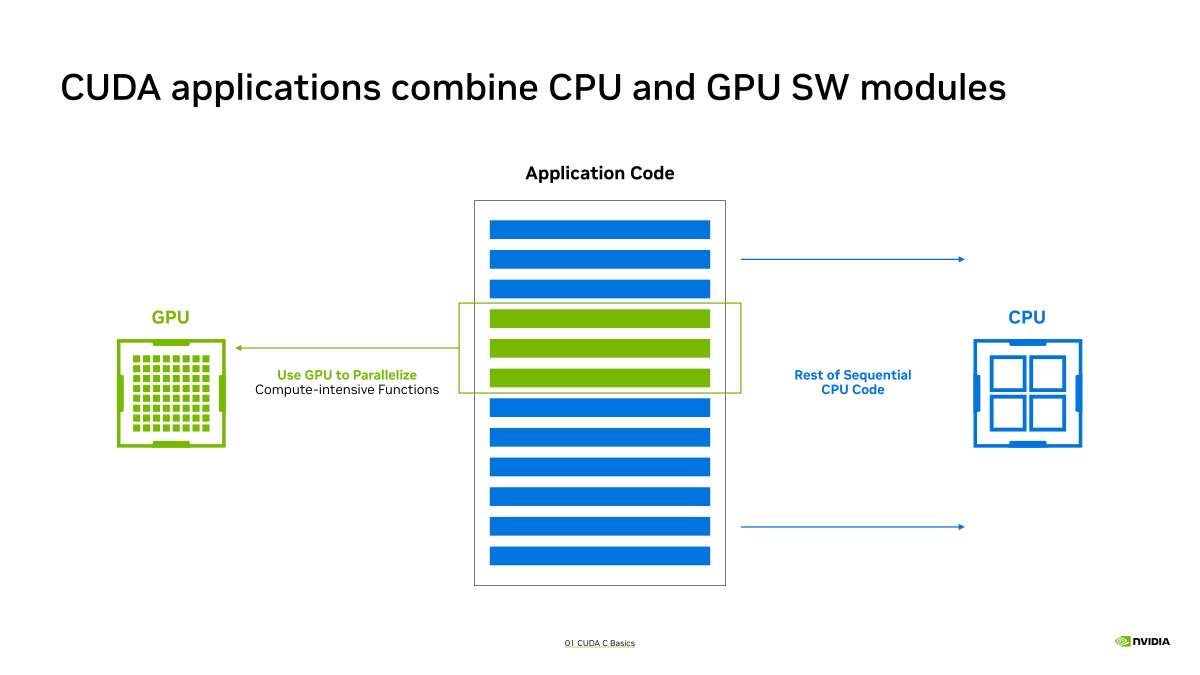
At the Hot Chips 2026 conference, NVIDIA discussed CUDA for RISC-V and the role of the open ISA inside NVLink Fusion systems. The ServeTheHome report describes a technical presentation, not a product announcement; that makes it a directional signal rather than a dated roadmap.
The architectural point is sharp. CUDA is the software fabric that ties NVIDIA GPUs to a huge body of workloads: without CUDA, most deep learning frameworks and inference pipelines would lose the compiler, runtimes and libraries they rely on. RISC-V, on the other side, is an open ISA that allows specialized cores to be designed without licensing fees and without depending on a single proprietary architecture. The intersection was not obvious: NVIDIA has built part of its advantage on vertical control of hardware and software. Seeing the company discuss CUDA for RISC-V indicates it is evaluating architectures where the host CPU or control processors do not have to be x86.
There is a specific element to watch: NVLink Fusion. It is a high-bandwidth interconnect infrastructure for coherent GPU and memory connectivity, central in multi-GPU systems. In that context, RISC-V can enter as a service processor, memory controller or auxiliary engine inside an accelerated node, reducing dependence on external components and widening integration margins. The report does not detail the implementation, but the NVLink Fusion and RISC-V combination suggests attention to control planes and expansion of the system fabric, not only the GPU.
For organizations evaluating on-premise or self-hosted deployments, the signal has structural weight. Many on-prem AI servers today are designed around x86 CPUs and NVIDIA GPUs. If the CUDA toolchain began to support RISC-V hosts more deeply, procurement constraints would change: a system integrator or a sovereign entity could design accelerated nodes with open cores while keeping access to the CUDA ecosystem. That does not mean x86 disappears tomorrow; it means choosing a host processor stops being a rigid prerequisite for using NVIDIA GPUs in AI workloads.
The consequences do not stop at single-server architecture. If CUDA support for RISC-V matures, RISC-V IP vendors and large cloud operators find a more open interface on the CPU side, while traditional server processor makers see part of the lock-in erode. Over a longer horizon, NVLink Fusion nodes with RISC-V controllers can increase the modularity of on-prem installations, better separating the accelerated data plane from the control plane. For those evaluating on-premise deployment, AI-RADAR offers analytical tools at /llm-onpremise to weigh these trade-offs, because data sovereignty is not only regulatory compliance but also the choice of components that can actually be adapted.
The final question is not whether RISC-V will have a role in AI data centers, but whether it can move from service cores to host CPUs in systems with NVIDIA GPUs. The Hot Chips 2026 presentation does not answer that, but it moves the boundary of what is possible.








💬 Comments (0)
🔒 Log in or register to comment on articles.
No comments yet. Be the first to comment!