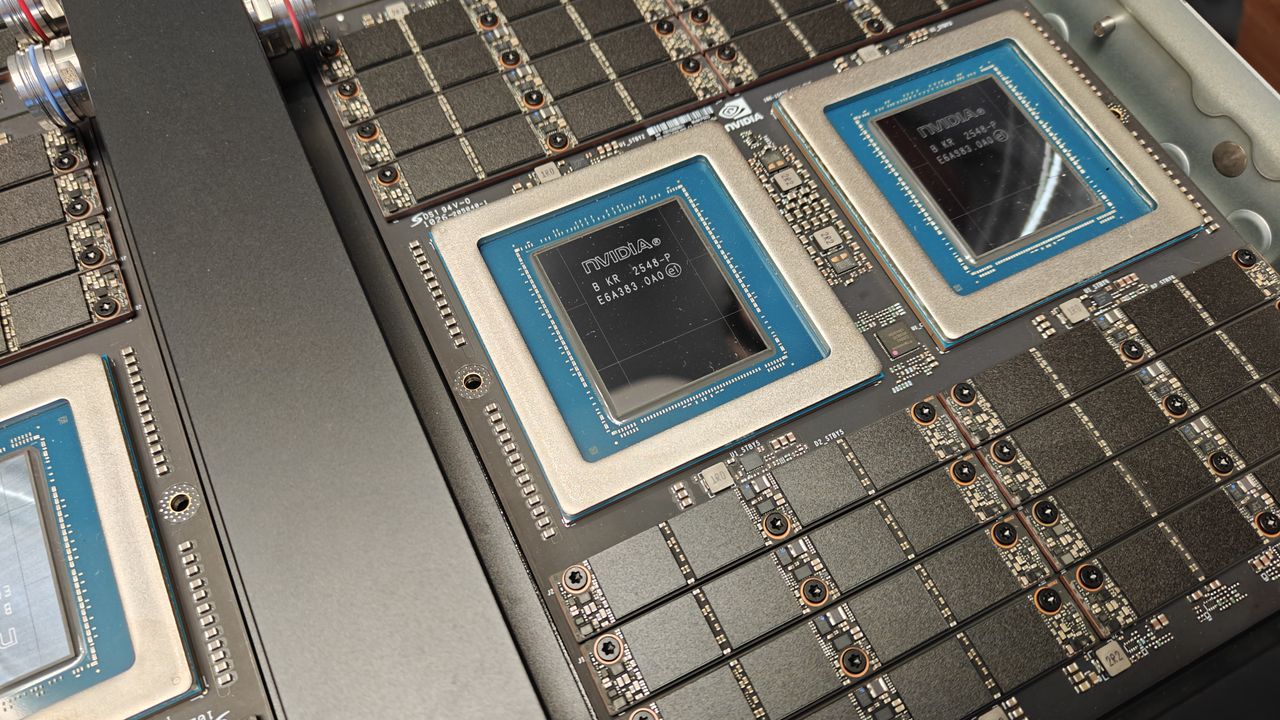
Nvidia just upended the table with a revelation that says far more than a simple number: hundreds of thousands of standalone Grace servers have already been shipped. The news, filtered through a messaging pivot by the Santa Clara giant, shifts the spotlight from GPUs to processors, with CPUs taking center stage in so-called agentic data centers.
The most significant detail is the adjective standalone. Grace is an Arm processor with 72 or 144 Neoverse V2 cores, designed to handle large amounts of high-bandwidth memory (up to 1 TB/s with LPDDR5X) and not necessarily paired with a Hopper GPU. According to the source, the shipped machines are servers with just the CPU — an object that until yesterday seemed ancillary in Nvidia's strategy, long identified with parallel acceleration.
Why this swerve? The answer lies in the word “agentic.” Workloads that run AI agents — chains of model calls, orchestration, retrieval from vector databases, code execution — consist of many concurrent but lightweight operations. They don’t require the massive brute-force of a GPU for training, but benefit from high thread-level parallelism, large caches, and fast memory access. In practice, the ideal profile for a high-end server CPU.
This repositioning is not just technical: it's a move that redraws the power balance in the AI infrastructure market. Until now, the debate over on-premise deployment has collided with the cost and availability of GPUs. The implicit message from Nvidia is that for a growing slice of inference and for running agentic pipelines, CPU-only racks may suffice — or at least can become the first choice for those who want full data control without competing for scarce GPU supply.
The implications for those evaluating self-hosted architectures are profound. An infrastructure based on standalone Grace reduces dependency on the GPU supply chain, simplifies cooling, and lowers cost per watt, even if it requires rethinking software libraries (many inference frameworks are GPU-optimized). However, compatibility with the Arm software ecosystem is now mature: Kubernetes, containers, and tools like vLLM already have builds that run natively on Arm. Total Cost of Ownership potentially shifts toward more predictable CapEx and reduced OpEx.
Strategically, Nvidia is telling the market: “You don’t always need our GPUs; you can use our CPUs.” The move broadens the addressable market, intercepts sovereign data center projects in Europe and Asia, and locks in customers to a hardware ecosystem that remains all-Nvidia branded. At the same time, it puts pressure on Arm server makers like Ampere and on x86 CPU vendors, because it introduces a player with AI credibility into a segment that seemed protected.
The “hundreds of thousands” figure is not hyperbole: it corresponds to a shipment volume comparable to entire enterprise server lines. It means that large hyperscalers, but also regional cloud service providers and companies with data sovereignty requirements, are already investing in this architecture. It signals that the market has started to separate the problem of reasoning — agent planning, the ability to hold state and memory — from massive training, and that CPUs are returning to center stage because value is shifting toward orchestration.
In short, the news is not just a sales figure: it is a snapshot of a bifurcation in AI deployment. On one side, training on monster GPUs; on the other, distributed agentic inference on CPUs. For those designing on-premise infrastructure, the question is no longer “how many GPUs can I afford?” but “how much CPU power can I deploy to run agents efficiently and securely?” With standalone Grace, Nvidia has already answered.






💬 Comments (0)
🔒 Log in or register to comment on articles.
No comments yet. Be the first to comment!