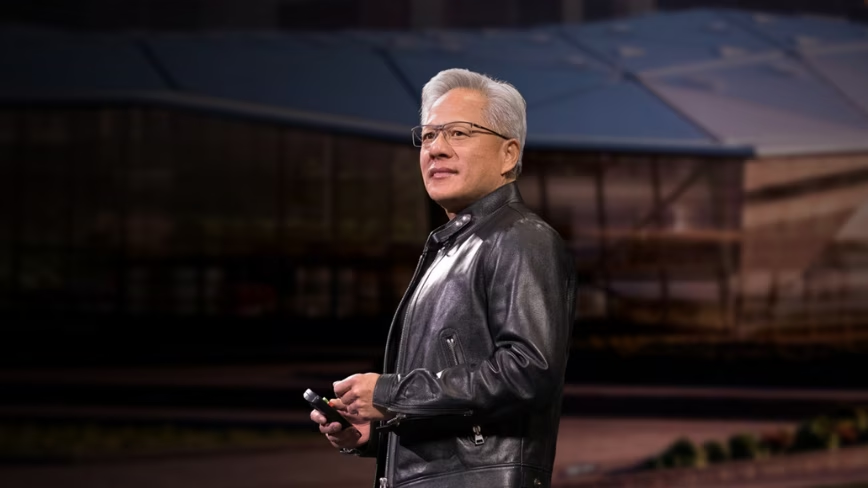
Nvidia's Vision for South Korea
Jensen Huang, CEO of Nvidia, recently concluded a four-day visit to Seoul, delivering a strategic message regarding South Korea's technological future. The announcement, made to reporters upon his arrival at Gimpo Airport, highlighted robotics and physical AI as the emerging growth engines for the nation.
This statement signals a potential shift in focus, urging a look beyond the established memory chip sector, which has historically been a cornerstone of collaboration between Nvidia and Korean industry. Huang's vision suggests a development trajectory that capitalizes on Korea's manufacturing and technological expertise, orienting it towards more complex AI applications integrated with the physical world.
The Role of Robotics and Physical AI
Huang's vision for robotics and physical AI implies a significant evolution in processing capabilities and deployment architectures. These fields demand systems capable of perceiving, reasoning, and acting in real-time within physical environments. This translates into a growing demand for compute power directly at the edge, close to sensors and actuators, to minimize latency and ensure immediate responses.
For companies operating in sectors like advanced manufacturing, logistics, or healthcare, adopting physical AI and robotics solutions often necessitates self-hosted or bare metal infrastructures. Such on-premise deployments offer granular control over hardware, data security, and regulatory compliance—crucial aspects when managing critical operations or sensitive information. The choice to process data locally, rather than relying on remote cloud services, becomes a decisive factor for data sovereignty and operational resilience in complex industrial contexts.
Implications for Infrastructure and TCO
Implementing large-scale robotics and physical AI systems involves significant considerations regarding infrastructure and Total Cost of Ownership (TCO). While the initial investment in hardware, such as GPUs with high VRAM and compute capabilities specific for Inference, can be substantial (CapEx), an on-premise deployment can offer long-term benefits. These include predictable operational costs, absence of data transfer (egress) fees, and the ability to optimize hardware resource utilization for specific workloads.
Managing local stacks for LLMs and other AI models, including orchestration frameworks and data pipelines, requires in-house expertise but ensures complete control over the entire ecosystem. For those evaluating on-premise deployments, AI-RADAR offers analytical frameworks on /llm-onpremise to assess the trade-offs between initial costs, performance, security, and data sovereignty—fundamental aspects for strategic decisions in this domain.
Future Prospects and Collaboration
Jensen Huang's vision not only outlines a growth trajectory for South Korea but also reinforces Nvidia's position as a key enabler of these emerging technologies. The emphasis on robotics and physical AI suggests a future where artificial intelligence will not be confined to data centers but will extend ubiquitously into the real world, interacting with it through autonomous systems.
This transition will require not only advancements in software and algorithms but also continuous development of specialized silicon, optimized for energy efficiency and performance in distributed environments. Collaboration between technology giants and nations with strong manufacturing and research capabilities, such as Korea, will be crucial to accelerate adoption and innovation in these high-potential sectors.








💬 Comments (0)
🔒 Log in or register to comment on articles.
No comments yet. Be the first to comment!