
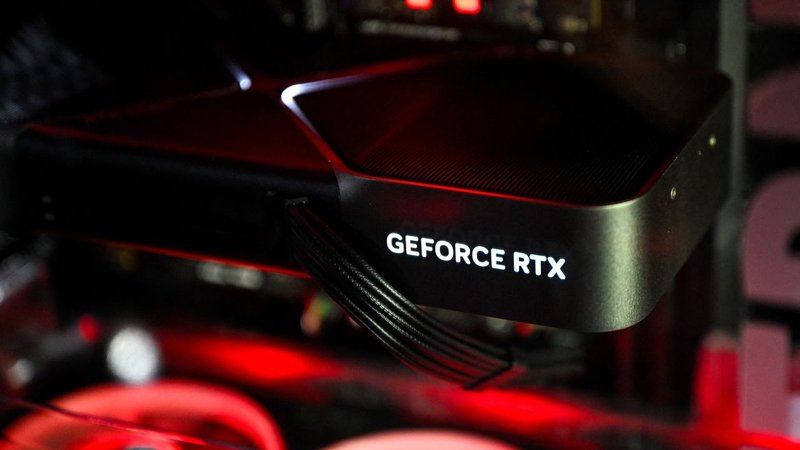
Consumer graphics cards have never carried as much weight in AI infrastructure discussions as they do today. News that NVIDIA is reportedly readying a GeForce RTX 5090 SE — surfaced by a Reddit post linking to TechPowerUp, with no technical details attached — falls into that category of rumor that, while lacking hard numbers, grabs the attention of anyone working with self-hosted LLMs on a daily basis.
The reason is simple: each new SKU in the top GeForce tier can redefine what is practical to do locally. The RTX 4090, with its 24 GB of VRAM, has already become a benchmark for developers and enthusiasts who want to run models at aggressive quantization levels without resorting to the cloud. A hypothetical 5090 SE—a label that in the past has denoted variants with trimmed cores or revised clock speeds—could position itself as a more affordable entry point to the next generation, or perhaps as a version with less video memory but improved power efficiency.
For the on-premise community, VRAM remains the primary bottleneck. Every extra gigabyte on the card allows on-device hosting of larger models, longer contexts, or the use of pre-loading and caching strategies that reduce inference latency. Even a controlled cutback in memory, if offset by a lower price, could lower the TCO for home labs or small businesses that want to retain full control over their data. Local deployment, after all, is not just a performance matter: for many it is a sovereignty requirement, driven by regulations such as GDPR or by architectural choices that favor freedom from external providers.
This is not the first time NVIDIA has played with naming to segment the market more finely. Iterations like the RTX 3080 12GB or the Super variants have historically responded to competitive pressures or to price-positioning needs. In an ecosystem where consumer GPUs are increasingly used for light training, fine-tuning, and especially LLM inference, a similar move with the 50-series could signal greater awareness of the dual role such cards play—gaming and AI—and a desire to span that space without cannibalizing professional lines.
The analysis here cannot ignore a caveat: in the absence of official specs, every line of reasoning is speculative. But the mere existence of this rumor and the amplification it is receiving tells us something about how thin the line between consumer and pro is becoming. For anyone evaluating an on-premise deployment, the RTX 5090 SE could become an important piece of the “power vs. cost” equation, provided that the final configuration—CUDA core count, bandwidth, VRAM—does not sacrifice precisely those elements that make a card capable of smooth and scalable inference. AI-RADAR will continue to track developments, offering analytical frameworks on /llm-onpremise for those called to decide which hardware best fits their sovereignty and total-cost requirements.






💬 Comments (0)
🔒 Log in or register to comment on articles.
No comments yet. Be the first to comment!