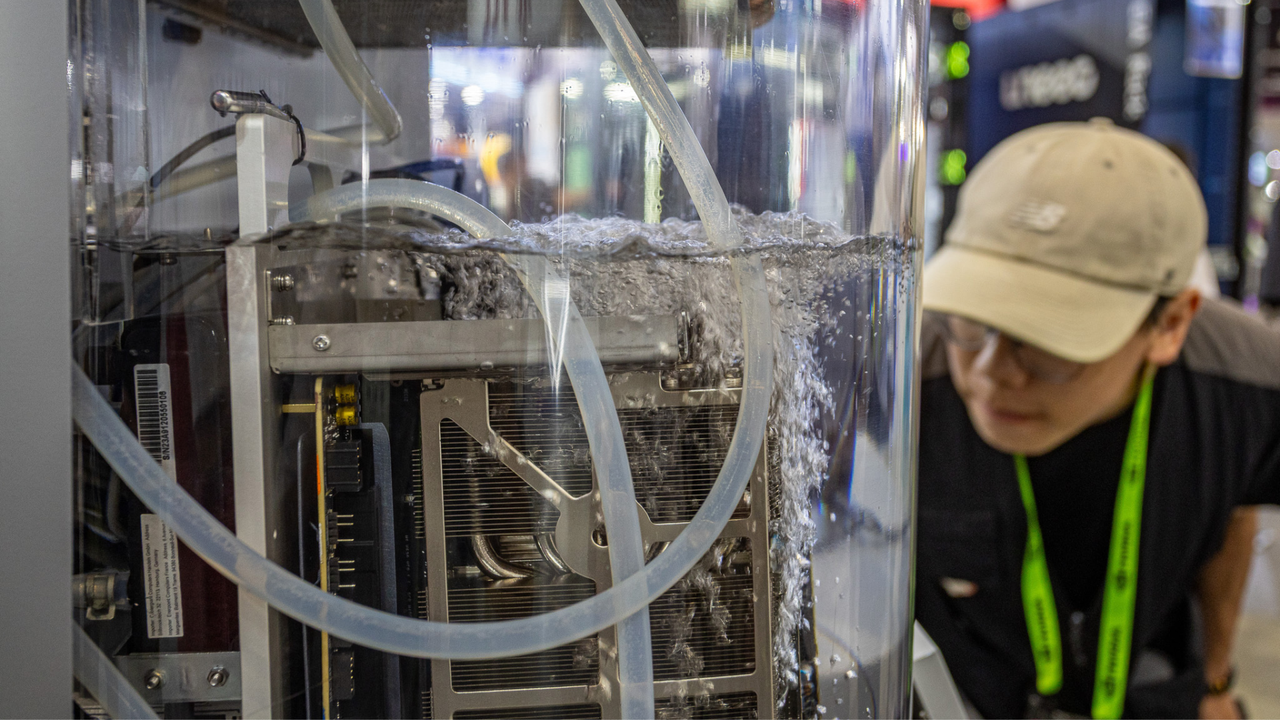
It’s not just about pipes and radiators. When Nvidia announces a liquid cooling system capable of running “at temperatures hotter than a hot tub,” it is touching one of the tender spots of AI infrastructure: heat management. The promise is twofold: to reduce electricity consumption and, in certain configurations, cut water use by up to 100%. Yet the company itself admits that sustainability challenges remain.
Why higher temperatures are good news
Conventional liquid cooling systems work with water at relatively low temperatures, often requiring energy-hungry chillers to keep the liquid within operational limits. Raising the operating temperature — the hot tub comparison is no coincidence — means being able to dissipate heat passively or with far more efficient heat exchangers. In many regions, outside air or simple cooling towers are sufficient to handle the thermal load without turning on compressors. The gain in PUE (Power Usage Effectiveness) can be substantial, reducing the electricity bill tied to air conditioning.
For AI workloads, this carries enormous weight. Servers with eight or more enterprise-grade GPUs can easily exceed 5-10 kW per node. In an on-premise scenario, where you don’t benefit from the scale economies of hyperscalers, every percentage point of energy efficiency translates into lower operating costs and fewer constraints on electrical and HVAC systems in the building.
Less water, more circularity
The other key element is water usage. Traditional air-cooled data centers often integrate evaporative systems that consume large volumes of drinking water. A closed liquid loop — as Nvidia’s system suggests — aims to eliminate continuous water withdrawal altogether, limiting the requirement to the initial fill and occasional minimal top-ups. In water-stressed areas, this can change the game for construction permits and social acceptance of new sites.
The upstream sustainability chapter remains open: the production of cooling systems, the dielectric fluids used, and their end-of-life disposal introduce non-trivial complexities that Nvidia itself acknowledges have yet to be fully addressed.
What’s at stake for on-premise deployment
Those evaluating whether to bring LLM inference or fine-tuning behind their own firewall know that thermal design directly impacts TCO. A cooling system that tolerates higher temperatures makes it possible to reduce or eliminate active cooling infrastructure, simplifies installation in offices or warehouses not equipped as Tier IV data centers, and lowers the entry barrier for self-hosted solutions.
This fits into a broader trend: AI hardware is becoming so dense and powerful that cooling becomes an integral part of the value proposition, not a mere accessory. For those focused on data sovereignty and full-stack control, understanding how modular, maintainable, and compatible these systems are with existing infrastructure will be crucial.
Outlook and unknowns
Nvidia’s announcement comes without details on availability, pricing, or specific models, but it highlights a focus area for the coming months. If high-temperature cooling delivers on its promises, we could see a generation of GPU racks less demanding in terms of facility requirements, bringing on-premise AI closer to a wider range of businesses. At the same time, the unknowns about full-cycle sustainability — from materials to logistics — remind us that operational efficiency is only one side of the coin. The real challenge spans the entire lifecycle.






💬 Comments (0)
🔒 Log in or register to comment on articles.
No comments yet. Be the first to comment!