
The signal: the on-premise node takes the form of a personal computer
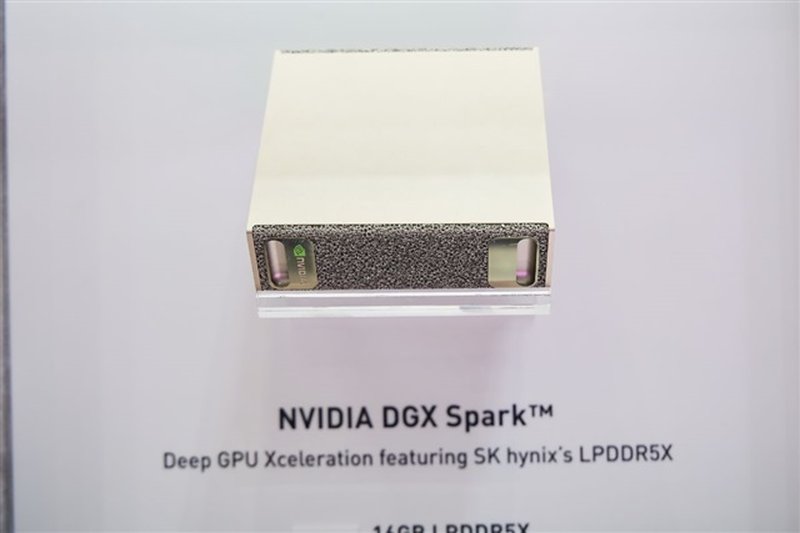
Nvidia has not simply announced a new line of consumer graphics cards. It has started describing the personal AI computer as an autonomous execution point for LLMs, not a terminal that delegates everything to the cloud. The shift is subtle but structural: inference stops being a remote service and becomes a device capability. For AI-RADAR this changes the vocabulary of infrastructure: we are not talking about a gadget for enthusiasts, but a miniature on-premise node that can keep data, reduce latency and give the user direct control over the model.
The fact that the news comes from DIGITIMES, with its focus on hardware supply chains, is telling. It is not an isolated marketing statement: it is a signal that the production chain is preparing for a wave of local machines capable of running models usefully. PC OEMs, memory makers and operating system vendors need to believe that the personal AI computer is not an experiment. Nvidia, with its weight, provides exactly that legitimacy.
The turning point is that a personal AI computer is, for all intents and purposes, a reduced-scale on-premise infrastructure. It processes data locally, avoids the network hop to a data center and can work even when connectivity is intermittent. This does not eliminate the cloud, but it redraws the boundary: some light and sensitive operations can live on the desk, while the cloud remains for massive workloads, training or models too large for local hardware.
In this reading, the personal device is not a competitor to racks, but an extension of the perimeter. The question is not whether the cloud will survive, but which portions of the inference pipeline will move downward. And this question directly affects anyone designing enterprise LLM deployments.
Local inference and VRAM: the constraint reshaping pipelines
The main technical boundary remains VRAM. Consumer GPUs and personal systems have less video memory than data center accelerators. This difference is not a detail: it conditions the size of executable models, context length and the ability to serve multiple requests in parallel. Anyone wanting to run an on-premise LLM on local hardware must deal with a memory constraint that data centers feel less acutely.
Quantization therefore becomes an unavoidable lever. It reduces the numerical precision of weights to fit smaller models into tighter spaces and, in many cases, accelerates inference. But it is not free: it can degrade answer quality, especially on tasks requiring complex reasoning or fine-grained knowledge. A team designing an on-premise pipeline is not simply compressing a cloud model: it is choosing a different balance between latency, quality and memory footprint.
This shifts attention from the largest available model to smaller, vertically focused models. Targeted fine-tuning becomes more important than massive training: you start from a compact LLM and specialize it on documents, tickets or internal processes. In many scenarios, a smaller model trained on company data produces more useful results than a giant model queried generically. It is a change of perspective that AI-RADAR has long observed: runtime efficiency starts to matter as much as training scale.
Hybrid architectures are the natural consequence. Some workloads can stay local; others, requiring more memory or larger models, can be routed to a cloud instance or a more capable internal server. This split is not a failure of on-premise, but a conscious pipeline design: the local device becomes a filter, a first processing layer, a custodian of sensitive data.
Economics shift: CapEx, OpEx and TCO in on-premise decisions
The cloud dominated for a long time because it turned CapEx into OpEx and promised near-infinite scalability. For many companies, paying for use was simpler than buying and maintaining infrastructure. But when a local device can run a useful LLM for stable workloads, the equation becomes more complicated. An upfront investment in on-premise machines can reduce recurring costs, especially if inference volume is predictable and data must remain internal.
TCO becomes the right metric, but it is not a simple number. It includes hardware, energy consumption, maintenance, updates and internal skills. A personal AI computer does not eliminate these costs: it moves them. The cloud bill can fall, but operational complexity rises. For an IT team used to managing a single API endpoint, a fleet of local machines introduces patching, monitoring, physical security and configuration management. It is not an automatic victory for on-premise; it is a trade-off to be calculated.
Data sovereignty adds both economic and strategic weight. In regulated sectors or European contexts, keeping data on the device reduces exposure to transfer obligations and simplifies audits. This advantage does not always appear in spreadsheets, but it can influence decisions more than cost per token. Local hardware becomes a compliance tool, not just a compute resource.
The signal coming from Nvidia also changes incentives on the supply side. PC OEMs can finally offer a concrete argument for device refresh. Cloud API providers risk losing light inference share, the part most sensitive to price and latency. And IT teams must prepare for a distributed infrastructure with multiple execution points and more complex governance.
Second- and third-order effects: who moves and who risks
The first visible effect is commercial: the personal AI computer becomes a sales argument for OEMs. It is no longer just about graphics performance, but about the ability to run local assistants, analyze documents and protect privacy. This can accelerate a hardware refresh cycle that the industry has long awaited.
The second effect is architectural: models will need to be designed to run well on constrained hardware. This concerns not only quantization, but also model structure, token handling and operation efficiency. Labs that train LLMs will start publishing versions explicitly intended for local execution, with quality and latency metrics adapted to this context. Massive training does not disappear, but attention shifts toward the execution phase.
The third effect is operational: companies will have to manage a heterogeneous fleet of local machines, not just a cloud endpoint. This requires orchestration tools, model distribution and monitoring. Self-hosted is not only a technical choice, but a new management burden. Teams that invest in automation and deployment frameworks will have an advantage; those that underestimate complexity risk ending up with underused hardware.
There is also a market effect on cloud APIs. Light inference, the kind that does not require enormous models, is the easiest to move locally. Cloud providers may react by betting on larger models, managed services and integrations that go beyond simple execution. But competitive pressure increases: the local device becomes a release valve for cost and latency.
Data sovereignty and regulatory constraints: the European context
A personal AI computer can process documents, email and conversations without sending them to external servers. In Europe, where GDPR and supervisory authorities pay growing attention to data transfers, this capability has specific value. It is not just about individual privacy: for companies, keeping data on the device reduces the risk surface and simplifies compliance demonstrations.
Self-hosted therefore becomes an architectural choice with legal implications. An LLM running locally can operate on confidential information without it leaving the perimeter. This is a concrete argument for law firms, financial offices, healthcare facilities and public administrations. It does not eliminate all risks — the device can be lost or compromised — but it changes the nature of risk: from uncontrolled transfer to physical security and local access.
The trade-off is between control and operational complexity. On one side, direct control over models and data is a strategic advantage. On the other, responsibility for security, updates and configuration falls entirely on the organization. There is no single answer: for some workloads, the cloud with solid contractual agreements may be more suitable; for others, on-premise is the only viable path. AI-RADAR has always insisted on this point: sovereignty is not an absolute value, but a requirement to be assessed case by case.
Nvidia's push does not resolve this tension. It makes it more visible and more practicable. When local hardware is capable enough, the boundary between what must stay internal and what can go to the cloud becomes a design decision, not a technical limit. This forces companies to equip themselves with evaluation criteria, not just preferences.
What to watch from here
The first signal to monitor is the evolution of VRAM in consumer and professional systems. If video memory grows significantly, larger models will become executable locally and the balance point between cloud and on-premise will shift further. No revolution is needed: incremental increases are enough to widen the number of use cases.
The second signal is the quality of quantization and compression tools. If techniques manage to reduce the quality impact, the memory constraint will become less binding. Some pipelines are already combining quantization, pruning and more efficient architectures to obtain models that run on modest hardware. This is a research field that AI-RADAR will follow closely.
The third signal is the emergence of orchestration frameworks for local fleets. Managing a personal AI computer is different from managing a server: it requires distributing models, updating them, monitoring them and revoking access. Tools that simplify these operations will be crucial to turn local hardware into reliable infrastructure.
Finally, it is worth watching how cloud providers and model labs react. If local models become a recognized category, we will see optimized versions, dedicated benchmarks and more transparent pricing. Nvidia's move does not close the cloud versus on-premise debate: it reopens it, lowering the threshold where personal computers become infrastructure. Anyone designing on-premise LLMs will have to get used to reasoning at this scale.






💬 Comments (0)
🔒 Log in or register to comment on articles.
No comments yet. Be the first to comment!