
The race for AI GPUs is reshaping not only data centers but also the power components that keep them running. According to DIGITIMES, rising power demands from Nvidia GPUs would open a fivefold opportunity for Green Solution Technology, a Taiwanese company led by chairman Yuan-ming Wang, in the market for PMICs, the integrated circuits dedicated to power management.
The news, though brief, signals a structural shift: power is no longer a peripheral commodity but a constraint that shapes the architecture, reliability, and cost of AI hardware. High-end boards require increasingly complex power delivery networks, with multi-phase converters capable of supplying high currents while maintaining precise voltage regulation. In this scenario, those who control power management technologies are not just selling components; they are entering the system design chain.
For specialized suppliers like Green Solution Technology, the effect goes beyond higher volumes. PMIC complexity grows together with power density: more phases, higher efficiency, tighter tolerances, and thermal management that cannot be improvised. This shifts value toward companies with specific skills in high-current converters and power topologies for dynamic loads, such as those typical of AI workloads where consumption fluctuates rapidly between intense compute phases and idle moments.
There is also a second, less visible but equally concrete effect. The race for GPU power puts pressure on the entire system supply chain: integrators must redesign boards, cooling, and power supplies, while power supply manufacturers and data center infrastructure providers must adapt to higher energy budgets. Those who move slowly risk being excluded from next-generation projects, where power conversion efficiency has become a selection criterion rather than a technical footnote.
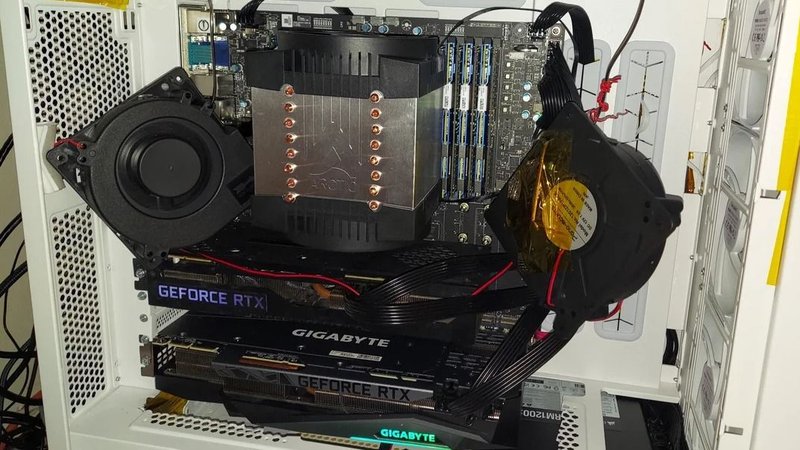
For those evaluating on-premise or self-hosted deployment of LLMs, the signal is direct. A multi-GPU server can draw power levels that stress the rack's electrical infrastructure, and PMIC quality affects system stability, heat dissipation, and total cost of ownership. It is no coincidence that AI-RADAR includes power analysis among the key variables for comparing cloud and local infrastructures: power is one of the factors that determine the feasibility of an on-premise project, alongside cooling, space, and TCO.
The Green Solution Technology case indicates that the AI game is increasingly played upstream, in the components that make model execution possible. And as GPUs continue to grow in performance, power management stops being a niche topic and becomes an integral part of architecture decisions.






💬 Comments (0)
🔒 Log in or register to comment on articles.
No comments yet. Be the first to comment!