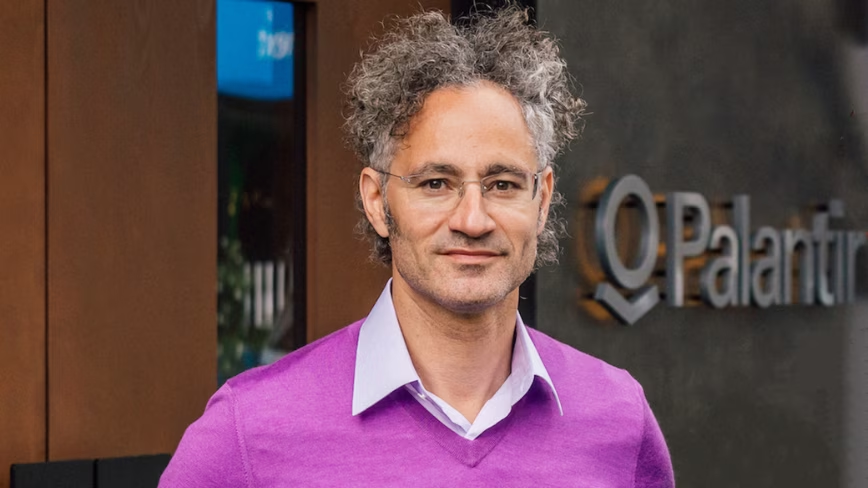
Palantir chose X to launch a message that sounds more like a declaration of war than a simple statement. In nine points, Peter Thiel’s company urges institutions to “defend their AI sovereignty”: hoard data, own model weights, and abandon “tokenmaxxing.” A manifesto that, beneath the veneer of principles, hides a precise commercial strategy: undermine the business model that currently dominates the AI market.
The nine points of a declaration of war
The document, posted on Tuesday on the social platform, is not yet a product but a stance. Of the nine points, three are enough to outline the conflict. First: accumulate data in-house, without handing it over to external platforms. Second: maintain full control over model weights, which represent the heart of trained intelligence. Third: stop “tokenmaxxing,” a term coined to criticize the obsession with increasing processed tokens, which feeds the consumption-based business model.
Tokenmaxxing: when business is based on volume
In the cloud, AI monetization revolves around the number of tokens processed: the more an organization uses an LLM via API, the more it pays. This model incentivizes the provider to maximize throughput, often at the expense of transparency and data control. Palantir flips the perspective: it’s not about paying per token, but about owning the infrastructure that generates value. For a company that develops software for data analysis and intelligence, this message is consistent with its own history.
What it means for those choosing on-premise
For decision-makers already looking at local stacks for LLMs, the manifesto offers additional arguments. Data sovereignty is not a whim: in regulated contexts like GDPR, physical data location and auditability become binding requirements. Owning model weights also means being able to fine-tune without sharing sensitive information with third parties, an advantage that cloud services struggle to guarantee in the same way. However, managing models in-house involves hardware costs, specialized staff, and continuous updates. Palantir seems to want to offer a path for these scenarios, although the details of its approach are still to be defined.
Sovereignty as a commercial lever
The timing is not accidental. As major cloud platforms seek to impose their ecosystems, demand grows for alternatives that keep control in the hands of organizations. Palantir, leveraging its historical positioning in the government and defense sectors, aims to capture this need. The manifesto is a pitch dressed as a principle, but it raises real questions: whoever holds the data and models decides how AI is used. For those evaluating on-premise deployments, the question is no longer whether sovereignty matters, but how much it costs and how to implement it. AI-RADAR has long analyzed these trade-offs, offering assessment frameworks for those seeking to balance control and costs.
Palantir’s initiative marks a turning point: the AI debate is no longer just technical, but deeply political and economic. And the battle for sovereignty has just begun.







💬 Comments (0)
🔒 Log in or register to comment on articles.
No comments yet. Be the first to comment!