
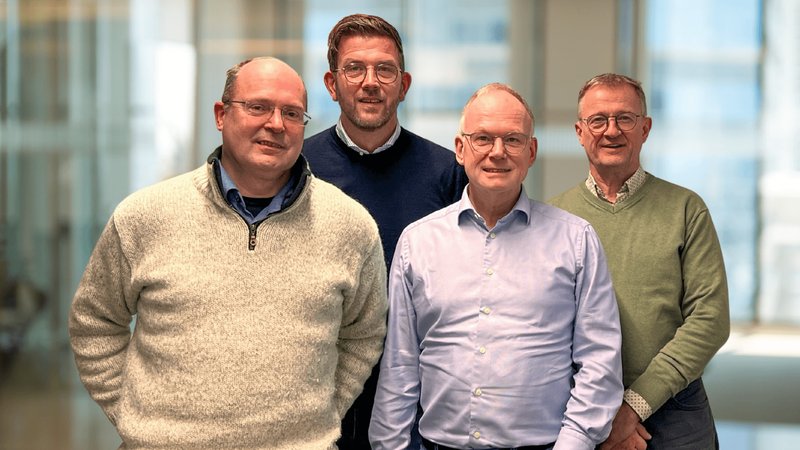
German deeptech startup Porelio closed an oversubscribed €2.4 million pre-seed round, led by Faber with participation from Polytechnique Ventures, Grupo Tecnológica, and better ventures. The funding will push its FOMS (Functionalized Ordered Mesoporous Silicas) materials from pilot scale to industrial production, targeting the capture of precious metals from industrial effluents and the removal of stubborn PFAS chemicals from water.
The underlying chemistry has existed for thirty years but remained a bench-scale curiosity. Porelio’s breakthrough is a patented continuous-flow manufacturing process that makes synthesis roughly 30 times faster than conventional methods while operating under more sustainable conditions. In European proof-of-concept tests, the material captured palladium six times faster than traditional adsorption technologies and removed far more trifluoroacetic acid (TFA)—one of the most persistent PFAS compounds—than commercial activated carbon under comparable conditions.
The stated goal is to move from a few kilograms per day to tonnes per year, a scaling leap that reshapes the game even for industries seemingly unrelated to chemicals. Consider on-premise data centers, where GPU clusters for LLM training and inference are packing ever-higher thermal density.
Liquid cooling is now the default choice to tame power consumption and maintain clock speeds. Whether open or recirculating, such loops use water that must remain chemically stable and free of contaminants to prevent scaling, corrosion, and biofouling. PFAS, pervasive in groundwater, threaten both system reliability and wastewater discharge compliance, especially in Europe under industrial effluent regulations.
Adopting advanced filter media like FOMS—regenerable and capable of operating in a continuous flow—could let on-prem operators close the cooling water loop, cutting dependence on external supplies and lowering disposal costs. This is not a green gadget but an infrastructure component that directly impacts total cost of ownership (TCO) and operational predictability. As electricity prices and water availability become decisive factors for new data center siting, having efficient, scalable on-site water treatment turns into a strategic lever.
Porelio’s story also sends a structural signal: advanced manufacturing of functionalized porous materials is moving beyond the semiconductor and catalyst niches to touch IT infrastructure. For anyone evaluating on-prem AI deployment, cooling logistics are not a detail but a primary design variable. AI-RADAR tracks these intersections to give decision-makers independent analytical frameworks, steering clear of marketing shortcuts.
With fresh capital, Porelio aims to convert pilot collaborations into commercial contracts while production capacity heads toward the tonne scale. If material costs drop enough, integrating such systems into enterprise-scale data center water treatment may no longer be a laboratory curiosity.







💬 Comments (0)
🔒 Log in or register to comment on articles.
No comments yet. Be the first to comment!