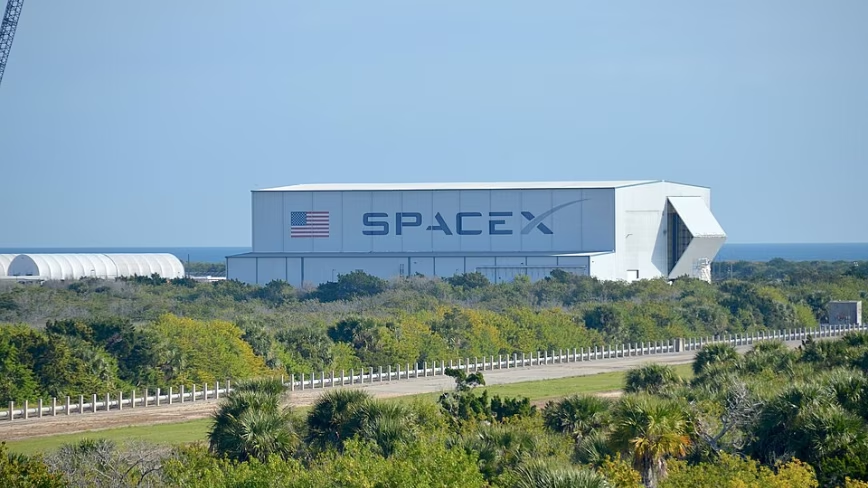
SpaceX's Infrastructure Hurdles for Grok
SpaceX recently leased its "Colossus 1" data center to Anthropic, a move that, according to Bloomberg, was not driven by surplus capacity. The decision stemmed from significant difficulties SpaceX encountered in making the facility fully operational for its own artificial intelligence models, particularly Grok. The primary reason for this action lies in persistent latency issues that prevented effective integration of the Memphis site with two other data center campuses, located more than ten miles away.
This incident underscores the inherent complexities in designing and deploying large-scale infrastructure dedicated to Large Language Models (LLMs). Even for companies with vast resources like SpaceX, managing distributed networks for AI workloads can present unforeseen obstacles, highlighting how the mere availability of hardware is insufficient without a robust, low-latency network infrastructure.
Latency and Distributed Architectures for LLMs
Latency, the delay in data transmission, is a critical factor for LLM training and inference operations. In contexts where models or datasets are distributed across multiple sites, even a few milliseconds of delay can drastically impact performance, slowing throughput and increasing response times. For training complex models, high latency between nodes can compromise gradient synchronization, reducing the efficiency and stability of the process. Similarly, for real-time inference, latency is directly correlated with user experience.
The physical distance between data centers, as in the case of the "more than ten miles" separating Colossus 1 from SpaceX's other campuses, inevitably introduces signal propagation delay. While modern fiber optic infrastructures are extremely fast, physics imposes limits that can become problematic when coordinating thousands of GPUs in a distributed cluster. This requires not only high-speed cabling but also advanced network switches, optimized communication protocols, and careful network architecture planning to minimize bottlenecks.
Implications for On-Premise Deployments and TCO
SpaceX's experience offers a valuable lesson for organizations evaluating on-premise AI infrastructure deployments. While control over data sovereignty, security, and hardware customization are significant advantages of self-hosted solutions, the Total Cost of Ownership (TCO) extends far beyond the simple purchase of GPUs and servers. The costs and complexities associated with networking, cooling, power, and operational management can be enormous.
For those considering on-premise deployments, it is crucial to evaluate not only raw computing power (e.g., GPU VRAM, compute capability) but also the entire infrastructural pipeline. The ability to effectively connect distributed clusters, manage high-bandwidth and low-latency network traffic, and ensure the resilience of the overall architecture are aspects often underestimated. AI-RADAR offers analytical frameworks on /llm-onpremise to evaluate these trade-offs, highlighting how the choice between on-premise and cloud is never trivial and requires an in-depth analysis of all technical and operational constraints.
Lessons Learned and Future Outlook
The Colossus 1 case demonstrates that even leading-edge companies can encounter significant hurdles in building and managing large-scale AI infrastructure. The need for an ultra-low-latency network for LLM workloads is a non-negotiable requirement, especially when opting for a distributed architecture. This pushes companies to invest not only in cutting-edge silicon but also in innovative networking solutions and specialized expertise for their implementation and management.
In a rapidly evolving technological landscape, the ability to adapt and optimize infrastructure for the specific needs of Large Language Models will become a distinguishing factor. Deployment decisions, whether on-premise, cloud, or hybrid, will increasingly need to balance performance, costs, and control, with the understanding that infrastructural challenges can emerge even in the most ambitious projects.






💬 Comments (0)
🔒 Log in or register to comment on articles.
No comments yet. Be the first to comment!