
Qualcomm’s 2026 investor day revealed more than a roadmap: it laid out an ambition to become a key player in the data center, just as the demand for large language model inference compute is exploding. In a single appearance the company discussed the Dragonfly C1000 CPU, a proprietary alternative to HBM called High Bandwidth Compute, and dedicated AI accelerators. Together, these three building blocks amount to an explicit challenge to incumbent server silicon vendors—and potentially a new reference point for those building on-premise infrastructure.
Dragonfly C1000: a CPU designed for the modern rack
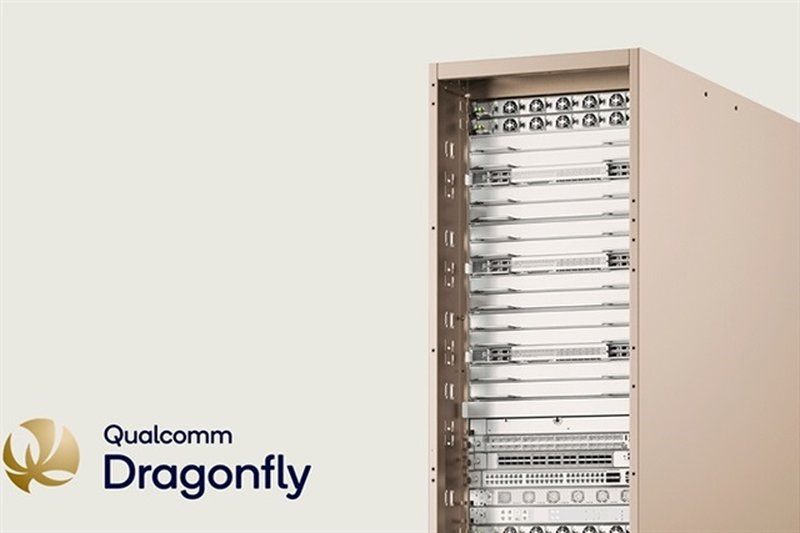
The Dragonfly C1000 processor marks Qualcomm’s entry into a space dominated by x86 architectures and, increasingly, Arm-based solutions. While official specifications are still missing, announcing it at the Investor Day signals an intent to supply CPUs for cloud-native workloads and LLM serving. Native integration with the company’s proprietary high-bandwidth memory hints at a design aimed at minimizing data-access bottlenecks—a critical factor when running inference on models with long contexts or when enabling on-the-fly fine-tuning.
High Bandwidth Compute: beyond HBM with an in-house solution
The real technical anomaly is High Bandwidth Compute, Qualcomm’s internally developed HBM alternative. As the industry grapples with the cost, packaging complexity, and limited availability of HBM—now indispensable for GPUs and accelerators—a proprietary alternative could offer greater supply chain predictability and finer control over the bandwidth-to-power ratio. For on-premise deployments, this may translate into a more stable TCO and reduced dependence on a single external provider of advanced memory. No throughput figures were shared, but the direction is clear: find a different way to deliver enough bandwidth for inference workloads without bearing the premium or shortages tied to HBM.
AI accelerators: the missing piece for a governable ecosystem
The announcement of dedicated AI accelerators completes the picture. Qualcomm is no longer confined to smartphone and always-connected PC chips: it now offers a catalog spanning CPU, memory, and specialized inference silicon. For teams evaluating on-premise stacks, a native accelerator within a single-vendor ecosystem can simplify software integration, reduce driver complexity, and deliver a more cohesive processing pipeline without vendor-hopping. From a data sovereignty perspective, the ability to procure homogeneous, self-hosted compute nodes reduces the compliance surface compared to hybrid or multi-cloud setups—a particularly sensitive topic in Europe following the introduction of strict regulations.
Room for on-premise adoption?
Beyond the announcements, the message for IT decision-makers is twofold. On one hand, the entry of a player with Qualcomm’s engineering pedigree introduces a third path alongside NVIDIA and AMD, with potential benefits for competition and pricing. On the other, uncertainties surround the maturity of the software ecosystem: the availability of optimized libraries, support in mainstream serving frameworks, and integration with orchestrators like Kubernetes will determine whether the hardware truly becomes an asset for on-premise inference or remains a promise. AI-RADAR has repeatedly observed that startups and mid-market organizations tend to favor platforms with an active community and proven tooling—elements that take time to build.
In short, the direction charted at this Investor Day is that of a vendor aiming to supply everything needed to populate private, hybrid, or edge data center racks. Whether the bet translates into real-world adoption will depend on how quickly actual workloads can exploit the Dragonfly C1000 and High Bandwidth Compute combination.









💬 Comments (0)
🔒 Log in or register to comment on articles.
No comments yet. Be the first to comment!