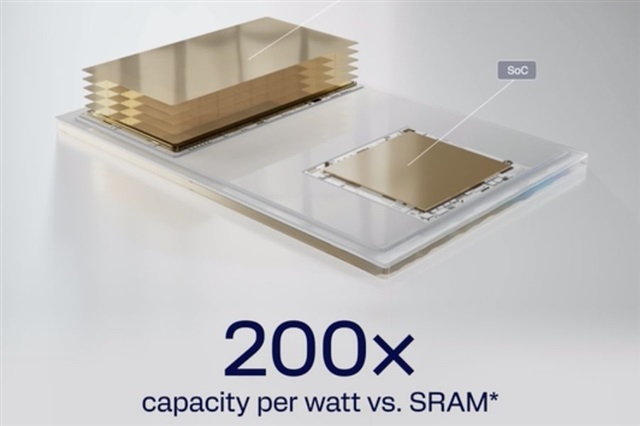
Memory cost is becoming the Achilles' heel of AI infrastructure, and Qualcomm has decided to step in. With an announcement still light on technical details, the company has hinted that its HBC architecture (High Bandwidth Cache?) could reshuffle the deck in data centers, aiming straight at the heart of spending: HBM memory.
Beyond VRAM: the HBM cost squeeze
In recent years, demand for high-speed VRAM has exploded. LLM inference and training workloads require extreme bandwidth – hundreds of gigabytes per second – to avoid turning matrix multipliers into bottlenecks. The dominant solution is High Bandwidth Memory (HBM), which stacks DRAM layers on a silicon interposer, but at very high costs. An AI accelerator card can easily have more than half its total cost attributable to memory alone, making every on-premise node a heavy budget choice.
This scenario penalizes those who want to keep data in-house – for sovereignty, latency, or long-term TCO – because buying servers becomes a significant capital commitment. Infrastructure vendors look for alternatives like quantization (e.g. INT8) or shared architectures, but the memory wall remains.
Qualcomm and the HBC bet
Qualcomm's HBC project is described as a frontal attack on HBM costs. While technical details have not been disclosed, the most credited hypothesis talks of a more compact high-bandwidth cache that could reduce the number of 3D stacks needed, or introduce a memory hierarchy that separates “hot” and “cold” data directly on the processor package. Such an approach would allow maintaining high performance – probably more in inference than in massive training – without having to buy the equivalent in HBM.
For on-premise environments, the move is significant. It means being able to size a server for a given LLM workload without blowing the budget, perhaps equipping more nodes with “adequate” VRAM rather than a few monsters with tens of terabytes. However, it remains to be seen whether HBC will offer the necessary bandwidth for fine-tuning loads or very large context windows, where HBM remains almost irreplaceable.
What changes for those evaluating on-premise deployment
Qualcomm's entry into this segment tips the scales for those designing self-hosted environments. Today, the main alternative to HBM is the use of GDDR memory (slower but cheaper) on consumer or workstation GPUs, often with heavy compromises on context window and token latency. A solution like HBC, if implemented on dedicated accelerators, could fill a gap: offer intermediate bandwidth at a sharply reduced cost, paving the way for hybrid configurations where the most expensive memory is reserved only for critical tasks.
AI-RADAR tracks precisely these developments, because every hardware evolution that lowers the economic barrier of on-premise changes the TCO equations compared to the cloud. For those who are currently holding off on bringing models locally due to the cost of HBM-equipped GPUs, the arrival of alternatives like HBC – if confirmed – could become the event that unlocks new projects.
A broad perspective: the signal to the market
Beyond the specific product, Qualcomm's move sends a clear message: the cost of memory for AI is no longer a side issue. It is the new battlefield of differentiation. Companies like AMD, NVIDIA, and Google (with TPUs) are already exploring advanced packaging and caches, but the entry of a player focused on mobile and energy efficiency could accelerate hybrid solutions. For on-premise deployment, it means that the next generation of LLM hardware could offer unprecedented flexibility in balancing performance and capital spending.
Pending concrete data, system architects can note this novelty as a potential turning point in planning AI workloads in the years to come.







💬 Comments (0)
🔒 Log in or register to comment on articles.
No comments yet. Be the first to comment!