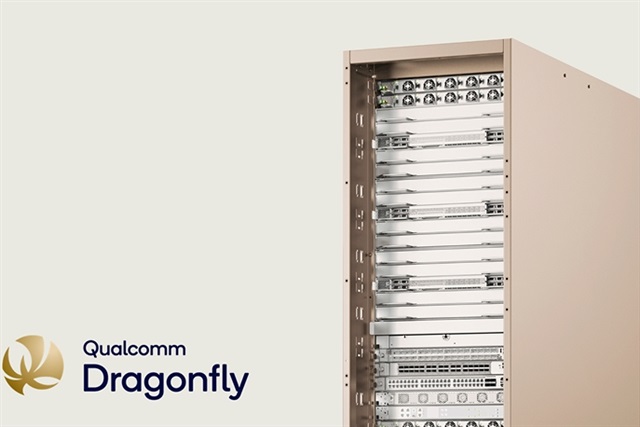
Qualcomm has announced its entry into the data center chip market with the Dragonfly family and a partnership with Meta. The goal is clear: to challenge Nvidia's dominance in AI infrastructure by focusing on inference-optimized solutions.
Qualcomm's data center foray
Best known for its Snapdragon mobile processors, Qualcomm is now bringing its expertise in energy efficiency and AI workloads to the server segment. The Dragonfly lineup targets inference acceleration, the phase where trained models are deployed in production. While raw performance dominates training discussions, the real scaling challenge for AI lies in low-cost, high-efficiency inference. Qualcomm, with its legacy of low-power devices, may hold a strong hand here.
The Meta partnership and the inference imperative
The collaboration with Meta adds substance to the announcement. Meta runs a massive AI infrastructure, from personalized feeds to recommendation models, and has long advocated for open, diversified hardware to reduce single-vendor dependency. The deal suggests Dragonfly chips will be tested at scale, potentially in high-density inference clusters. It’s not just about raw throughput; performance per watt, integration ease, and Total Cost of Ownership (TCO) are decisive factors for a company like Meta.
Implications for the market and on-premise alternatives
Qualcomm's data center move isn't only relevant for hyperscalers. For organizations evaluating on-premise deployment, availability of new accelerator chips widens the options beyond the CUDA ecosystem. Data sovereignty and cost control push many enterprises toward private infrastructure, but the scarcity of Nvidia alternatives has often stalled these plans. If Dragonfly chips prove compatible with popular frameworks and are backed by a robust software stack, they could become a key component for self-hosted environments. However, without detailed technical specifications, it's too early to judge: memory capacity, bandwidth, and software maturity—critical for LLM workloads—remain to be seen.
A heating-up ecosystem
Qualcomm's move fits into a competitive landscape featuring Intel's Gaudi, AMD's Instinct, and a surge of custom chips built by Google, Amazon, and Microsoft. The prize is control over large-scale inference, a rapidly expanding market. For those tracking on-premise deployment dynamics, such developments signal that hardware diversification is becoming real. AI-RADAR will continue to monitor these solutions, offering analytical frameworks to evaluate trade-offs between cloud and on-premise in the dedicated LLM on-premise section.







💬 Comments (0)
🔒 Log in or register to comment on articles.
No comments yet. Be the first to comment!