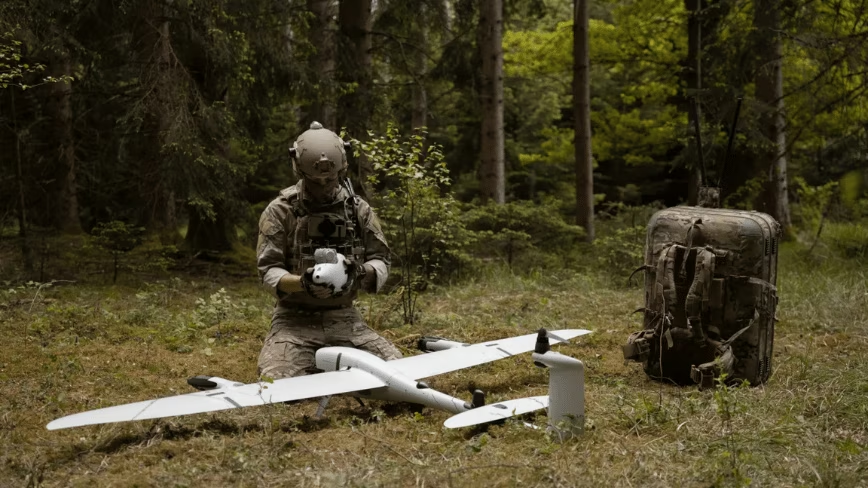
European defense tech has a new heavyweight. Quantum Systems, a German company specializing in autonomous drones, has raised $1.2 billion in a Series D round that more than doubles its valuation to around $8 billion. The deal, announced on Thursday, was co-led by Blackstone, Noteus, Airbus, and Advent. It ranks among the largest fundraisings ever for a defense startup on the continent.
The figure doesn't surprise industry watchers. Over the past two years, venture capital has increasingly flowed into dual-use technologies – civilian and military – and Quantum Systems is one of the most visible beneficiaries. Its fixed-wing drones, such as the Vector series, are already deployed in operational scenarios ranging from tactical reconnaissance to precision logistics, with vertical take-off and landing capabilities that allow operations in confined spaces without dedicated runways.
The technology stack behind autonomous flight
For those developing unmanned aircraft for defense, the challenge goes beyond aerodynamics or flight endurance. The real differentiator is onboard intelligence: every drone must process high-resolution video streams, fuse data from multiple sensors in real time, and make decisions in environments where connectivity is often absent or deliberately denied. This imposes computing architectures that favor local inference and data sovereignty, far from the cloud data centers that dominate the enterprise world.
We are in the realm of operational AI, where computer vision models run on ruggedized hardware and training datasets remain in air-gapped environments for security reasons. It's no coincidence that recent military contracts explicitly require on-premise options and edge computing solutions, bound by latency requirements below 30 milliseconds and the need to function even without satellite links.
The Quantum Systems round also signals a shift in Europe's supply chain. Airbus Ventures' participation confirms the interest of aerospace incumbents in startups bridging the gap between prototypes and field-ready systems. Meanwhile, the entry of Blackstone and Advent, two global private equity giants, shows that defense is now considered a mature asset class, capable of absorbing billion-dollar investments without the regulatory uncertainty that holds back other deep tech segments.
How these resources will be deployed remains to be seen. Quantum Systems has spoken of expanding production capacity and accelerating the development of swarm intelligence algorithms, where multiple drones cooperate without human intervention. That goal will require a generational leap in distributed computing and new approaches to model deployment – topics AI-RADAR follows closely, analyzing trade-offs between dedicated hardware, energy costs, and compliance with data protection regulations.
For the European industrial ecosystem, the deal is a maturity test. Public demand for autonomous drones is set to grow, driven by armed forces modernization programs and the war in Ukraine, which has accelerated the adoption of commercial aircraft adapted for combat. Those who can best integrate sensors, local computing, and continuous model updates will gain an edge that is hard to close.







💬 Comments (0)
🔒 Log in or register to comment on articles.
No comments yet. Be the first to comment!