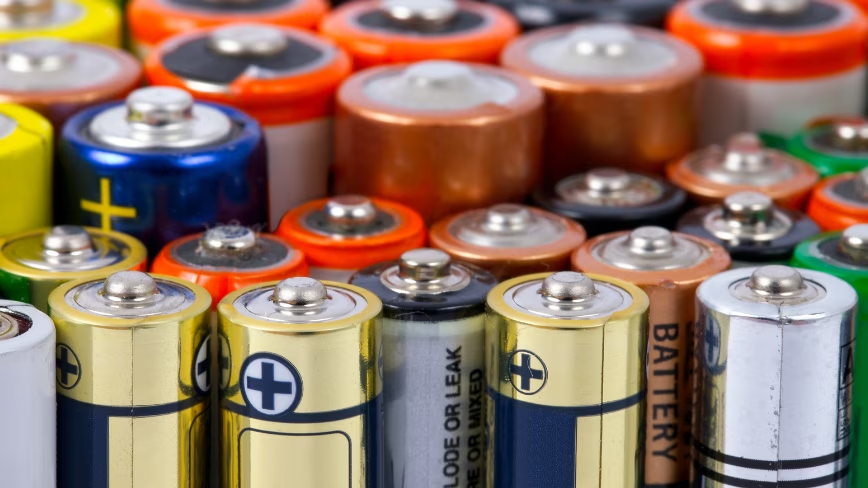
The news comes from the Institute of Physics at the Chinese Academy of Sciences: Lu Yaxiang, a 35-year-old researcher, received the Youth May Fourth Medal — China’s highest honor for under-35 achievers — for building a sodium metal battery that charges in roughly four minutes and retains 90% capacity after an unspecified number of cycles. The result caps a decade of work on commercializing sodium-ion batteries.
Behind the stopwatch record lies much more. China currently depends on imported lithium for 75% of its needs, a strategic bottleneck that constrains electrification plans and, increasingly, the plans of those managing data centers and computing infrastructure. Sodium batteries promise to bypass that dependency by using abundant, widely available raw materials, but until now they suffered from slow charging and early capacity fade. Lu’s work tackles both problems at once: charge speed competitive with the best lithium cells and capacity retention that extends the usable life of storage.
For those who follow AI from an on-premise and local deployment perspective, the leap has a less visible but concrete reflection. GPU clusters for inference or fine-tuning — especially in self-hosted configurations — consume huge amounts of electricity, and energy cost weighs more heavily on TCO than many calculation models admit. An affordable sodium-ion battery with near-instant charging changes the stationary storage equation: it allows peak shaving without relying on expensive lithium-based UPS systems, integrates intermittent renewables, and gives resilience to installations in locations with weak grids.
This is not lab fantasy. Sodium-ion technology is entering early supply chains in China for electric vehicles and grid storage, and major cloud infrastructure providers are beginning to look with interest at sodium chemistry for their own backup systems. If Lu’s promise consolidates into mass production, the cost differential versus lithium could widen to the point of making the old paradigm unsustainable. In such a scenario, decision-makers evaluating on-premise racks might face an energy cost so low it tilts the make-or-buy balance toward self-hosting, at least for sensitive workloads where data sovereignty is non-negotiable.
It is not yet time to declare winners. Sodium batteries still suffer from lower energy density than lithium, which currently rules them out for applications where space and weight matter (smartphones, drones). But in stationary storage — exactly what a data center needs — density is less critical. And the cost of raw materials, combined with an extended cycle life, could make the difference. China, with this move, is not just chasing a scientific record: it is trying to defuse a systemic vulnerability, the mineral dependency that has already slowed other energy-intensive sectors.
The message for those architecting on-premise AI infrastructure is clear but must be read with patience: innovation in storage materials is not background noise, but a silent vector that shifts the economic fundamentals of deployment. Ignoring it today means finding oneself tomorrow with TCO numbers less competitive than those who bet early on the combination of efficient hardware and low-cost storage.




💬 Comments (0)
🔒 Log in or register to comment on articles.
No comments yet. Be the first to comment!