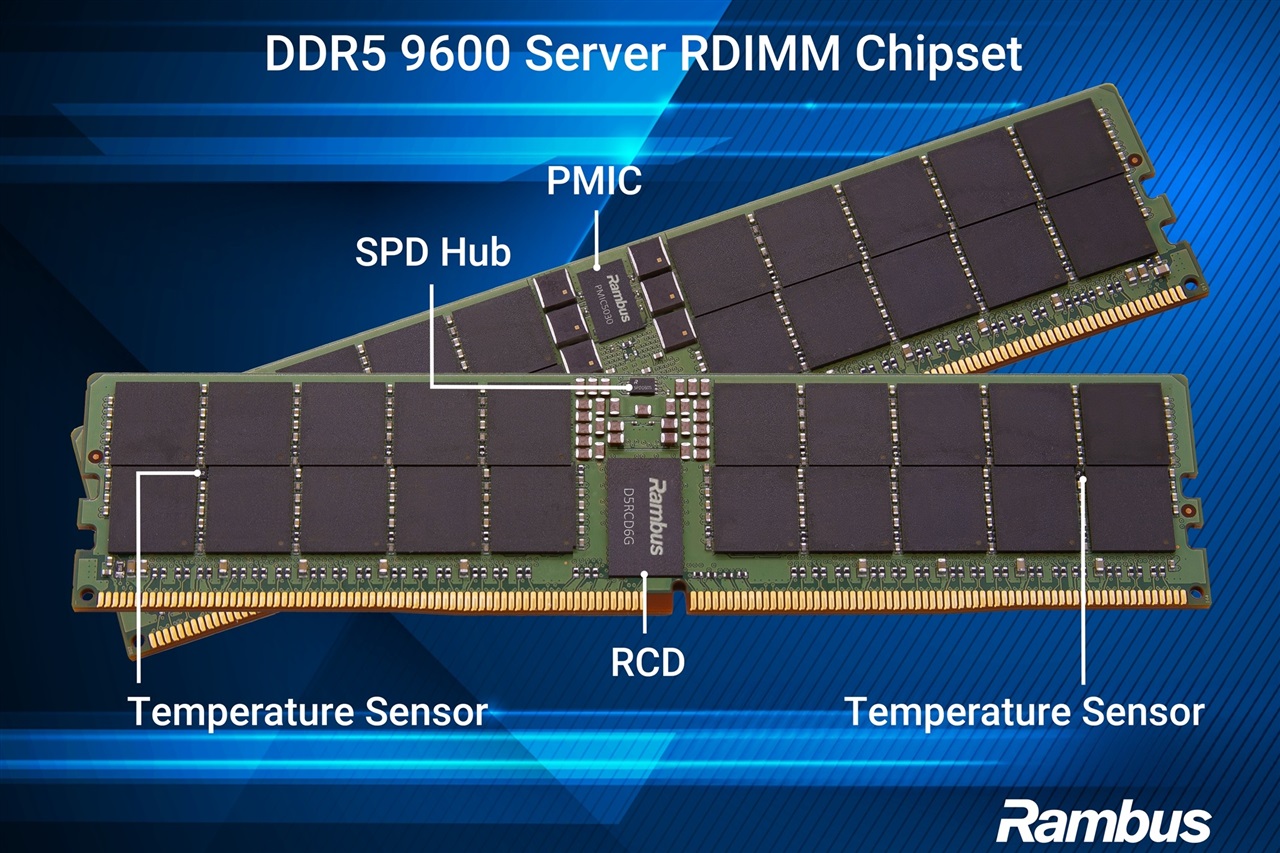
Rambus has unveiled the first DDR5 chipset with a transfer speed of 9600 megatransfers per second, purpose-built for servers handling artificial intelligence workloads. This isn't just another marginal semiconductor announcement: system memory has long been the most overlooked bottleneck for those running large language models locally, and each leap in RAM throughput redraws the boundaries of what's practical without leaning on the cloud.
The new chipset from Rambus, which the California-based company presents as an enabling component for next-generation AI infrastructure, pushes the DDR5 standard to 9600 MT/s, roughly 50% faster than the speeds typical of current DDR5-6400 modules. In practical terms, this higher bandwidth means processors—be they x86, Arm, or dedicated accelerators—can access data in memory with effectively lower latency and higher throughput, critical when working with models of tens of billions of parameters that don't fit in GPU VRAM and must be partially handled in system RAM.
For those designing on-premise LLM deployments, the message is clear: the fight for efficient inference isn't fought only on the graphics card front, but hinges on the ability to feed compute cores without bottlenecks in the memory hierarchy. Inference workloads, and even more so fine-tuning, demand continuous shuffling of weights and activations between storage, RAM, and on-chip memory; every weak link in the chain translates to lower tokens per second, longer request queues, and a TCO that drifts away from economic sustainability.
Rambus's announcement comes at a time when companies are pragmatically reassessing deployment strategies: moving everything to the public cloud carries unpredictable operational costs and raises questions about data sovereignty, while building one's own infrastructure forces a reckoning with hardware limitations. A faster memory chipset doesn't solve the equation on its own, but it shifts the goalposts significantly for those assembling AI servers based on highly parallel CPUs or hybrid CPU-GPU architectures where system RAM acts as a second-level cache for model data.
From a market perspective, Rambus doesn't directly compete with HBM (High Bandwidth Memory) manufacturers—the stacked memory used by high-end GPUs—but occupies a different segment: general-purpose servers and AI-dense systems that can't afford the cost and complexity of HBM. In this sense, the DDR5-9600 chipset redefines the price-performance sweet spot for a broad range of enterprise workloads, from scientific research to industrial applications requiring always-on models and local data.
There's a second-order consequence worth noting: with more generous memory bandwidth, it becomes more plausible to run large quantized models (INT8 or FP16) without paying the heavy performance penalty that currently comes from continuous swapping between RAM and VRAM. For teams building AI applications in regulated environments, where data cannot leave the corporate perimeter, this means the trade-off between control and speed becomes less stark, tipping the balance toward on-premise.
It remains to be seen on what timeline server manufacturers will integrate the new chipset into their product lines, but the direction is set: system memory stops being an undifferentiated commodity and becomes a strategic element in the design of AI hardware. With this move, Rambus signals that the industry is recognizing that the era of memory bottlenecks can no longer be sidestepped with just bigger GPUs; it must be tackled at the root.






💬 Comments (0)
🔒 Log in or register to comment on articles.
No comments yet. Be the first to comment!