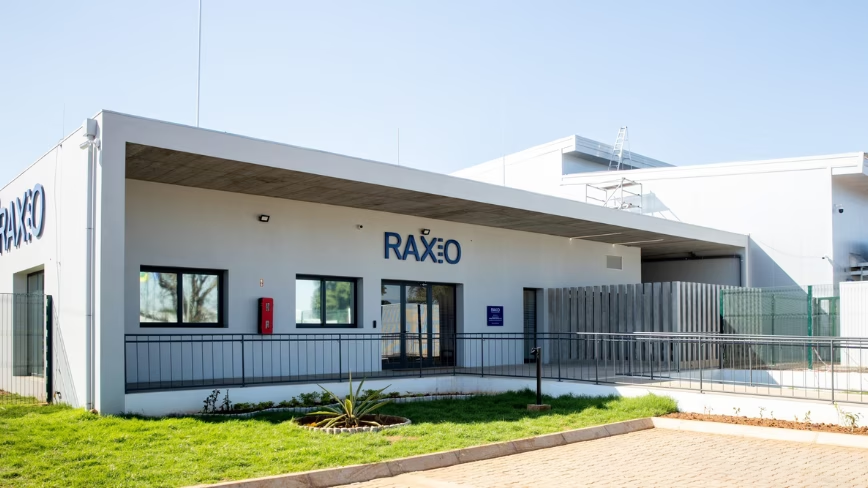
It’s not just a matter of square meters and megawatts. Raxio Group’s decision to enter Tanzania, coupled with an increased capital pool of $380 million, is a strong signal for those tracking the evolution of artificial intelligence on the African continent. The two main shareholders, French infrastructure investor Meridiam and US-based Roha Group, have deepened their commitment to a data center operator that is now targeting the last missing piece of East Africa.
Demand for high-quality infrastructure, as the company itself notes, is accelerating. But reducing this to basic digitalization would be shortsighted. The real driver is the need to process data where it is generated, without bouncing it off servers in Europe or South Africa. Inference from a Large Language Model for a banking, healthcare, or agricultural application requires minimal latency to deliver an interactive experience. A data center in Dar es Salaam turns that potentially prohibitive latency into an acceptable value, below 10 milliseconds for users in the region.
There’s more. Carrier-neutral colocation is not just a cloud service — it enables on-premise deployment in a broader sense. A company that wants to run language models locally, for data sovereignty or TCO reasons, can lease space in these facilities and bring its own GPU-equipped servers. It doesn’t need to build a cooled, connected environment from scratch, nor rely on a foreign hyperscaler. This is a structural shift: it transforms Africa from a consumer of cloud services into a potential self-managed computing hub.
For those developing LLMs for local languages — Swahili, Amharic, Yoruba — having training and inference infrastructure on the continent means not having to move sensitive datasets across borders, simplifying compliance with regulations increasingly inspired by Europe’s GDPR. It also cuts operational costs, because international bandwidth is expensive, and data egress from Africa can significantly impact the bottom line of an AI startup.
The capital Raxio has raised is not just concrete and fiber: it’s a vote of confidence in the possibility of a self-sufficient African AI ecosystem. When data centers become an accessible commodity, the barrier to entry for innovation drops. In the long run, this shifts the balance: those who depended on a single global cloud supply pipeline can now choose a local alternative, and those who wanted to experiment with fine-tuning an open-source model can finally do so without geopolitical constraints. Infrastructure is the silent prerequisite of every AI strategy. With Raxio, that silence is starting to fill with racks and fiber, and Africa is preparing for a future where artificial intelligence is not an imported service, but a local resource.





💬 Comments (0)
🔒 Log in or register to comment on articles.
No comments yet. Be the first to comment!