
Local Opposition Slows US AI Data Center Projects: Billions in Costs for Hyperscalers
The rapid expansion of artificial intelligence, particularly Large Language Models (LLMs), is putting global infrastructure under significant strain. In the United States, this AI race is encountering growing local opposition, threatening to derail crucial data center projects. Protests, such as one featuring a young demonstrator holding anti-AI signs, are symptomatic of widespread discontent that extends beyond traditional environmental or urban planning issues, touching on broader perceptions of technology's impact.
These delays are not merely bureaucratic inconveniences; they represent a substantial financial burden. "AI hyperscalers," the companies leading the development and deployment of large-scale AI solutions, are already facing billions of dollars in costs due to these disruptions. Building a data center is a complex undertaking requiring massive investments in land, power, cooling, and, of course, specialized hardware like high-performance GPUs with ample VRAM, essential for LLM Inference and training. Every slowdown in the construction pipeline translates into an increase in TCO and a delay in making the necessary computational capacity available.
Infrastructure Challenges for Large-Scale AI
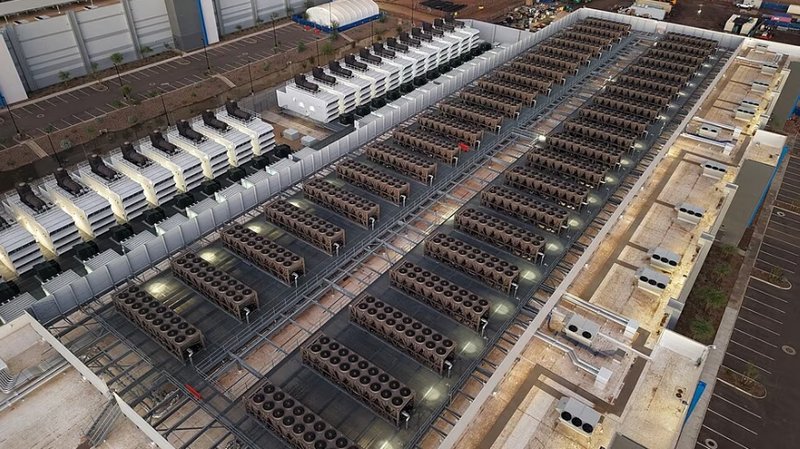
The demand for AI computational capacity has exploded, driving the need for increasingly larger and more powerful data centers. These infrastructural complexes are not just server warehouses; they are sophisticated ecosystems that must ensure stable and massive power supply, advanced cooling systems to manage the heat generated by thousands of GPUs, and very low-latency, high-throughput network connectivity. The site selection for a new data center is strategic, depending on factors such as the availability of renewable energy, proximity to network nodes, and, increasingly, acceptance by local communities.
For companies considering self-hosted or on-premise LLM deployment, the availability and cost of physical infrastructure are primary constraints. The ability to scale Inference or fine-tuning of complex models directly depends on access to adequate hardware resources, often in air-gapped environments for data sovereignty or compliance reasons. Delays in the construction of new data centers nationwide limit the overall supply of capacity, affecting both cloud costs and the feasibility of on-premise projects, making it harder for organizations to maintain control over their data and technology stacks.
Economic and Strategic Impact for Hyperscalers
The billions in costs cited by the source are not just a balance sheet issue for hyperscalers; they have cascading implications for the entire AI ecosystem. Delays in deploying new capacity mean fewer resources available for research, development, and commercialization of new AI-powered products and services. This can slow innovation and increase competitive pressure in an already extremely dynamic sector. Companies that had planned to expand their AI operations might find themselves having to revise their strategies, opting for temporary solutions or postponing ambitious projects.
In a context where data sovereignty and security are growing priorities, the ability to build and manage one's own infrastructure becomes a strategic asset. Disruptions in data center projects in the United States highlight the vulnerability of this critical pipeline. For organizations aiming to maintain full control over their data and models, planning an on-premise deployment requires careful evaluation not only of hardware specifications (such as GPU memory or network capacity) but also of external risks related to the procurement and construction of physical infrastructure.
Future Outlook and the Importance of Planning
The current situation in the United States underscores a global trend: physical infrastructure for AI is an emerging bottleneck. While LLM technology advances at a dizzying pace, the capacity to host and power it does not always keep up, especially when encountering local resistance or energy supply issues. This scenario compels companies to adopt a more holistic approach to AI deployment planning, considering not only technological benefits but also real constraints related to infrastructure, costs, and social acceptance.
For those evaluating on-premise deployments, it is crucial to carefully analyze the Total Cost of Ownership (TCO) and the trade-offs between control, performance, and infrastructural risk. AI-RADAR offers analytical frameworks on /llm-onpremise to evaluate these complex decisions, helping organizations navigate the challenges of deploying LLMs in controlled environments. The ability to anticipate and mitigate infrastructural delays will become a critical factor for long-term success in the age of artificial intelligence.






💬 Comments (0)
🔒 Log in or register to comment on articles.
No comments yet. Be the first to comment!