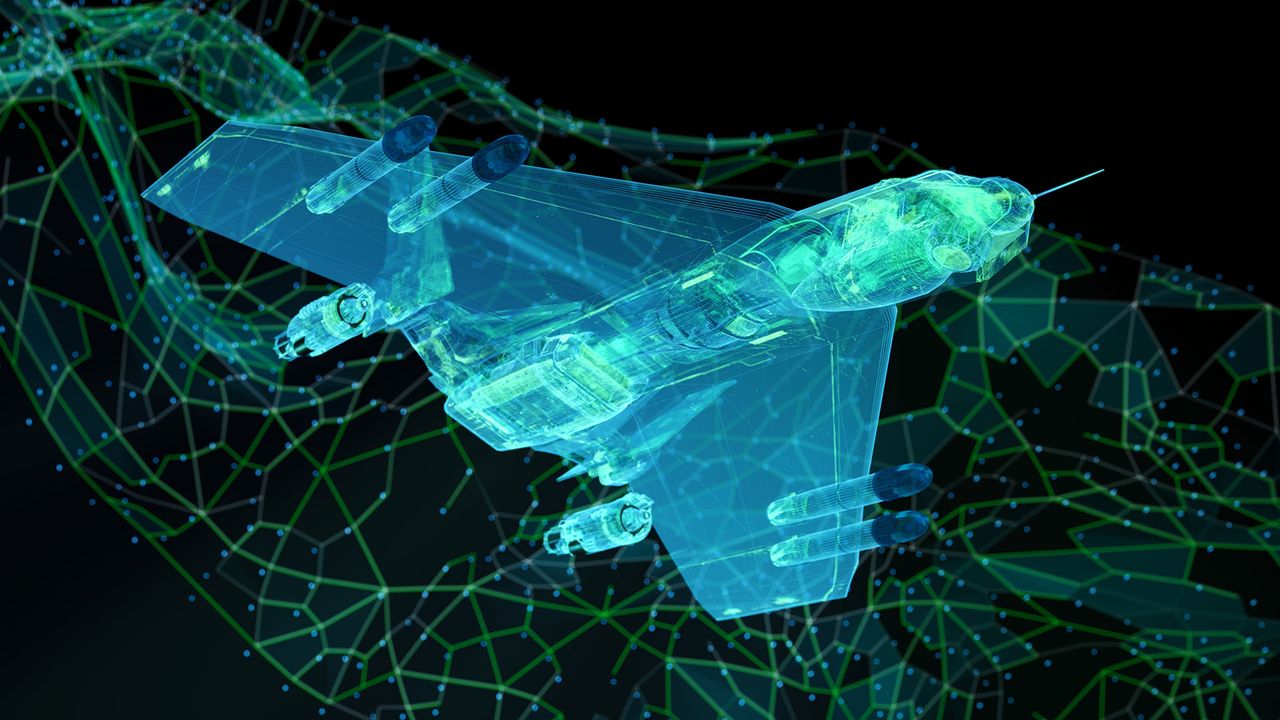
A Leap Forward in Drone Stealth Technology
Research in advanced materials continues to push the boundaries of technological capabilities, and a recent discovery promises to redefine the concept of operational discretion for drones. A researcher has developed an innovative 'spray-on' stealth coating that, according to initial indications, can drastically reduce the radar detectability of these aircraft. This innovation is based on a unique formulation that utilizes volcanic rock, an approach that significantly differs from current solutions.
The potential impact of such a material is considerable, opening up unprecedented scenarios for applications ranging from surveillance to logistics, and even to more sensitive contexts where non-detectability is a fundamental requirement. The ability to make drones less visible to traditional radar systems could indeed alter deployment dynamics and operational strategies across various sectors.
Technical Details and the 43-Decibel Advantage
The core of this innovation lies in its exceptional effectiveness. The volcanic rock-based coating boasts a reduction in radar return signals of up to 43 decibels (dB). To understand the significance of this figure, it is useful to compare it with conventional Radar Absorbent Materials (RAM), which typically offer a reduction between 20 and 30 dB. A 10 dB increase corresponds to a tenfold reduction in signal power, meaning a 43 dB reduction represents an exponential improvement over existing technologies.
This significant signal attenuation makes drone detection extremely more difficult for radar systems, reducing the distance at which it can be identified or making it entirely invisible at certain frequencies. The 'spray-on' nature of the coating adds an extra layer of flexibility, potentially allowing application to existing drones or large-scale production with reduced costs and complexity compared to integrating structural stealth materials.
Implications for Deployment and Data Sovereignty
While stealth technology is often associated with military contexts, its implications extend to a wide range of civilian and industrial applications. More discreet drones can be used for critical infrastructure inspection, environmental monitoring, or goods delivery in sensitive areas, where privacy and operational security are paramount. In these scenarios, the ability to operate undetected by unauthorized third parties directly contributes to data sovereignty and the protection of collected information.
For organizations evaluating the deployment of drone fleets in on-premise or air-gapped environments, a coating like this could represent a crucial enabling factor. Reducing the risk of interception or identification not only enhances the physical security of the drone but also protects the integrity of missions and the confidentiality of acquired data. Trade-offs to consider will include the durability of the coating, its impact on drone weight and aerodynamics, and the costs of application and maintenance—all fundamental elements for a TCO analysis.
Future Prospects and the Evolution of Operational Discretion
The development of such an effective stealth coating marks a turning point for the drone industry and for concealment technologies in general. The next phases of research will likely focus on validation in real operational environments, optimization of the formulation for different platforms, and scalability of production. Volcanic rock, an abundant and relatively inexpensive material, could offer a path towards more accessible and widespread stealth solutions.
This innovation underscores how materials research continues to be a fundamental pillar for technological advancement. For those involved in infrastructure architectures and deployment decisions, understanding these evolutions is essential to anticipate future operational capabilities and security requirements. Discretion, once the preserve of a few, could become a standard feature for a new generation of autonomous systems.





💬 Comments (0)
🔒 Log in or register to comment on articles.
No comments yet. Be the first to comment!