A doubling that is not a list-price detail
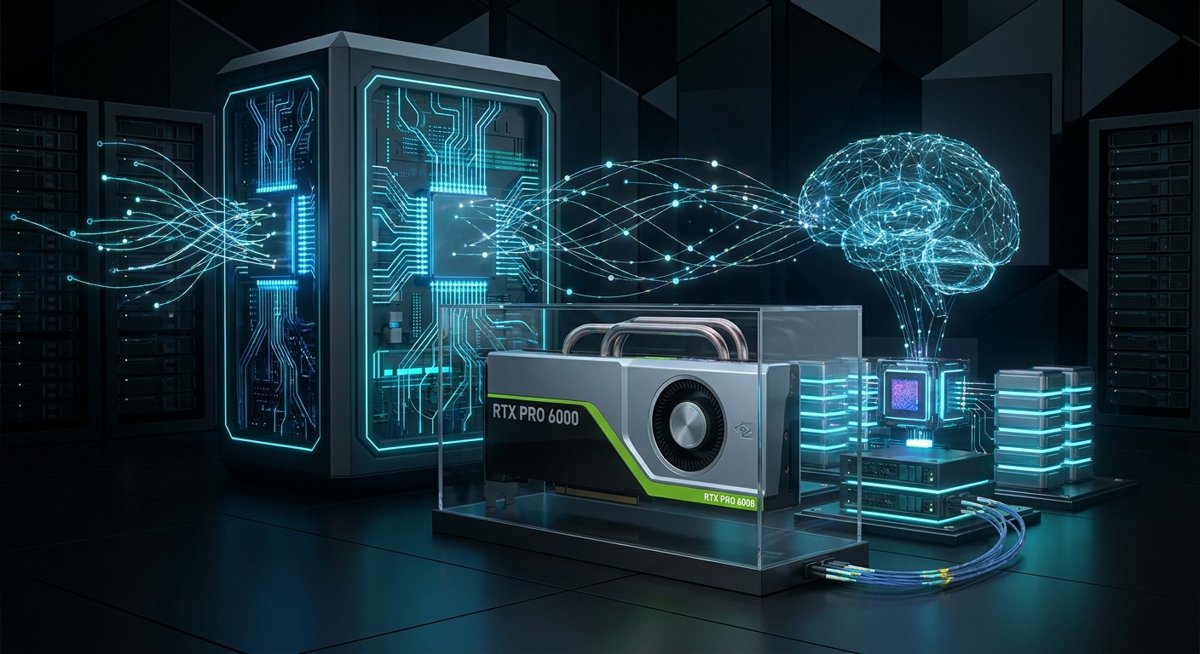
Nvidia has brought the list price of the RTX PRO 6000 Blackwell to $16,000, double the level seen in preorders last year, when the 96GB VRAM card was below $8,000. This is not a minor adjustment: it is a thermometer for the tension running through AI hardware, especially for teams planning self-hosted and on-premise deployments.
The number matters because this card is not a consumer product. Its 96GB of VRAM places it in workstations and compact servers used for LLM inference, light fine-tuning, and model development. A doubling of the unit price changes the calculations for anyone assembling a local node, not just the final bill for a single purchase.
From AI-Radar's perspective, this kind of move can be read as a market signal: accelerator cost is a strategic variable, not an accessory. When the reference price doubles, anyone planning local infrastructure has to revisit assumptions, budgets, and priorities. The data point fits into a phase in which local compute capacity is contested among large customers, cloud providers, and enterprise teams.
Inelastic demand explained by expiring contracts
Investor Gavin Baker recently noted that several private companies are planning to spend at least twice as much on GPUs when existing contracts expire, and some have already said so publicly. The point is not to verify the forecast, but to understand what it reveals about enterprise demand: for part of the market, the marginal cost of compute capacity is still secondary to the need to avoid falling behind.
This willingness to pay more for the same GPU signals inelastic demand. Teams that have standardized pipelines on CUDA and the Nvidia stack cannot migrate without porting, retraining, and compatibility costs. The constraint is not just silicon supply; it is the software and operational ecosystem built around the hardware.
For Nvidia, this translates into pricing power beyond physical component availability. The MSRP doubling is not an anomaly, but the normalization of a market in which the supplier can raise prices and demand absorbs the increase. For anyone evaluating on-premise, this belongs in every medium-term projection: prices can remain high even if production expands, because the perceived value of the local stack has changed.
Multi-GPU nodes and TCO: starting from zero
At $16,000, the entry cost for a node with multiple cards quickly becomes a TCO problem, not just a CapEx issue. If the accelerator price doubles, every budget forecast for self-hosted projects has to be rebuilt from scratch. This is not about a single invoice; it is about the sustainability of the entire infrastructure lifecycle.
A card with 96GB of VRAM is used to run local LLMs with extended context windows, for light fine-tuning, or for development. When unit cost rises, teams must revisit the number of cards per node, available memory, and the service level they can guarantee. The alternatives are not neutral: smaller models, more aggressive quantization, and reduced context change the application experience.
The doubling also changes the comparison with cloud services. Moving workloads to managed services converts spending from CapEx to OpEx and avoids immobilizing assets. But for teams with data sovereignty requirements or a desire to keep control of the local stack, the higher price makes access more selective. TCO is no longer a fixed formula: it is a negotiation space between cost, control, and performance.
Accessory costs also matter: power, cooling, rack space, and maintenance do not stand still. When the board cost doubles, the relative weight of these items can shift, pushing some teams to consolidate workloads on fewer, denser nodes or to review upgrade policies. The decision is not limited to the list price.
Sovereignty, cloud, and lock-in: the trade-off widens
The price increase pushes part of the market toward the cloud, where cost shifts from CapEx to OpEx and assets are not immobilized. For many projects, a monthly fee can be easier to manage than a doubled upfront investment. But that path is not available to everyone.
Teams with data sovereignty requirements, or those that want to avoid cloud provider lock-in, face a higher barrier. The higher price narrows access to local hardware. Small and medium projects risk being priced out, or accepting smaller models, more aggressive quantization, and compromises on service levels. This is not abstract: it is the difference between running a local LLM with a given context window and splitting it into shorter inference workloads.
The price signal therefore does not act only on the balance sheet. It acts on possible architectures: cloud, on-premise, hybrid. Organizations with control requirements may have to pay a growing premium to keep data inside the corporate perimeter. Those without such constraints can shift the problem to the cloud provider, but they take on other risks: dependency, variable costs, and less infrastructure transparency.
In this scenario, data sovereignty becomes a selection factor. Organizations that consider it non-negotiable must accept higher hardware budgets or revise the ambitions of local models. Others can use the cloud as a release valve, but they lose part of their operational control.
The cascade effect: compact workstations, DGX Spark, and developer access
The question around DGX Spark — whether that product will also double in price — is not rhetorical. If professional card prices rise, the same signal of scarcity and pricing power can extend to compact systems. DGX Spark is designed to bring AI compute to the desktop; a price increase would further reduce access to local hardware for developers and small teams.
This has a second-order impact. Less access to local hardware means less room to experiment with self-hosted LLMs, to fine-tune models on proprietary data, and to build internal skills. Those who cannot afford a powerful workstation tend to move toward cloud APIs, with less control over data and a more limited understanding of model behavior.
The dynamic does not only affect large customers. Smaller development teams, university labs, and software houses that want to maintain local environments also feel the increase. The entry price for a workstation with ample VRAM becomes a selective barrier, not just a variable cost. This can slow the adoption of on-premise skills and consolidate dependence on external platforms.
For teams evaluating on-premise deployment, AI-RADAR offers analytical tools at /llm-onpremise to compare these trade-offs: the GPU price is only one item in a broader calculation. The choice is not between 'cloud yes' and 'cloud no', but between different profiles of cost, sovereignty, and operational autonomy.
What to watch now: signals for the next quarters
There is no need for catastrophism: prices can correct with new production capacity or alternatives. But as long as enterprise demand remains willing to double spending, the cost of on-premise will continue to rise faster than budgets. The RTX PRO 6000 Blackwell at $16,000 is the signal that the market has stopped treating local AI compute as a discounted investment.
The next signals to monitor concern contract renewals, professional GPU lead times, and whether the price increase extends to other cards in the same family. The used market and the availability of alternative accelerators are also useful indicators, because they can absorb part of the demand or, conversely, confirm price pressure.
For teams planning self-hosted infrastructure, a more robust approach is to build scenarios rather than chase the price. A budget based on a list price from a year ago no longer represents reality. Those who update TCO models with higher cost assumptions can make more robust decisions and avoid ending up with incomplete infrastructure or unwanted cloud commitments.
Finally, it is worth watching whether the RTX PRO 6000 Blackwell increase remains an isolated case or becomes the starting point for a broader revision of professional price lists. In a market where demand absorbs significant increases, price signals should be read not as noise, but as planning variables.





💬 Comments (0)
🔒 Log in or register to comment on articles.
No comments yet. Be the first to comment!