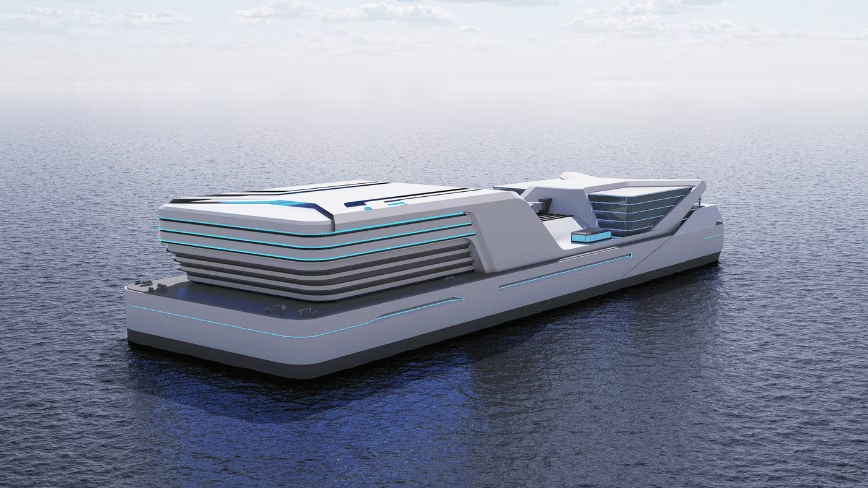
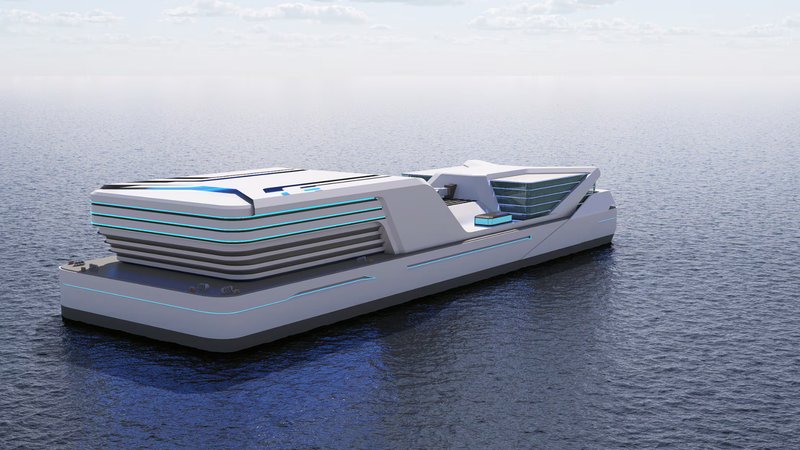
Samsung Heavy Industries is responding to a very specific real estate crisis: the one plaguing data centers. According to the Seoul Economic Daily, the shipbuilding giant aims to launch by 2028 its first barge purpose-built to host servers and cooling systems offshore. This won’t be a converted vessel; it’s designed from scratch as a floating data center anchored close to the coast.
The move comes as land-based digital campuses face two increasingly hard-to-circumvent barriers: saturated buildable spaces and tightening restrictions on water usage for cooling. In many regions, data centers have become unwelcome neighbors, their environmental footprint and water consumption stirring local opposition. Moving servers onto the water isn’t just a naval engineering exercise — it’s an attempt to bypass the political and bureaucratic knots that are throttling the expansion of global compute capacity just as AI demand spikes.
Why water can be a solution, not just a problem
The idea of putting data centers at sea isn’t entirely new, but Samsung SHI’s approach flips the script. Instead of retrofitting existing hulls, it starts fresh with a barge optimized for racks, power systems, and cooling loops that can tap seawater directly. This shifts the Total Cost of Ownership equation: access to a virtually unlimited heat sink cuts energy costs for climate control, while serial construction at specialized yards could drive down build times and expenses compared to traditional construction.
For organizations weighing on-premise or hybrid deployments, a floating data center introduces a new variable: the ability to scale compute without negotiating land permits or competing for industrial plots. If the modular model catches on, enterprises and governments could deploy compute infrastructure where needed, perhaps tethered to offshore wind farms, sketching a scenario where the line between “local” and “remote” blurs into an archipelago of floating nodes linked by fiber.
The hidden game: who wins and who loses
Industrially, this signals heavy industry’s pivot into the IT infrastructure market. Samsung’s shipyards could become critical suppliers to hyperscalers and AI-focused enterprises, reshaping the balance between traditional real estate developers and marine engineering. Well-connected port cities — backed by submarine cable landings — might turn into compute hubs, while inland regions would be left behind.
Uncertainties remain. Jurisdiction over a data center in territorial waters, or hypothetically in international waters, would raise compliance questions for regulations like GDPR. Weather resilience and saline-environment maintenance also pose engineering challenges that will take years to validate. Yet Samsung’s entry suggests the industry takes the maritime route seriously as a concrete alternative to land, at a moment when every square meter and every watt counts in the race for AI infrastructure.







💬 Comments (0)
🔒 Log in or register to comment on articles.
No comments yet. Be the first to comment!